Words Lester Perry
Images Thomas Falconer
RRP $8999
Distributor Worralls
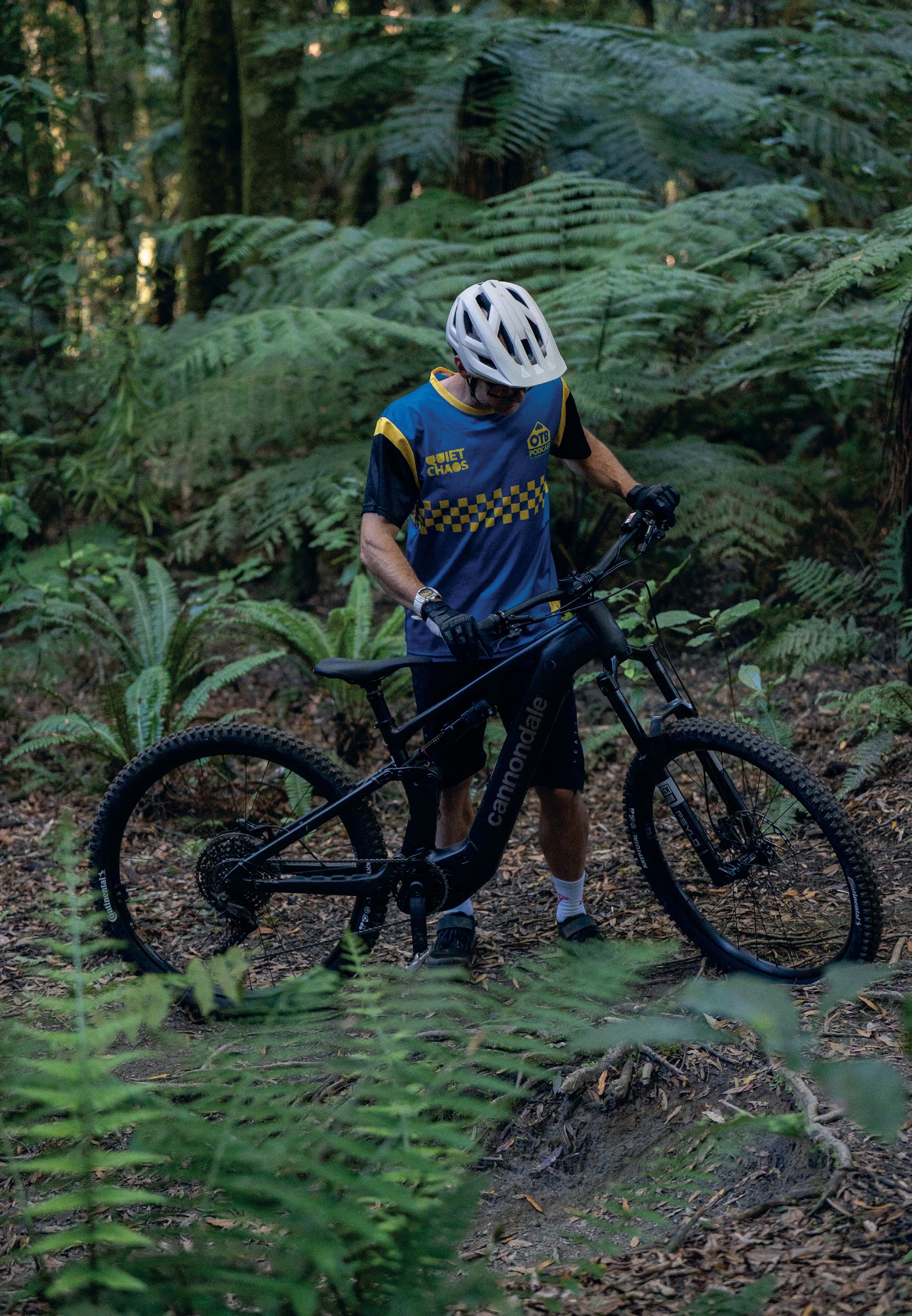
Although I’ve never owned one of their bikes, secretly, I’m a Cannondale fanboy. Cannondale has a deep, storied history as a true innovator in cycling. Particularly in their earlier years, they led the way with computer-aided design (CAD), and their unconventional suspension forks, the Headshock and the Lefty, which we still see today.
From the distinctive Flying ‘V’ frames of the early ‘90s to their short-lived motorbike division, they’ve stood out in a sea of vanilla designs. Let’s not forget NZ’s own Kashi Leuchs flew the NZ flag on a Cannondale during his glory years, across various cross-country World Cup and Olympic seasons.
The Moterra officially launched back in 2016, and although it caused a stir, that was as much due to its unique “only a mother could love” looks as anything else. It’s evolved incrementally over the years, but fortunately, this latest iteration has broken free of the lines inherited from that original beast, and we now find a far less polarising Moterra. The downside is that, from a distance, it looks somewhat like ‘just another eMTB’.
The Moterra 3 is a full 29er-wheeled bike with 150mm travel Horst-link-driven rear suspension and 160mm up front. The frame is entirely crafted from Cannondale’s SmartForm C1 Alloy with tidily finished welds and large tube shapes. There’s a gigantor-sized head tube allowing for cable routing internally through the headset.
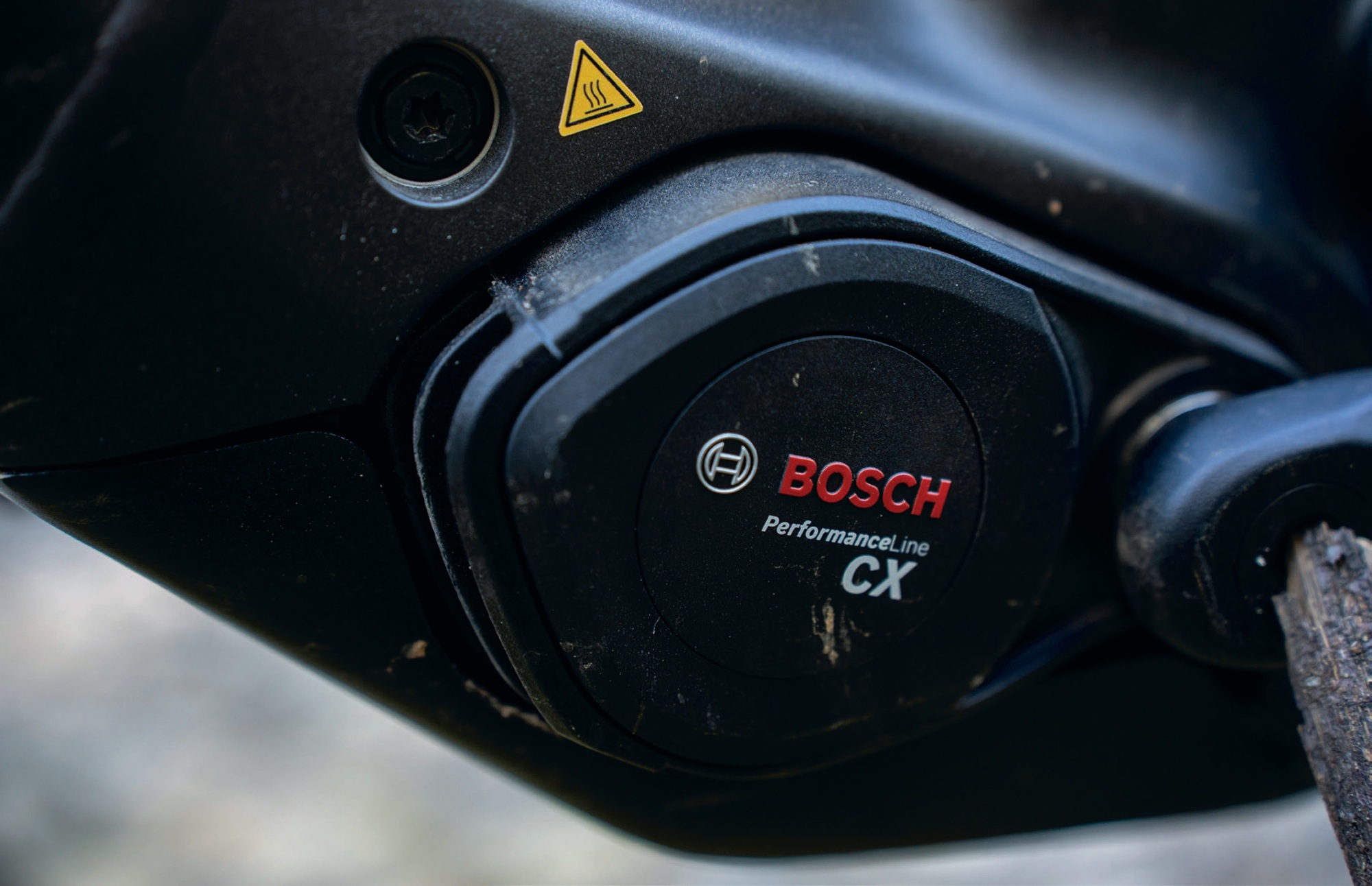
Drive is taken care of by Bosch’s Performance Line CX motor powered by an 800Wh Powertube battery. Bosch’s Purion 200 display controls the whole setup neatly from the left-hand side of the handlebar. There’s a tidy alloy skid plate protecting the motor, and even a removable kickstand mount on the non-drive chainstay – very handy while parked up on the cycle trails.
The battery is easily removable from the bottom side of the downtube. The outer cover is removed with a simple twist of a thumbscrew at the top end, then the battery can be unclipped and removed. It’s a simple task but still requires the use of the battery locking key. Thanks to this ease of battery removal, two-battery (or more) rides are a reality. For those just wanting a bit more range, a 250Wh PowerMore range extender can be added to the main drink bottle mount, for an additional 30% when added to the standard 800Wh battery.
Geometry
Key geometry figures across the Moterra don’t stray far from the norm for this type of bike:
Chainstay length
455mm to accommodate the 29” rear wheel.
Head tube angle
64.8°, perhaps a hair steeper than some similar bikes, but this helps keep handling snappy and the front wheel under you while climbing.
Seat tube angle
72.5° actual and 78.2° effective. The effective seat tube angle is steep enough, although if you run an exceptionally high seat height this will be slacker, so it’s worth sitting on the bike to see where things line up for each individual.
Reach
A 45.9cm reach is a tad shorter than some more “progressive” bikes, but again fine for this level of rig.
Stack
64.1cm. The Moterra stack is on the higher side for sure. That’s not a negative thing, though, as it means handlebars can be set lower towards the headset, with no need to have a stack of spacers or super-high-rise bars to get the cockpit set up correctly. The only downside I can see is that an increased stack generally brings with it a higher front end of the top tube and, consequently, lower standover clearance.
Drive Unit
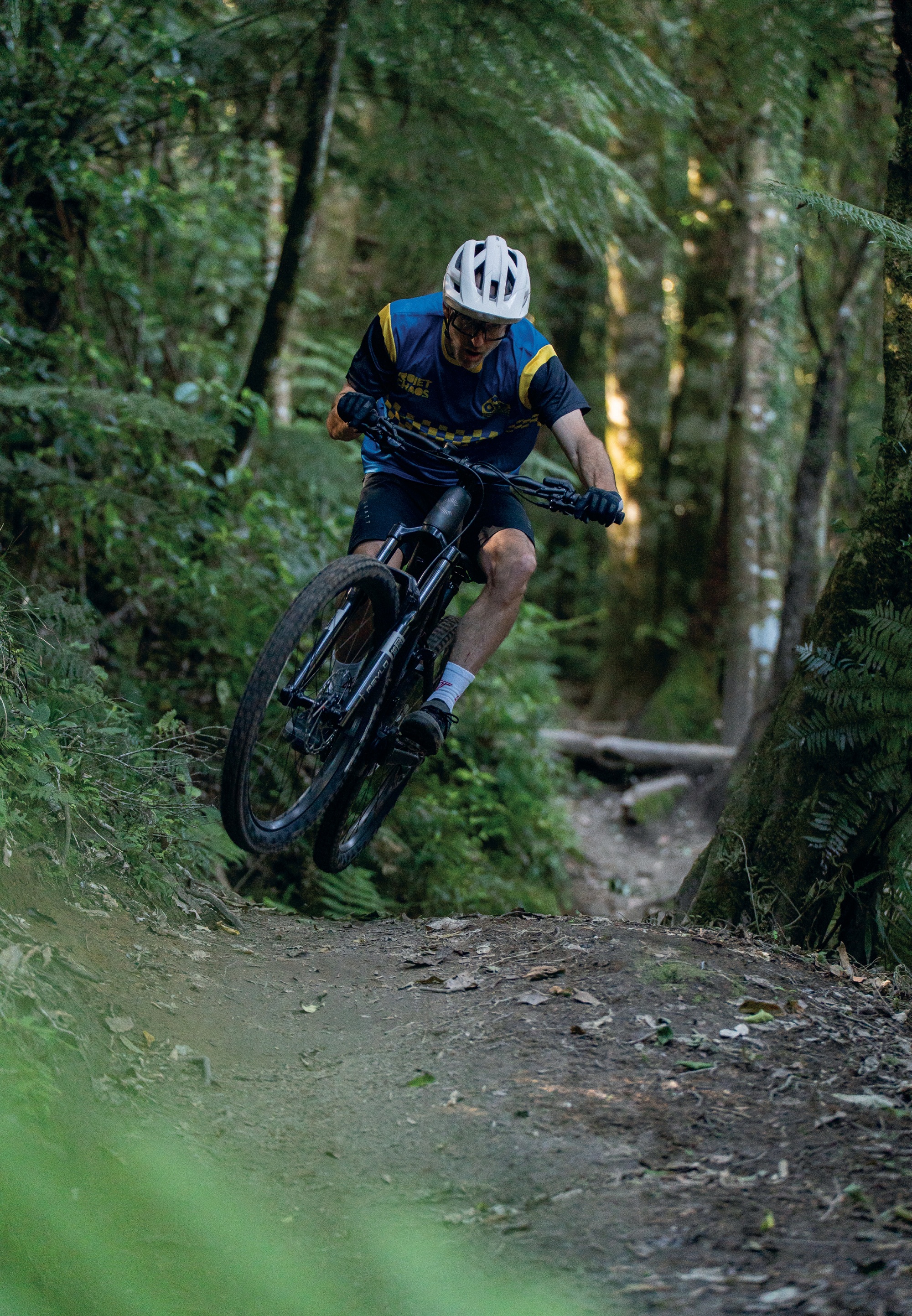
I was pleasantly surprised at how controlled and consistent the power was. Overall it maintained traction exceptionally well. One of my test loops has a long clay climb, which, even with the slightest bit of moisture, is a challenge to clear. In damp conditions, I managed to all but clear the climb, the eMTB mode tempering the drive at the wheel to maintain a surprising level of traction. Although it still took some finesse, it was significantly easier than some other eMTBs that I’ve tackled the same climb on in equivalent conditions.
Components
Overall, the component selection on the Moterra 3 suits its price point and the riders it’s targeting. No frills here, just solid parts that should have some longevity.
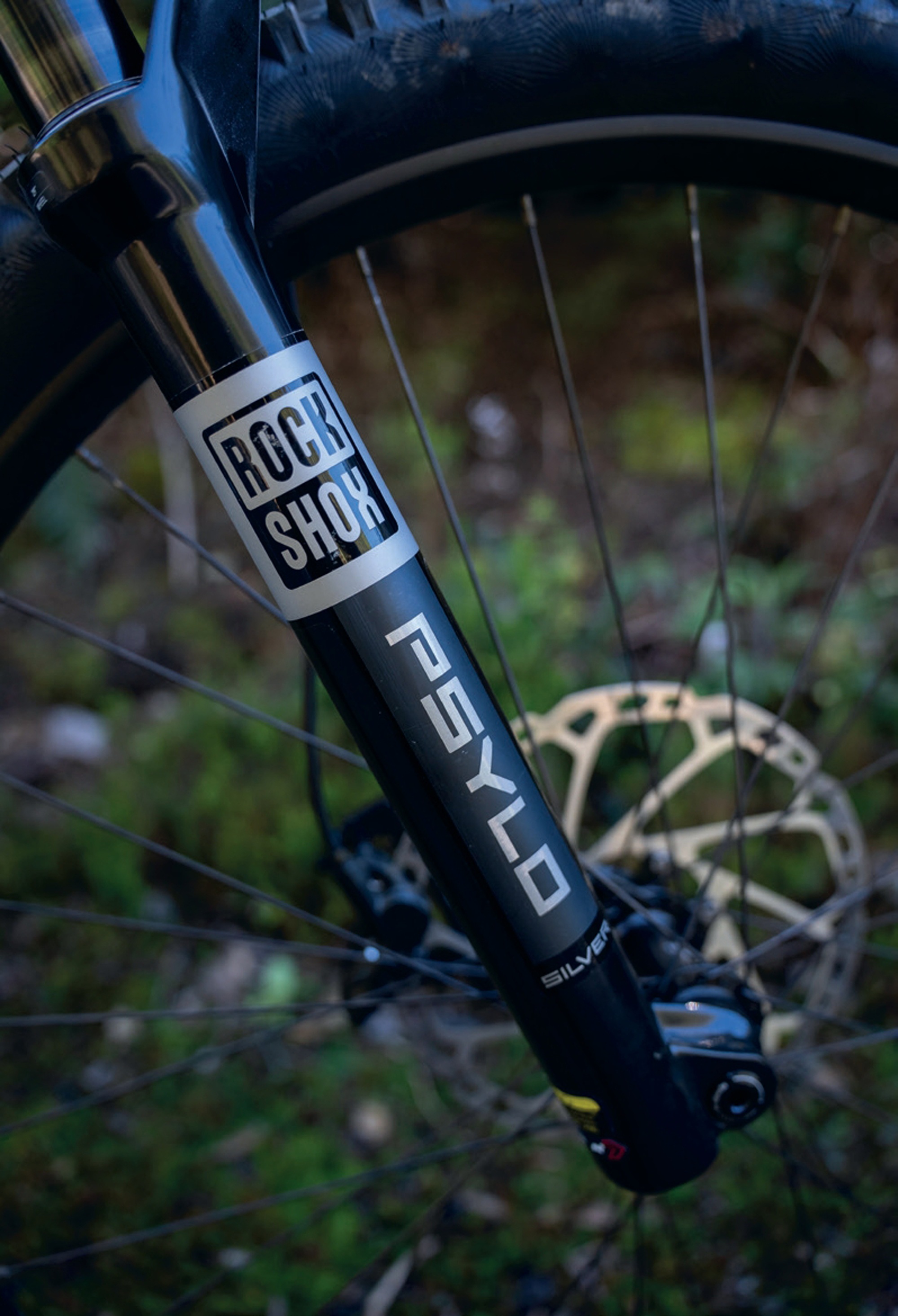
It’s been some years since RockShox ditched the Psylo fork, but it’s back! Anyone who was riding the Psylo back in the early 2000s won’t find much resemblance to this new version other than the name (probably a good thing). The Psylo range supersedes several of the lower- end RockShox forks, including the Revelation, Yari, and 35, with different Psylo models.
The Psylo Silver RC fork on the Moterra has 160mm travel and slides on 35mm stanchions. A revised motion control damper is fitted and features a simple dial for low-speed compression adjustment. RockShox claim the damper is tuned to mimic their higher-level Charger dampers. Although I wasn’t able to quantify RockShox’s claims that it felt similar to a Charger, the overall performance of the fork was better than I expected from this lower-mid-tier offering. It was plenty plush and tracked really well.
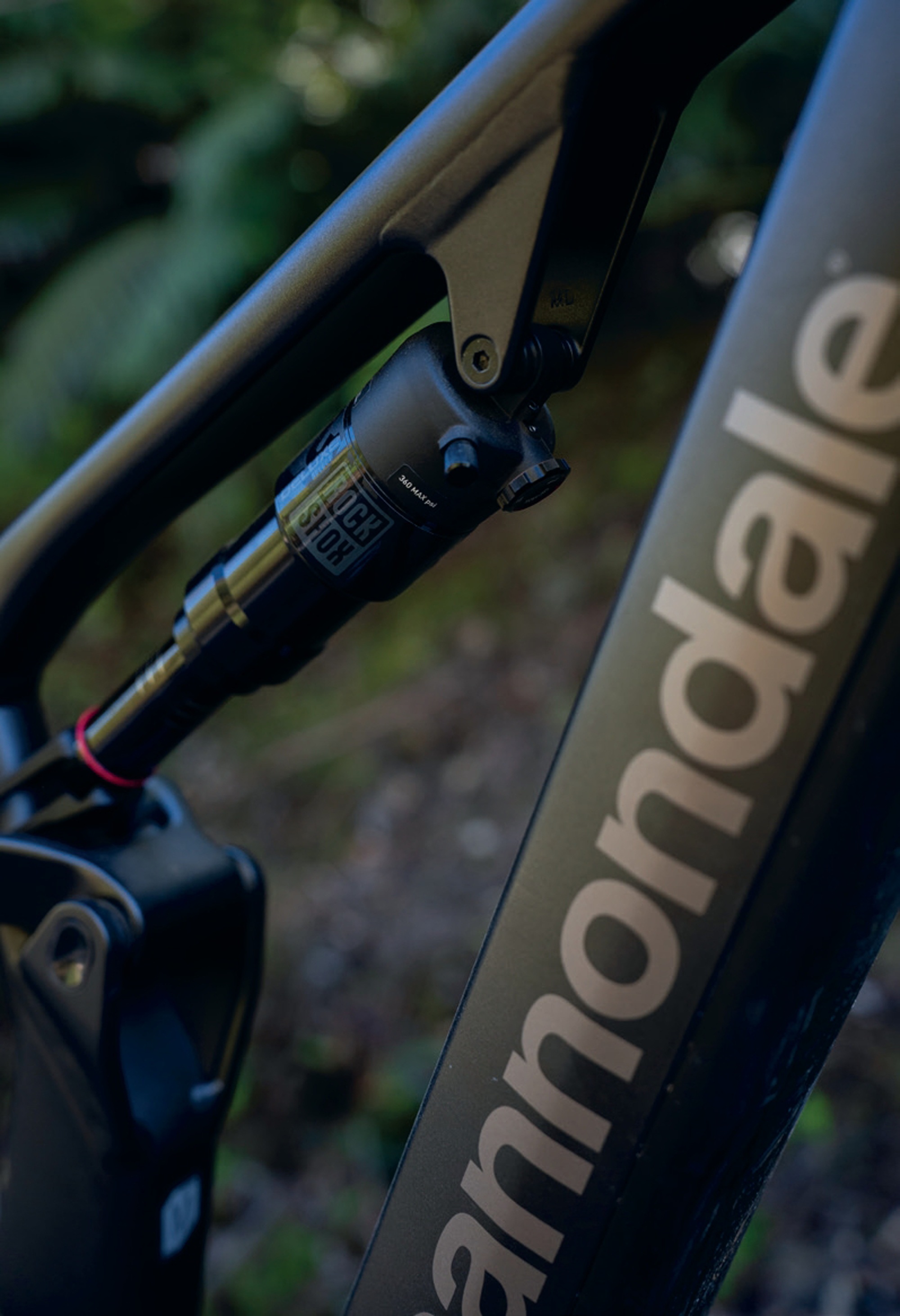
The low-speed compression knob worked fine, although I ran it more or less open at all times, and there’s plenty of rebound damping available. Again, somewhat surprisingly, the fork punched above its weight in the stiffness department; the long 35mm stanchions are obviously helped out by the stiffness of the beefy lower legs. The fork is certainly not as stiff as the larger 38mm-stanchioned Zeb, but I’d wager that it’s not dissimilar to a Lyrik when it comes to stiffness. It’s sure heavier though, around 700g depending on the level of Lyrik it’s compared to! The RockShox Deluxe Select air shock handles damping duties out back. It’s a simple shock with solely a rebound adjuster. RockShox claim the shock performs similarly to many of their higher-end units thanks to shared damper tunes. This unit just gets less adjustment and is heavier than the upper-end ones. The back end is nice and supple. It’s got a plush, linear feel and ramps up quickly at the end of the travel. There were times it would have been nice to have a bit more support to push against, and moments under heavy compression when there was a bit of uneasiness as it prepared to rebound. For most riding, though, this shock is adequate for the bike, and if a buyer wanted some extra performance, an upgraded shock could be a good place to start.
The Shimano MT501 brakes with 203mm rotors front and rear are decent. They’re not the most powerful brakes out there, but they’re cost- effective and offer ample stopping power, considering they’re a base-model brake.
The bike rolls on a WTB i30 wheelset. It’s nothing flashy, but if other WTB wheelsets I’ve used long term are anything to go by, they’re pretty durable. They won’t love being cased onto rocks, but neither do a set of $3000 carbon hoops!
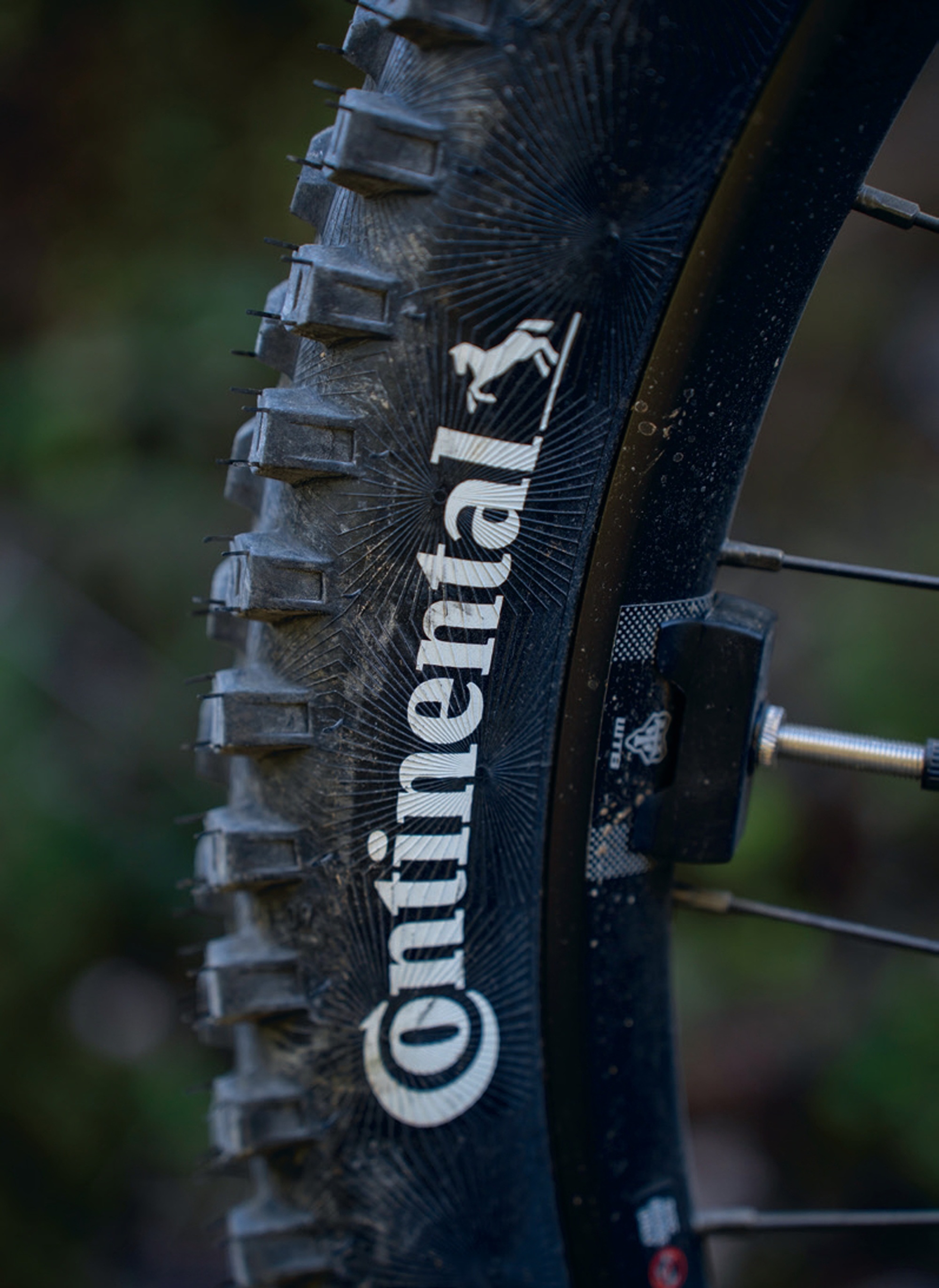
Continental Kryptotal tyres are featured front and rear in a 29” x 2.4” size. The Enduro casing offers protection against punctures and a level of support against being too squirmy underneath while railing turns or g-outs. The soft compound rubber rolls surprisingly well, and from what I’ve heard from friends, wears exceptionally compared to other soft compounds in the market. Traction was awesome across the board, although something with more spaced knobs may be preferred in really soft, wet conditions. The Enduro casings were okay, but I think long term, once these treads were worn, a move to some gravity casing tyres of the same model would offer more support, and even better puncture resistance.
The cranks are a nice short pair of FSA brand 160mm length with a 34t chainring. Nothing to sniff at here, I’m a big fan of 160mm cranks on an eMTB.
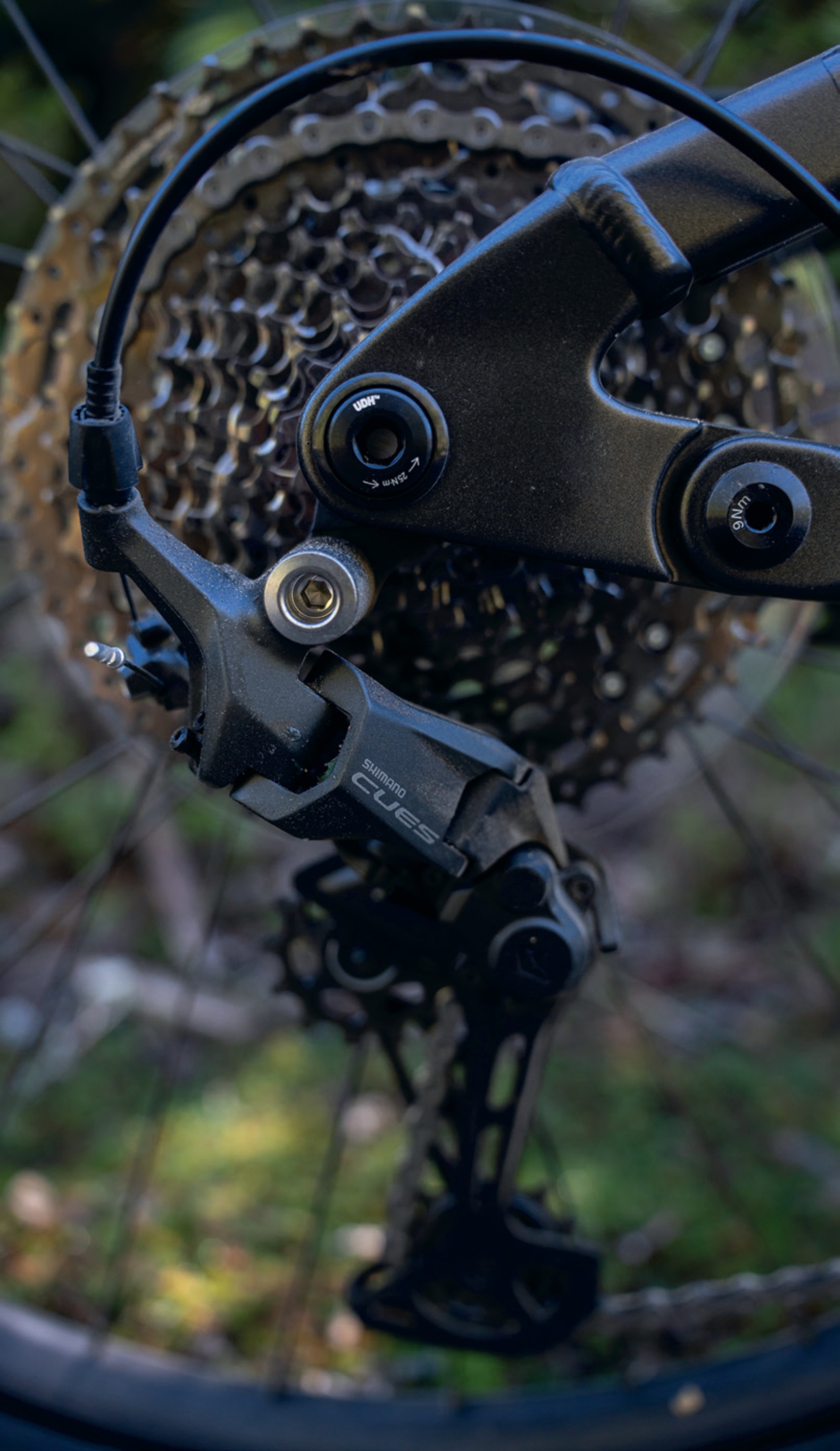
The drivetrain features a mechanical 11-speed Shimano CUES U6000, LinkGlide derailleur and shifter, coupled with an LG500, LinkGlide chain and Shimano CUES LG400, LinkGlide, 11-50 cassette. It’s got an almost yawn-inducing level of personality to it, but it’s been admirable to say the least, and the shift quality over my test period has been great. LinkGlide is claimed to last really well on eBikes. Like the rest of the bike, this drivetrain isn’t light, and again, it’s a place for easy long-term upgrades.
The finishing kit is from Cannondale’s in- house brands, with a WTB saddle. A pretty bog-standard 35mm handlebar and stem help keep you pointed in the right direction, and the dropper post is aptly long at 170mm drop on the medium bike. As usual, a longer after-market drop could be found, but as an original unit goes, this suits the bike well and works a charm.
On the trail
The Moterra 3 is an interesting beast. Its geometry and suspension travel lean it towards hard-charging riding. And charge it can, to a point. For a bike of this ilk, with full 29er wheels and a hefty overall weight, it hooks into turns surprisingly well, though it sometimes needs a conscious effort to weight the front wheel to maintain traction and go right where you want it to. Successive, fast corners, requiring quick changes in direction demand extra body language and strength due to the bike’s heft. As I mentioned earlier in this piece, the Moterra is a mountain goat. I put this down to a combination of the CX motor applying power smoothly and consistently, and the traction of the fresh Kryptotal tyres. A less tempered, higher power would likely break traction a lot easier. On climbs where the front end needs lifting up, and over steps or trail features, the heft of the bike is noticeable, but thankfully, the assistance from the motor helps wheelie the front end up. When hopping the rear wheel up a step, the weight of the bike is noticeable. Thankfully, even when the wheel doesn’t completely clear an obstacle, the motor overrun helps drive it up and over the feature.
With the Moterra’s travel and geometry numbers, this bike is plenty comfy on the downhills. The suspension package performs well most of the time, and even on steep and technical trails, it does the job it should. But when really pushed at speed through chunder, as mentioned previously, better dampers would be welcome. It may be a case of some further tuning with volume spacers or custom valve tunes or even upgraded suspension units to help keep the wheels tracking and bring a sense of calm to the ride when pushing hard.
Overall thoughts
The Moterra 3 (size medium) tips the scales at 27.4kg. With that in mind, I’ve found myself asking, “At what point does the overall weight of an eMTB heavily detract from its overall ride quality?” When ridden just on mellow trails, it’s great and offers no dramas, but where speeds are high and rapid changes of direction are needed, or it’s necessary to unweight over a rough section or even bunny hop, there’s a fair amount of strength required, and much more effort to stay ‘light’ on the bike than those at the lighter end of the eMTB spectrum. The weight requires a decent amount of strength to manhandle, and if you’re heading off-line or get skewed off a jump, getting the bike back in the precise direction you want to go is that bit harder. I’d imagine for inexperienced riders this would be exacerbated if they’re trying to ride progressively.
The recent software upgrade to more power output and torque, although welcome on paper, does leave me wondering if it’s really necessary for most riders (including myself). More power equals more battery drain and shorter runtime from a charged battery. I think there’s a case for smaller, 600Wh batteries on bikes like this, even with motors detuned for less power and torque. This may actually (total speculation) allow for similar range rides, and an overall lower weight of the bike, so more spritely handling. Possibly a net gain? I guess we’ll never know?!
I’d also question whether a bike of this level warrants having cables routed internally through the headset. They look tidy on the shop floor, but to get my stem height correct, as low as I’d prefer, they are in the way and get squashed down by the stem. With cables for mechanical gears, a Bosch remote controller, a seat post, and a rear brake all needing to squeeze in there, there’s a lot that could go wrong, and a lot of possible headaches if a headset bearing needs replacement. “Everything is possible given enough time and money.” A very accurate saying when dealing with internal headset routed cables.
So, who’s the Moterra 3 for then? For someone who’s looking to do a broad mix of mountain biking, commuting and more ‘bike path’ type endeavours, without the urge for too much airtime or aggressive riding, this bike, at this price, is more than ideal.