Words Lester Perry
Images Thomas Falconer
RRP $2975
Distributor Shimano NZ
Developed in conjunction with the Yeti factory team, their team of “skunk works” riders, and feedback from riders globally, this new groupset brings Shimano to the fore—particularly in the drivetrain department. Arguably, it’s taken a very long time for this release, but it’s fair to say they’ve launched a highly competitive grouppo that, like its predecessors, is sure to become a “working man’s favourite”.
This isn’t Shimano’s first waltz with an electronic drive train, though. Back in 2016, they launched the original wired version, M8050. It worked OK and was well ahead of its time, but the mess of wires, weight, and a shifter that only a mother could love, meant it wasn’t widely adopted.
While Shimano’s red friends (that’s SRAM if you hadn’t realised) went all-in on proprietary parts, with a drivetrain requiring a complete ecosystem of components in the form of their AXS transmission. Shimano’s new XT Di2 is refreshingly simple. No need for a specific styled frame dropout; no need for a particular chain or cassette. It’s designed to easily upgrade from a mechanical system with minimal faff and far less money than needing to buy into a complete system.
For bikes running existing Shimano 12-speed drivetrains, the jump to XT Di2 is as significant as you want it to be. At its most basic, entry can begin with purchasing a shift kit consisting of a derailleur and shifter, including battery and charger, and a chain quick-link. If a new cassette and chain are required, there are a couple of tweaks to the newly released cassette, but nothing drastically different from the previous XT, and all key components are compatible across previous Shimano 12-speed ranges.

XT M8250 Drivetrain
Derailleur
Durability is one of the core elements Shimano strived for in this redesign. While they don’t promote that you stand on it, you can seemingly smash it on a rock and it will be fine. The parallelogram sits closer to the frame than the competition, and the revised chain stabiliser (previously clutch) sits a significant 16mm further inboard than the competition. The overall shape of the derailleur is wedge-like, designed to glance off an obstacle, disengage the servo, allowing it to move with an impact, then snap back into place and reengage once the obstacle passes. Given how easily the XT mechanical derailleur was bent during impact, this complete revision— and its durability—will be welcomed by anyone looking for confidence in their investment. Shimano launched the groupset to dealers at a ride camp in Queenstown in late February 2025; the ideal destination to test the real-world durability of the drivetrain and brakes before it landed in their stores. Queenstown’s rocky trails saw two bike mechanics smash derailleurs into rocks at different times. Knowing the level of impact a derailleur should be able to withstand, and how they’d just well exceeded this, they feared the worst; worried they’d be returning a smashed derailleur to the Shimano team. This wasn’t the case, though, and the units continued their ‘zit-zit’ noises and flawless shifting. The proof was in the pudding.
Because they began with a completely clean slate, rather than working with an existing battery style, the design wizards at Shimano managed to squeeze the derailleur battery into the centre of the parallelogram, keeping it well out of harm’s way. Installation and removal of the battery is unique; a cap on the base of the derailleur slides off, allowing the battery to slide out of the bottom of the derailleur body. The battery cap provides upward tension on the battery contacts and the rubber seal surrounding them. Shimano’s North American development team commented that this provides a water-tight seal around the terminals. However, the rest of the battery is open to whatever elements can make it into the battery cavity. So, while the terminals remain dry and clean, the rest of the battery can be wet and dirty after a mid-winter slop fest. I can’t see any way, unless intentionally, that the battery could be damaged in its home within the derailleur. Even the way that the battery door slides into place means that even with a hard impact, it should stay put; it also helps provide some damping to a direct blow.
The battery itself is a tidy little 310mAh versus the SRAM 300mAh. Shimano claims that during testing, their slightly larger battery, combined with a more efficient system, offers 340km of riding vs 230km of the SRAM, under identical test conditions.
What, no UDH? As much as the UDH derailleur has become commonplace—and for good reason—there are still a considerable number of frames available without one. Although this new derailleur doesn’t require a unique UDH hanger, it benefits from the UDH’s increased stiffness if it’s attached to one.
Two derailleur cage lengths are on offer, depending on which cassette it’s paired with: a 10-51t (long cage) or 9-45t (short cage). The 9-45t offers 10% less range (500%) than the 10-51t (510%) but achieves equivalent ratios with a smaller, 28 vs 32 tooth chainring. This ‘Compact drive’, with its smaller ring combined with the shorter cage derailleur and shorter chain, saves some weight but, more importantly, offers better ground clearance: some 8mm at the chainring, and 23mm at the derailleur—not insignificant, and totally worthy if it’s being threaded through rocky terrain or deep ruts over long rides.
The cassette itself is essentially unchanged, aside from some tweaks to tooth profiles increasing shifting quality a fraction, and the obvious addition of the 9-45t option with a new lockring. Yes, you’ll need a new tool for that. This updated cassette is completely backwards compatible, and fear not, if you’ve committed to a ‘Compact drive’ with its short derailleur cage but want to go back to a more ‘regular’ setup with the larger cassette and chainring, this can be achieved with a simple swap to the ‘long’ derailleur cage, rather than necessitating a completely new derailleur.
Clutches are out, springs are in. Enabling the slimline profile of the front edge of the derailleur is the change of the tensioner mechanism. Gone is the venerable clutch, replaced by a much tidier dual opposing spring stabiliser. With a claimed 72% increase in tension and better chain wrap around the cogs, there’s now better shifting and less ‘skipping’ of gears. Shimano claims this new system is service-free, and its performance won’t degrade over time. If this proves to be the case, then this change in chain stabiliser will be welcomed by anyone who’s dealt with a dicky clutch in the past.
The combination of the new chain stabiliser and a smaller b-tension gap (distance from top jockey wheel to cassette cog) has enabled increased chain wrap, meaning a faster, more positive gear shift, and less of the chain bouncing off the top jockey wheel. The jockey wheels aren’t needlessly overengineered and, with no holes in them, there’s no chance sticks or debris can go through the cog, jamming it up.
In my thinking, the new shifter is a perfect evolution of the XT mechanical shifter (it’s not even worth mentioning the previous M8050 Di2 shifter!). Rather than an entirely new and unfamiliar shifter system, Shimano have taken the familiar fixings, paddle layout and overall styling of mechanical XT- 8100 and brought it into this century with thoughtful refining and class-leading tech.
The shift paddles are in a similar position to previous, although the ‘up’ (harder) shift paddle is slightly more tucked in behind the ‘down’ paddle. Its positioning seemed odd at first, but I quickly forgot about it, never giving it another thought; it just worked as it should. Each independent paddle has a degree of adjustability and, when combined with the overall adjustment of the complete shifter unit, i.e. upward/downward and inside/ outside on the handlebar, there’s a decent level of customisation to suit all preferences.
Another nice carryover from the mechanical is the two-step multi-shift; depress either shifter paddle and there are two clicks as it moves through its travel. That’s two shifts, or hold the shifter on a stop to shift multiple gears.
The shifters light action does take some getting used to, and I initially found I was over-shifting, leaping to gears beyond where I wanted to be. It didn’t take long to become accustomed to the light action, and I found myself shifting gears on a whim. The shift speed is so fast that it’s a case of thinking about a shift, tapping the paddle and almost instantly being in the next gear. Anyone familiar with road Di2 will find the feeling familiar.
On the rider-facing edge of the shifter is a small button for on-the-fly adjustment. This button allows for a level of adjustment within the unit while riding, no need to open the e-Tube app on a phone to fine-tune a shift that’s not quite perfect, or switch into auto-shift mode (when paired to an EP-8 e-bike motor). The button can be further customised in the e-Tube app, where a host of other settings and customisations are available, from shift speed or shift paddle customisation to specific eBike functions.
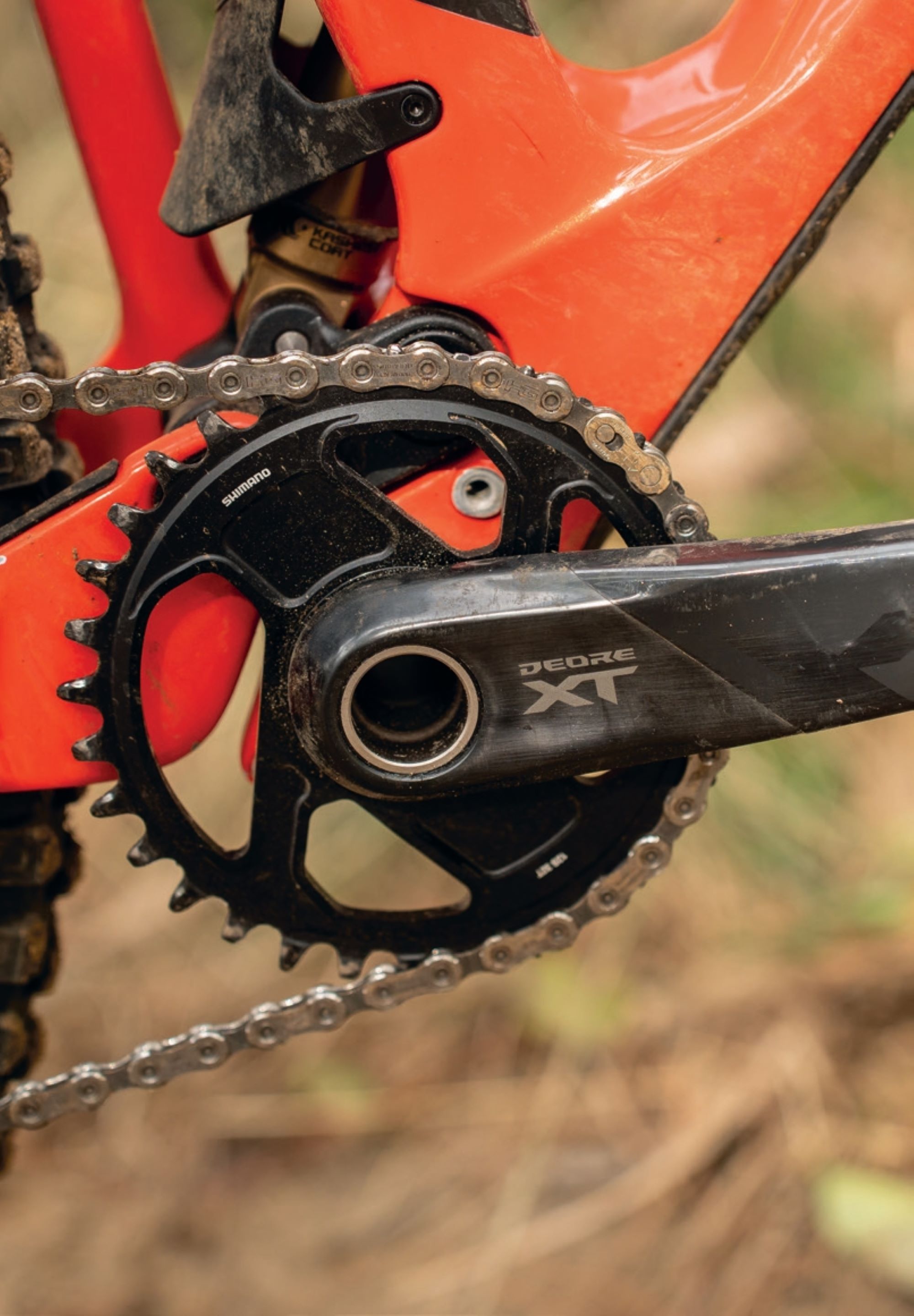
Crankarms remain largely unchanged from previous, aside from tweaked graphics. The refined one-piece chainring is updated and specifically sculpted for impact resistance, particularly when feet are parallel, ensuring it can withstand larger impacts than the previous version. The new chainring has an offset, giving a 55mm chainline for better overall performance and efficiency. The cranks are now available in more sizes, right down to a 160mm length.
When asked about replacement parts for the derailleur, Shimano’s response was an interesting one. SRAM claims a fully rebuildable derailleur, offering replacement parts for a complete T-type derailleur rebuild. Shimano, on the flip side, utilise a standard derailleur hanger, relying on the redundancy of this to help protect a derailleur from significant harm during excessive impact. Shimano’s thinking is that if a derailleur is damaged enough not to function correctly, and a replacement hanger doesn’t solve it, then the mech itself has sustained damage significant enough that even if spare parts were available, it would likely require a full derailleur worth of parts to get it back to 100% shift quality.
Drivetrain on the trail
XT M8250 has a familiar feel at the pedals, and outside of the electronic shifting part, everything feels similar to the XT mechanical, and that’s a good thing. First off, as mentioned earlier, the shifter, while familiar in layout, did take a little time to adjust to; the action is just so light.
Shift speed is fantastic and totally noticeable. I find myself shifting more, and whenever I want, rather than having to think early about when I need the gear to be engaged—we’re talking fractions of a second here but it makes a difference. With this XT, it’s just a simple thought of ‘I want to be in this gear’ and quickly shifting to it, nearly instantly. In situations where shift speed is key, on unfamiliar technical trails or rolling terrain with surprise features, where a prompt shift is paramount, the XT Di2 delivers.
The new chain stabiliser does its job well. I’ve had no dropped chains and, although it’s claimed to have much higher (75% more) tension than the clutch of old, it seems much smoother through its motion. One thing I have noticed is a subtle, dull ‘thud’ at times after the bike has been near full compression. Shimano tells me this is the derailleur cage returning to its neutral position and isn’t noticeable on all bikes.
I haven’t tested the impact resistance of the system as yet, but I’ve dragged the derailleur on the side of a few ruts and nothing untoward has happened. It strikes a slim silhouette and, from the reports I’ve heard, lives up to expectations when it comes to rock impacts.
During one ride, I noticed the chain exhibited almost chain-suck-like characteristics and made a strange ticking noise in the easiest two gears. Although the chainrings’ slightly revised tooth profiles decrease chain drops, with a dirty, dry chain it appears the teeth can hold on to the chain a fraction longer than ideal as the chain is rolling off them. It’s a simple fix with a clean and lube, but interesting to note and I’d be keen to do a huge 6+ hour ride in the wet to see how it reacts.
The big question on many people’s lips is this: how does this new XT compare to a SRAM AXS transmission? Shimano’s Hyperglide+ system can shift 1-2 gears under full power with ease, although it doesn’t have as ‘sure’ of a feel and there’s a bit more noise to the shift than SRAM’s Transmission, however, the speed of change on the XT makes up for the extra noise. The slower Transmission shift means that at times, if I’m caught out or late to shift, I’m still between gears while powering up a section. Thankfully, it’s so solid while shifting under power that I can push hard on the pedals without any worries. The Shimano is quite different; in similar scenarios, the XT will be entirely shifted, its gears will already be completely engaged before I have any worries, whereas the Transmission may still be halfway through its shift. Each brand offers a different experience, but neither is better than the other.
While Transmission and XT Di2 have similarities, the reality is that they are fundamentally poles apart. Transmission requires buying into a complete system, where the XT Di2 is supremely cross-compatible, and the barrier to entry is low. The release of XT Di2 has been likened to an iPhone upgrade; sure there’s some new hardware but it’s not a monumental leap forward. In the case of Di2, it could easily be said that this release only brings it in line with SRAM’s standard, non-t-type AXS systems that have been in the market a number of years now. With XT M8250’s crisper shifting under power, better battery life, arguably superior shifter and much greater durability, I think it’s clear XT outperforms the standard AXS. It sits alongside Transmission; there’s enough difference between the two systems not to crown one a winner, but instead they’re offering two quite different experiences and will meet the needs of different riders.

XT M8220 Brakes
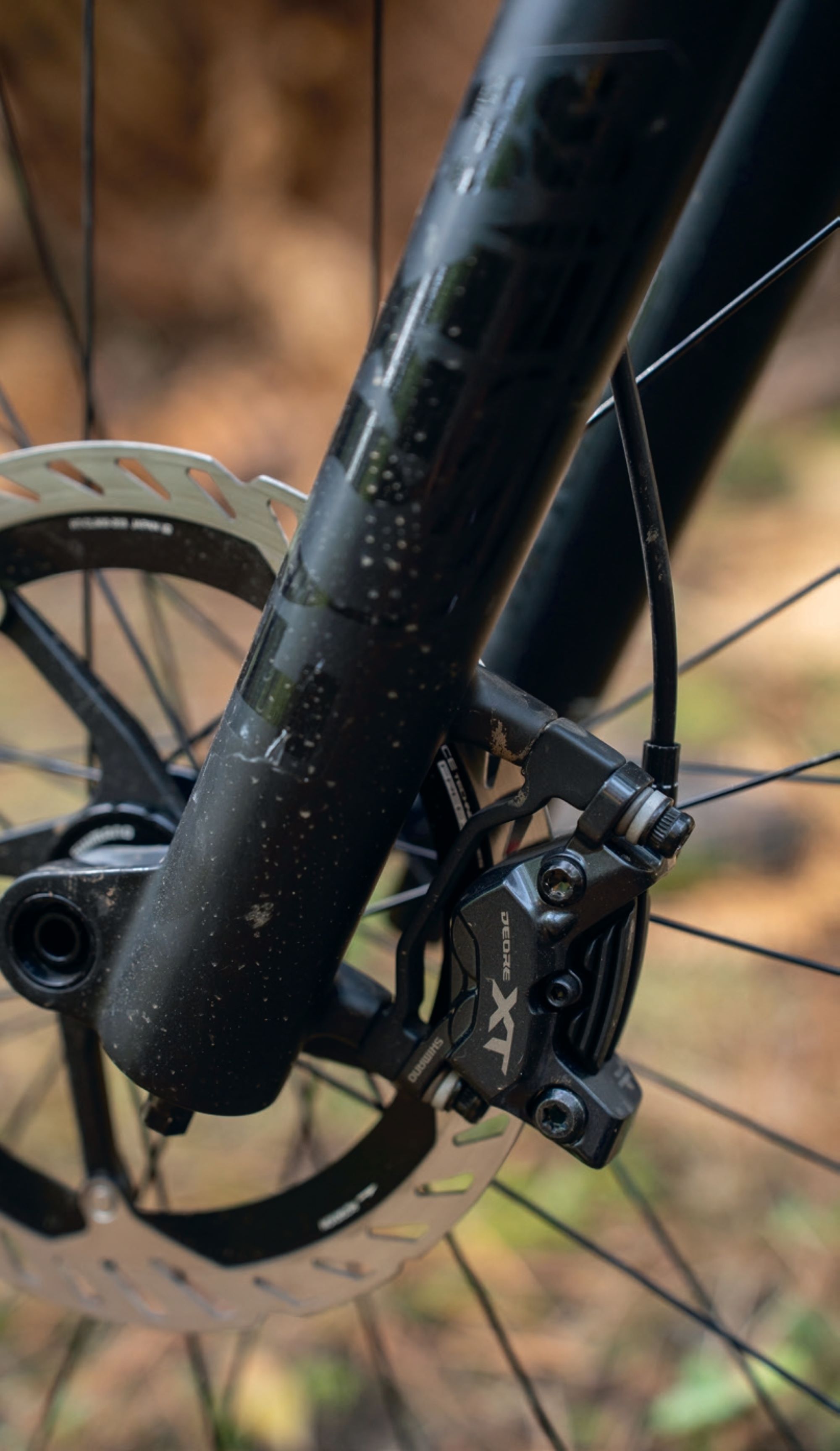
As much as the new Di2 has been front and centre of this recent release, the new XT brakes deserve some serious spotlight too. The previous XT brakes were the go-to for many riders, and rightly so; they were durable, powerful and generally low maintenance, if only more consistent with their much-publicised wandering bite point. While it wasn’t a deal breaker for most, the wandering bite point wasn’t something you wanted to be thinking about, or affecting your braking, while in the middle of an enduro race run.
Thankfully, as with the Di2, Shimano have rewritten the script with an almost completely revised brake. Many of the changes not only affect the consistency and performance of the brake itself, but with changes targeting ergonomics, they’re comfier and more intuitive to use.
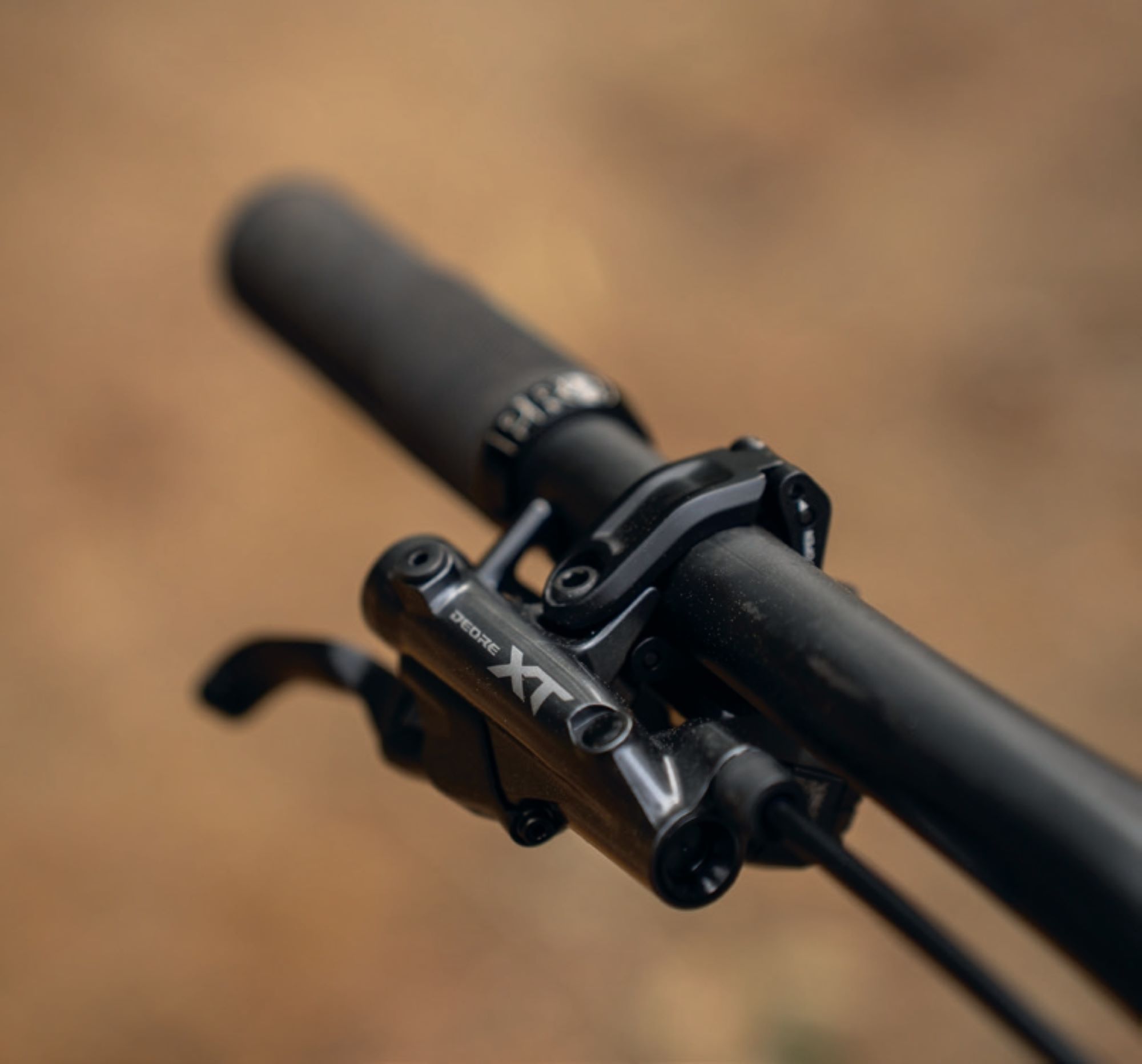
Beginning at the lever, the master cylinder has been squared up, now nearly parallel to the handlebar; the brake line exiting in a straight line, bringing it much closer to the bar. The lever pivot point has also moved toward the bar, 5mm further in than before. This change makes the lever path through its stroke more in line with the natural finger pull direction, tracking through the same path as a forefinger would as it pulls the lever.
The Servowave lever has a reach adjust dial and a ‘free stroke’ adjuster. Servowave has been featuring on the XT brakes, as well as some Shimano road brakes, for some time. Essentially, it amplifies the lever input as it’s pulled. I’m a massive fan of the feel and power it creates. The Free Stroke adjustment is more effective than in the past, but it still doesn’t offer a lot of range.
The entire system is filled with a new low-viscosity mineral oil, and it gets a new gold colour so as not to be confused with the previous red mineral oil, which isn’t compatible with these brakes—nor is this new fluid compatible with older brakes. The new oil is said to be much more stable across a broader range of temperatures and, when combined with new piston seals, should see the end to the wandering bite point curse of the previous brakes.
The calliper is not dissimilar to the previous: a two-piece, machined unit housing a pair of 15mm and 17mm resin pistons, a switch from the ceramic of old. The differing-sized pistons enhance stopping power while retaining exceptional modulation. The new pistons are coupled with previously mentioned new seals, which are said to snap the pistons back into place more rapidly when the brake is released, assisted in part thanks to the low viscosity oil, to put the wandering bite point of old to bed finally.
The brake pads have had a slight tweak in size, helping them fit more snugly into the calliper, which eliminates the pad rattle some units previously had.
Brakes on the trail
I’ll put it out there that the old XT brakes were my favourite brakes for a long time, and if it weren’t for that pesky wandering bite point, for general use, they’d still be on my bike. I’ve been using these new M8220 brakes for a relatively short time, so I can’t speak to their true longevity, but I have gained some insights into how their upgrades differentiate them from the old XT.
First off, they have an amazingly smooth, light action. The new fluid and seals help keep the lever feeling light and consistent. The feel is less on/off than the old versions, and although you can still feel the point the pads hit the rotor, there’s more modulation there than before. This softer feel shifts the lever experience more towards that of a SRAM brake, while retaining enough of the classic Shimano feel to be familiar. So far, I’m super impressed with the consistency of the brakes, and the wandering bite point appears to be gone; every pull feels the same, even down reasonably long descents.
The lever feel is excellent; I can feel the difference in the lever path thanks to the shifted pivot point. In theory, this should make long descents more comfortable, and it is the case, although the difference is hard to quantify. The new brake line routing looks tidy, but it does increase a bit of cable slap. This is easily fixed with a little tape or a zip tie. Shimano should have angled the hoses out a tad more, maybe not to the extreme of the previous, but somewhere in the middle would have been nice. This new angle does make it easier for internal routing of the hoses, but that’s a subject for another article, and not a good one.
My stock pair of brakes came with organic pads installed, which have proved to offer a nice bite, although I’d be keen to try a set of sintered pads in them for a maximum grunt at speed.
The overall power seems fractionally better than the XT’s of old, although power means nothing without control. I feel these new brakes have far better modulation and consistency than before, so overall are a peg up on the previous XT’s across the board.
The release of the M8220 brakes puts the XT back near the top of the list for overall performance, to dollar and weight ratios. Sure, there are lighter brakes around, but they don’t have the raw power of the XT, and there are certainly more powerful brakes out there, but they’re drastically heavier. The XT strikes a sweet spot in the brake market and should continue to be the “working man’s” brake.