Words Lester Perry
Images Thomas Falconer
RRP $24,900
Distributor Yeti NZ
The e-EDR World Cup is dead (eMTB Enduro Racing), but the bikes developed by teams trying to win these races sped up the development of eMTBs, and their learnings have helped manufacturers create some of the current crop of top-performing eBikes.
One such bike is the Yeti LTe which was developed alongside the heavy-hitting, diverse riders from the Yeti Factory team, including 2024 e-EDR World Cup overall winner Ryan Gilchrist and 2025 e-EDR World Champion (and multi-time Enduro World Cup winner), Richie Rude. Yeti’s race-winning pedigree runs deep, and their years of experience across all genres of MTB racing mean the brand is exceptionally well qualified to create some of the best bikes in the business.
The Yeti LTe is essentially a heavily updated version of its predecessor, the Yeti 160e – Yeti’s first race-focused eMTB. Geometry and suspension both saw significant updates; however, the biggest news upon launch was the switch from a Shimano drive unit to a fresh, much more capable Bosch CX-R drive unit.
The eMTB market has become something of an arms race recently, with buyers selecting bikes purely on the numbers associated with a given drive unit rather than the combined experience of the drive unit, frame and components. A drive unit alone cannot dictate how much fun or capable a bike will be, but it sure helps to have both the best drive unit and the best frameset.
There’s no denying that Yeti’s bikes target the high-end consumer looking for high performance. Even their most basic build options sit out of reach for most mountain bikers, but for those who either have ample funds or choose to spend what funds they do have on top-performing bikes, Yeti’s range is hard to look past. The LTe retails for $24,900 in New Zealand.
Usually, I’d hesitate to think that any bike priced this high could be exponentially better, or offer a much better ride experience than one that’s $10,000 less. However, I’ve been surprised to find that the performance – and all-out, grin-inducing fun – the LTe offers when ridden hard is, at least in part, worth the step up to its premium price tag.
Drive unit
In July 2025, Bosch launched a significant performance upgrade for the new Performance Line CX drive unit. This upgrade brought existing drive units up to date, more in line with the latest competition, raising max torque to 100Nm and power to a possible 750W (depending on the bike), as well as support multipliers going from 340% to 400% assistance. As part of the performance upgrade, we now find an eMTB+ assistance mode and associated Dynamic Control functionality. We’ll get to those features in a bit. Where fitted with the new Performance Line CX, most 2026 model bikes will ship with standard software, but users can adapt the performance upgrade wirelessly via the Bosch eBike Flow App.
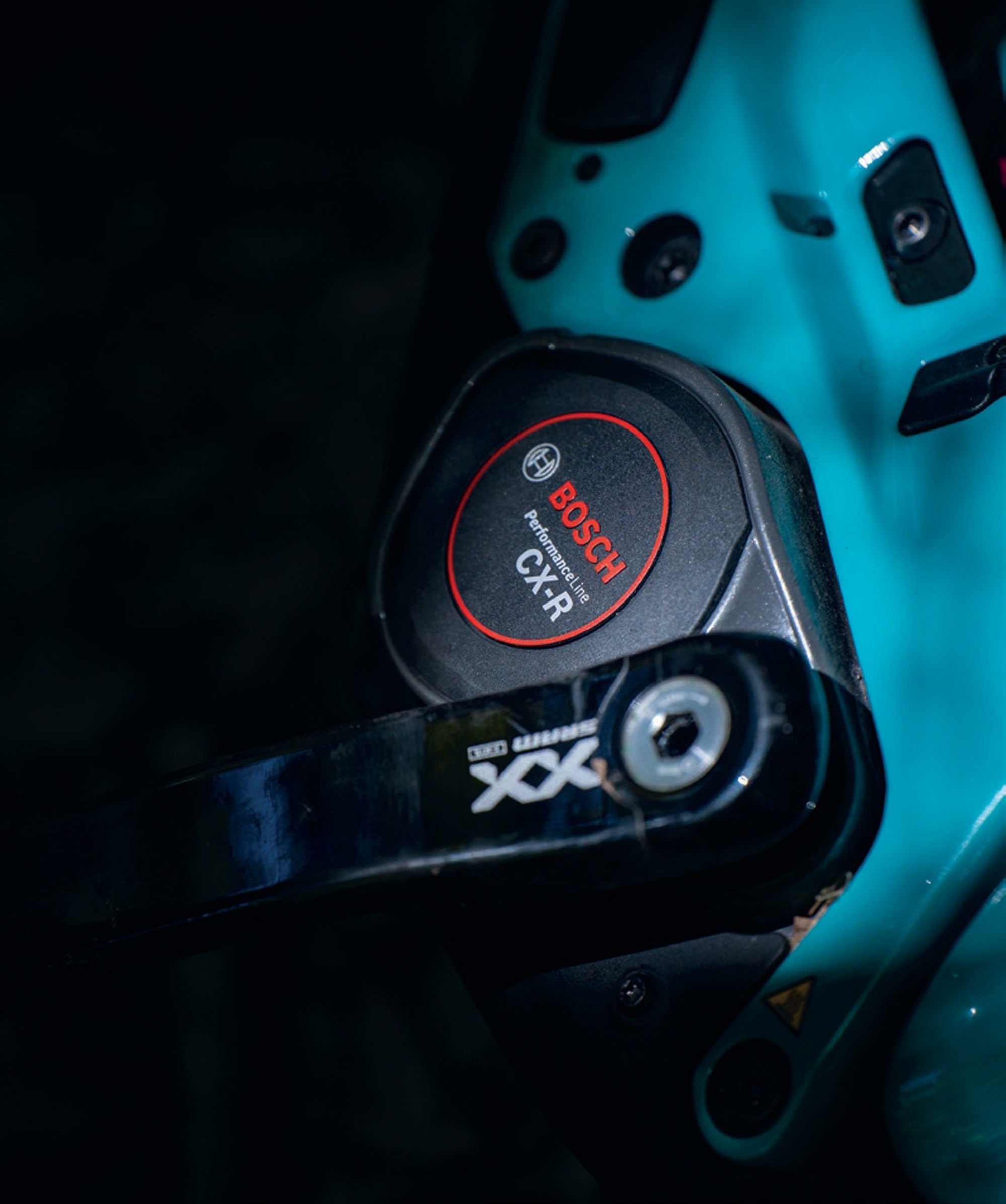
Alongside performance upgrades, Bosch released the all-new CX-R drive unit and Kiox 400C display. The Performance Line CX-R drive unit is designed to win races and slots in as Bosch’s top-tier offering. It’s lighter weight, coming in at 2.7kg, and more powerful, coming stock with 100Nm torque, 750W max power, and 400% rider support.
The weight savings primarily come from the use of a magnesium housing, titanium crank spindle, and ceramic bearings, which are designed to handle the higher torques that come with racing and consistent use of aggressive assist modes.
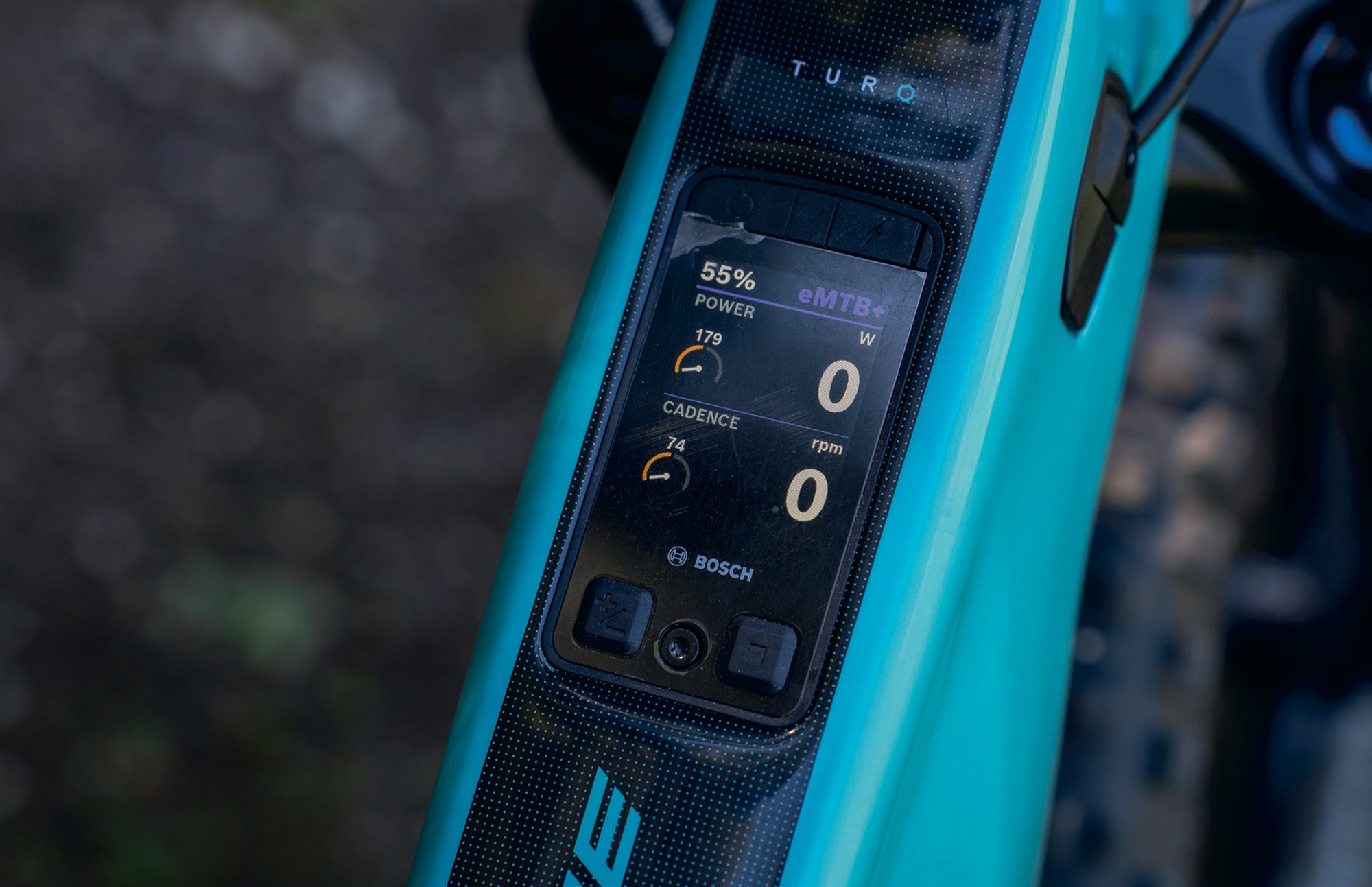
The Kiox 400C display and wireless “mini-remote” were released alongside the CX-R drive unit. With these two gadgets, it feels like Bosch has finally caught up with the competition. The Kiox 400c is a fully integrated display that tucks snugly and almost seamlessly into the bike’s top tube just behind the headset. It’s large, measuring 2 inches diagonally, it’s bright, it’s high resolution, and it’s full colour, almost a mini-iPhone mounted in the bike! Unfortunately, unlike an iPhone, it’s not touchscreen. The mini-remote lets you shuffle between info screens or scroll between assistance levels. It’s ergonomically ideal, sitting where most remotes do, just beside the left handlebar grip, the buttons have a noticeable click to them, and their rubberised finish means even the sweatiest of fingers don’t slip.
If you’ve set up navigation in Bosch’s eBike Flow app and have a destination programmed, the Kiox 400C will display directions as if it’s your phone, even with handy sounds to notify you of upcoming turns.
There’s a host of information that can be displayed while riding, from heart rate (if you’re using a HR strap or other device), rider power, cadence, and even shifting suggestions. Ideal if you’re one to just throw it in top gear and grind around the trails – the unit will suggest shifting to a more optimal gear ratio. What’s displayed on the screen is entirely up to the user and can be configured in the eBike Flow app on your phone. Speaking of phones – there’s even a handy USB-C port at the top of the display for phone or light charging.
I found the Kiox 400C a considerable step up from previous, more basic, Bosch display options. The screen is a great size, and with the bright, easy-to-read display, I found myself taking a quick glance down to see what speed I was doing, or even what power I was pushing, all while navigating technical trail.
There’s a new assistance mode thrown in the mix, too. eMTB+ mode features Dynamic Control, which essentially switches between aggressive and more subdued output, automatically adjusting between the two based on rider inputs such as cadence and torque, as well as internal sensors that measure gradient and detect loss of traction.
Sampling 1000 times a second, the system seamlessly adjusts to terrain, helping maintain traction regardless of conditions or rider inputs. I found this mode to be the most natural and it felt like riding a regular non-assist bike. Although, when I put the power down, I was able to take advantage of the full 400% support and pull up and over whatever was in my path. The eMTB+ mode is not dissimilar to the standard eMTB mode in terms of how it works but it does offer the higher top-end power availability of the Race mode at 400% assistance vs the 340% of eMTB which doesn’t have the Dynamic Control feature.
We’re now presented with four assistance modes: Race, eMTB+, eMTB, and Tour+. As it says on the tin, Race mode is for just that: racing. Only offered in the CX-R drive unit, it provides 400% support (so 4x rider input). It takes some skill to make the most of this level, and it will rinse a battery quick-smart if not used sparingly. I found this level ideal for uphill sections where I knew maximum attack was the only way over or through them. It’s a load of fun but does require some caution, as more than once I nearly got spat off the back as the bike almost looped out.
eMTB mode, as we’ve known it previously, is like having the bike on automatic, offering less support than eMTB+ mode, up to 340% assistance. The Race and two eMTB modes have “extended-boost”. When stopping pedalling, the motor continues to drive for a short time, helping to maintain speed between pedal strokes or over technical crux moves where a pause in pedalling is needed to navigate a feature. Tour+ offers similar assistance to the eMTB mode at up to 340%, but loses the extended boost and prioritises battery conservation over all-out performance.
Users can tune riding modes to their liking in the eBike Flow app, so if you want more or less power or torque, you’ll find your nirvana with some digital fine-tuning.
It’s worth mentioning the Walk Mode. Hold the ‘down’ button on the mini-remote, and the drive unit moves the bike forward, helping push it back uphill. I used this each lap back up Kataore trail in Rotorua while we were shooting photos for this review. Without this function, getting back up the hill each time would have been significantly more difficult!
The whole drive system on the LTe is powered by a Bosch 800Wh battery. There’s also a range extender that gives an additional 250Wh for those big days lapping the hills! It would be nice to have an easy-to-swap main battery. Unfortunately, it’s not a quick trailside task. While I never needed to remove the battery, according to the bike’s manual (which is quite impressive, I should add), it doesn’t seem like something you’d want to do unless it’s really necessary. Sorry, team, no double-battery rides on this one, by the looks of it.
Frame details
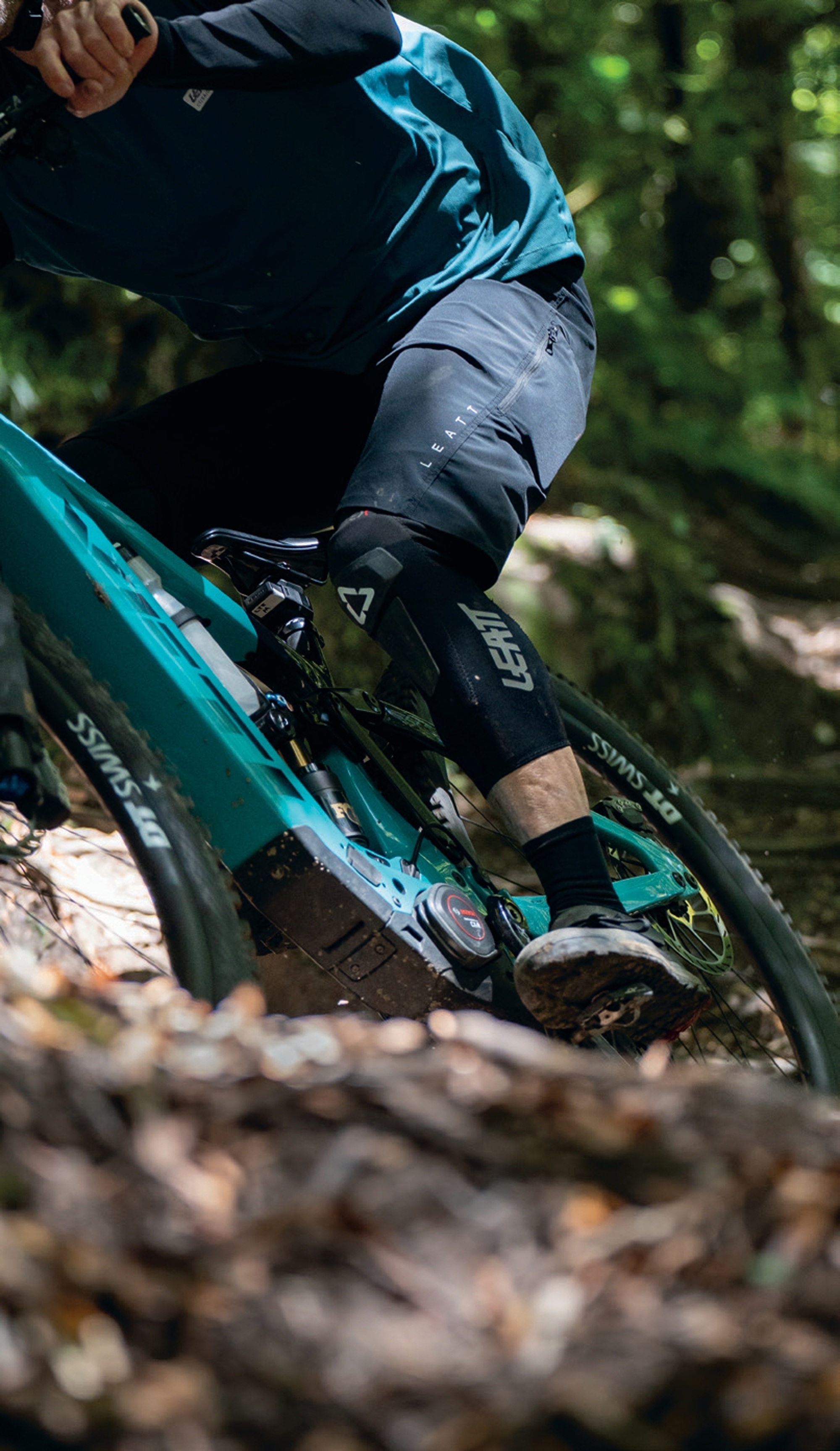
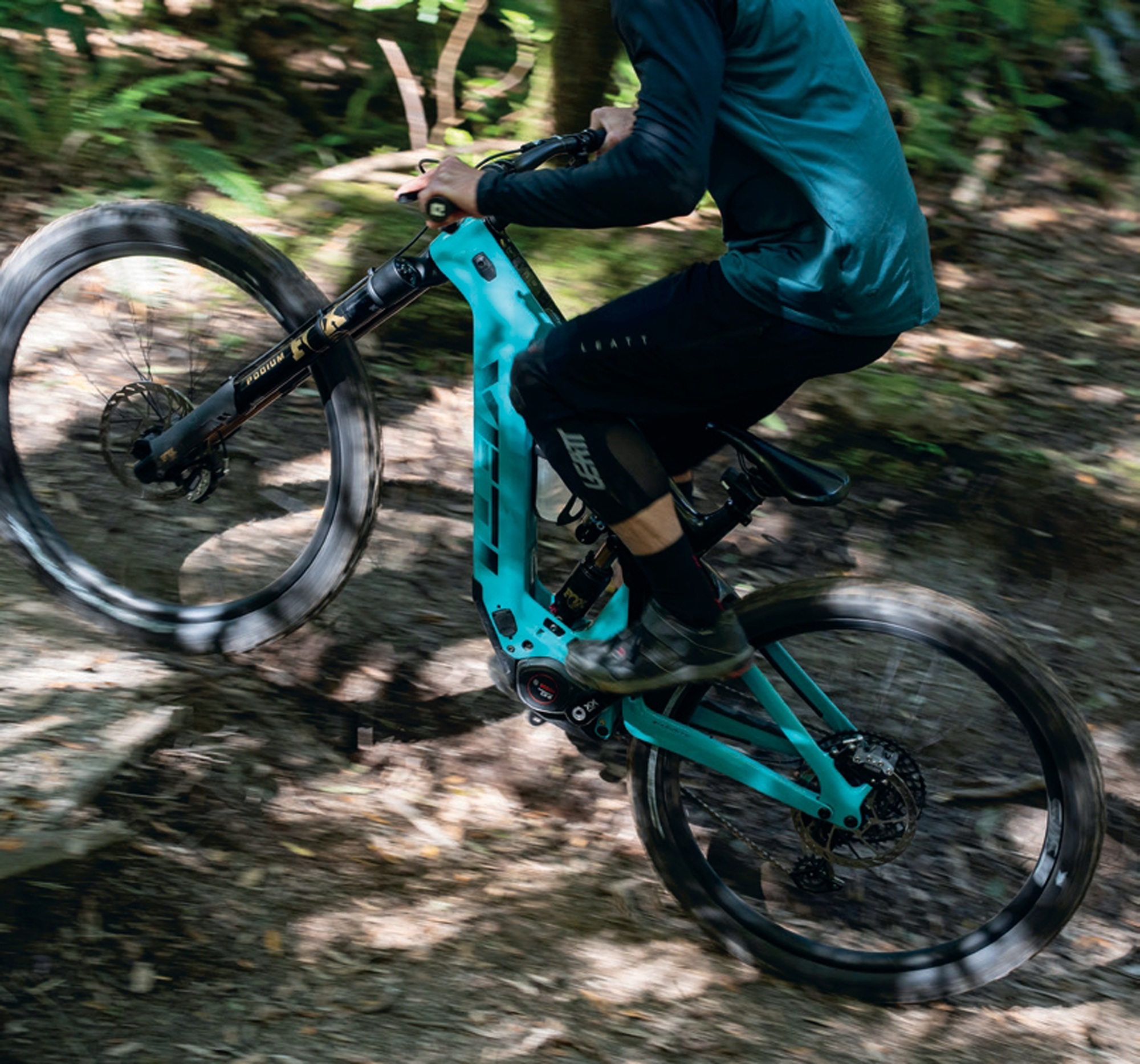
The Yeti LTe is a 160mm (r) / 170mm (f) travel bike bred with an e-EDR focus. It’s crafted from Yeti’s signature TURQ carbon fibre, reinforced with Vectran (similar to Kevlar) to deliver downhill-bike-level strength. The complete chassis (minus suspension linkages) is top- shelf, lightweight carbon fibre. Using carbon not only helps keep the overall weight down but also allows Yeti to tune the ride feel.
The Sixfinity suspension is a unique six-bar design in which all six linkages contribute to controlling the wheel path. It offers higher anti-squat focused around the sag point, keeping a solid and efficient platform for pedalling or pumping. As the bike progresses further into its travel, where pedalling is unlikely, the Switch link drops and anti-squat falls away quickly, offering confidence and stability for downhill-bike-like descending.
As one would expect from a top-tier bike, all the small details are taken care of. Cable routing is tidy (at least externally), and key areas have guards and bumpers to protect the frame and drive unit from rock strikes and debris, or chain slap, all of which helps keep the ride experience nice and quiet and the frame crisp.
I tried to find something on the frame to highlight as a negative, or perhaps not quite right, but all I could come up with is that the ‘loam shelf’ on the lower suspension link behind the motor sits right in the path of mud, slop, and, of course, loam. Most rides, I’d finish with a little pile of debris in this area. No biggie when it’s dry, but I guess long-term over a winter of riding it may negatively affect the lower linkage bearings as they’ll be constantly sprayed with slop from the rear wheel.
On the subject of bearings, by my count there are 16 bearings involved in the Sixfinity linkage, which is not an insignificant number to keep serviced or to replace when necessary. I guess that’s the cost of having all the advantages the Sixfinity brings to the bike: can’t have one without the other.
Adjustable rear suspension leverage rate can be achieved via a swap out of the lower shock mounting chip, allowing for three levels of suspension progressivity tuning: 25%, 30% and 35%. This gives the ability to set it up precisely for where and how it’s to be ridden. I ran this in the stock ‘middle’ 30% progression setting. I found it ideal for my local North Island trails, with shorter, not highly technical climbs and descents featuring a wide variety of features, from drops and g-outs to short chundery steeps and high-speed flow with jumps.
The 30% was plenty supportive and balanced enough to keep the bike playful and poppy, but linear enough to give me the confidence and control for max attack. I didn’t test either of the alternate settings, but for true mountainous descents the lower, 25% setting may be an advantage, offering a more linear suspension rate. The inverse 35% rate should be more relevant for sustained steep, technical climbs and flat riding with its higher progression making the bike ramp up quicker while maintaining the buttery early stroke. These options also open the door to swapping out the air shock for a coil while still maintaining a consistent feel.
The higher torque of an eBike compared to a non-assisted bike means that if the anti-squat is not dialled in, it will be very noticeable, as there won’t be any consistency in how the bike feels under pedalling. Pedalling the LTe was predictable and natural. Regardless of my cadence or how hard I pushed the pedals, the suspension appeared to be unnoticeably active. If I can’t notice something, that’s a green tick from me, as it must be doing an admirable job: just turn the pedals and let the bike do the rest.
Those who want a bit more clearance over the tyre or more ‘flickability’ can switch to a 27.5” rear wheel via flip-chips in the upper seat stays, and thanks to the aforementioned shock mount adjustments, the bike will ride equally as well as it does in the stock, full 29er option.
The overall system weight of the LTe is a fraction over 23kg – pretty light for an eMTB in this e-enduro category. While that Podium fork adds 300+ g over a FOX 38, the weight still feels balanced on the bike, not significantly front-heavy. I’d love to throw a leg over one of the lower-specced LTe bikes with a lighter fork for comparison, to see if a substantially lower price tag really provides a less enjoyable ride experience.
Geometry
The LTe geometry is comfortably balanced. With a 64° head angle, it’s slack enough to be confidently ripped around any terrain and just steep enough to retain a level of playfulness and keep it nimble and quick through turns, even while climbing. A 78° seat tube angle brings the rider forward into a reasonably forward position for comfortable climbing and ensures the front end doesn’t need any overly pronounced effort to keep down while climbing. A 449mm chainstay, 465 reach (medium frame) and an 808mm front centre measurement put the rider in a nice central position within the reasonably long 1257mm wheelbase.
Component highlights
As you’d hope for on a bike with this price tag, the component selection on the LTe is nothing but top-shelf. I’ve picked out a few highlights below:
Fork – FOX Factory Podium 170mm
A new-to-market fork from the boffins at FOX, oh, and it’s upside down! They seem to have solved all the issues that previously stopped upside-down forks from succeeding, and this fork seriously impressed me. Although it’s not the lightest, some 300g+ heavier than an equivalent FOX 38 fork, the weight is well worth the extra performance. The fork changes direction from compression to extension and vice versa with less effort or delay than a regular fork, in part thanks to its lower unsprung weight and constant lubrication from the fork oil sitting atop the main external seals. Buttery is not a word I thought I’d use to describe this fork, but it is just that. The early stroke is phenomenally supple and even deeper into the travel, it’s evident this is very active and smooth, the wheel sticking to the ground, no chattering, jarring or feeling like the fork is overwhelmed, just a precise, controlled feel.
With much larger bushing overlap than a standard fork, which keeps the legs stiff and parallel to each other, there’s less binding as the fork legs compress, helping maintain the smooth action. Even under heavy braking down rough, steep sections of trail, there was not once when I even began to explore the limit of the fork.
There’s ample adjustment on offer on the Podium, with the GRIP X2 damper. You’ll find high and low speed compression and rebound adjustments, as well as the ability to add volume spacers. There’s a tonne of tunability available. On most bikes, I use manufacturer-recommended settings as a baseline, then tweak settings from there. On the LTe, to my surprise, I found that Yeti’s suspension setup calculator gave me ideal settings for everything, right down to tyre pressure, so I didn’t see any need to go outside these.
The only downside to the Podium at this stage, if I’m getting picky, is wheel installation. When the axle is removed, the lower fork legs can rotate, making it more difficult to reinstall the wheel and axle than with a traditional fork. Once again, a small price to pay for the performance this design offers. If, like me, you’re often unloading the bike from a vehicle after taking the wheels off, and in a hurry to get going, lining the dropouts up with the axle and wheel can take a few deep breaths!
SRAM Selections
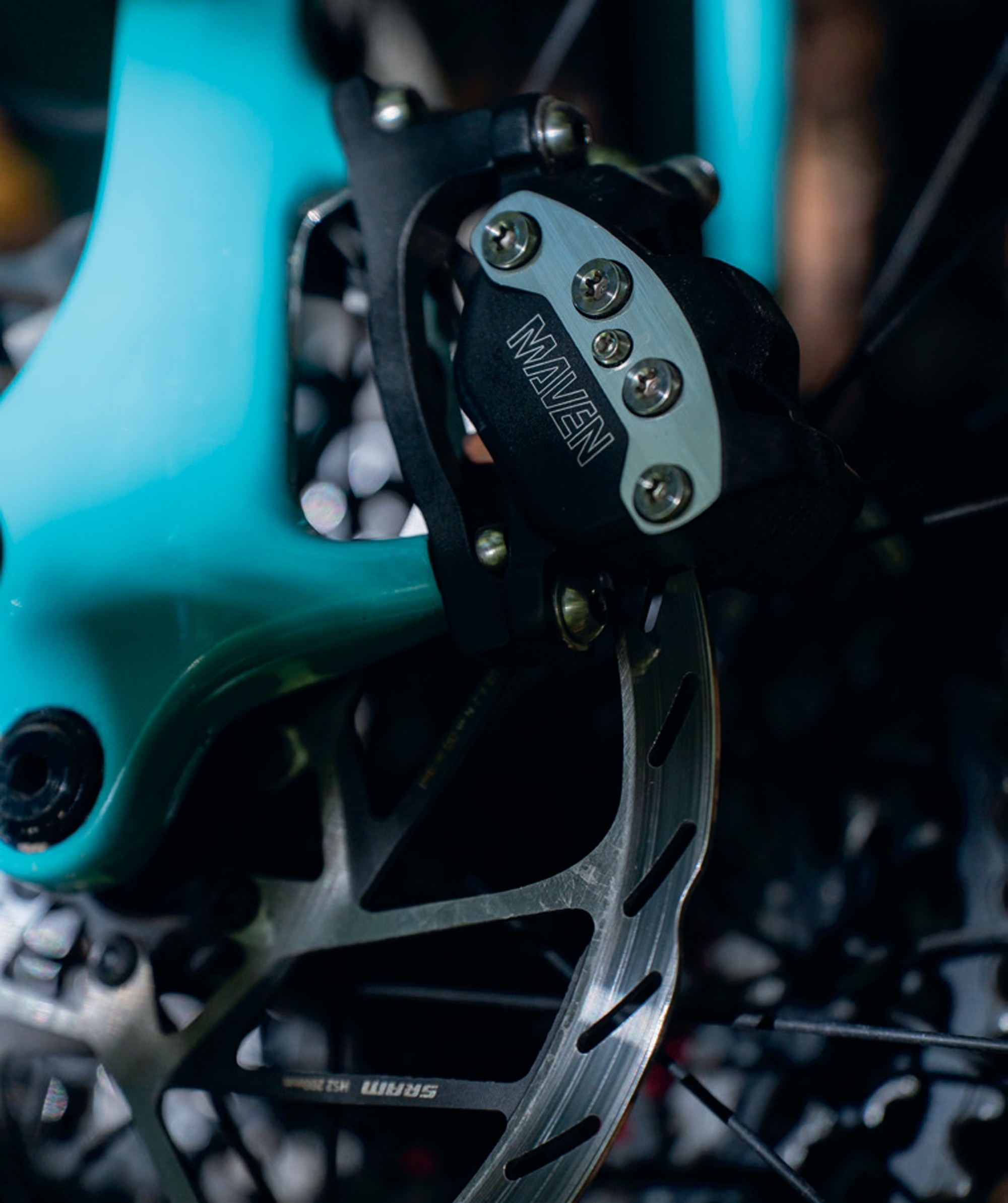
With a SRAM XX drivetrain and 165mm cranks, you can’t go wrong. Although a 160mm crank would have been better, it’s not available at the XX level. This t-type Transmission is at home on an eMTB, and when combined with SRAM’s Maven Ultimate brakes, it’s the perfect combo for speeding up and slowing down. Dropper post duties are handled by a RockShox Reverb AXS 175mm post on the medium bike, while large and XL bikes use a 200mm post, and the Small frames use a 150mm post. Another great spec, but I still find it hard to accept the bulbous battery and control unit on this post – unsightly at best. Thankfully, it works like a dream!
Tyres – Schwalbe
The best suspension and bike setup can be let down by bad tyre choice or wrong tyre pressures. I found the Schwalbe Magic Mary Trail Pro 2.5 Radial Ultra Soft on the front, coupled with the Schwalbe Albert Gravity Pro 2.5 Radial Soft, to be wise spec choices by the product managers. Having never ridden radial tyres before, I wasn’t sure what to expect. Once inflated to the recommended 29psi rear and 28psi front, much higher than my normal pressures, I discovered why people have been singing about these tyres: supple, fast and grippy all sum up the radials.
With a lighter trail casing and ultra-soft rubber up front, and a heavier Gravity casing and sturdier rubber out back, there was no need for concern on any terrain I put them on. There was enough support and traction to keep the bike well under control, although on rocky, high-speed trails, a Gravity casing up front may be preferred. I didn’t get to test them on a super-wet ride, so I’d be interested to see how they perform in those conditions. Judging by the height of the tyre knobs, I doubt there would have been a need to use anything else.
Riding the LTe
The LTe is the best eBike I’ve ridden, and potentially the best overall bike I’ve ridden, full-stop, end of story. Set up was effortless thanks to Yeti’s suspension setup web app. I found no reason to change anything from their recommended settings after some initial pressure adjustment and dial twiddling. The medium bike was perfect for my 176cm height, and everything felt in the right place, even down to the handlebar width. I’ve reviewed other high-priced carbon eMTBs with similar drive systems, and I couldn’t get the setup to feel great, even with a reasonable amount of setup time and head- scratching, so it was nice to just hop on and go.
The LTe is designed with a downhill focus, and that’s where it really shines, although climbing is also excellent. Manoeuvring up and through technical climbs was on par with other high-end eMTBs I’ve ridden. Nothing really puts it head- and-shoulders above, and in some ways, the excess weight of the fork makes it marginally more challenging to pull up over obstacles. Fortunately, that Bosch CX-R drive unit has enough torque on tap to pull me up anything.
Generally, I blasted around in eMTB+ mode, the Dynamic Control aiding traction when the terrain was loose or slippery. Race mode was reserved for sections of climb that I wasn’t really sure I could get through, releasing all the power of Race mode in the hope it would pull me through. The Race level of assistance was more than I needed most of the time and often required more man-handling, and thought about how best to apply power to the pedals. This bike needs to be ridden hard to get the most out of it and really see where it shines. Descending is where the LTe really comes into its own, largely thanks to that Sixfinity linkage and the top-shelf suspension, but also the brilliant selection of components. For example, sub-par brakes would totally kill the vibe on this bike, regardless of how good the suspension platform is.
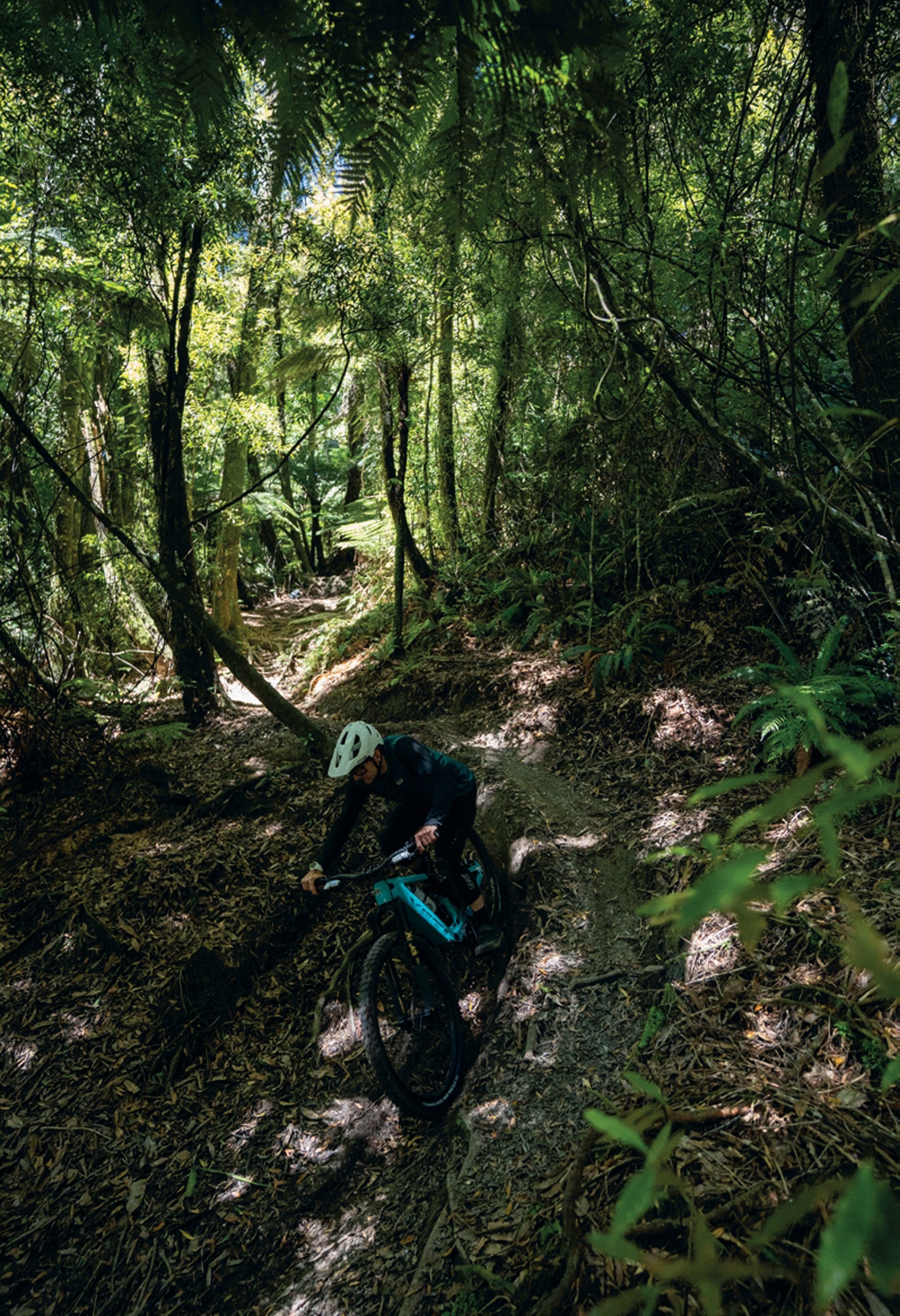
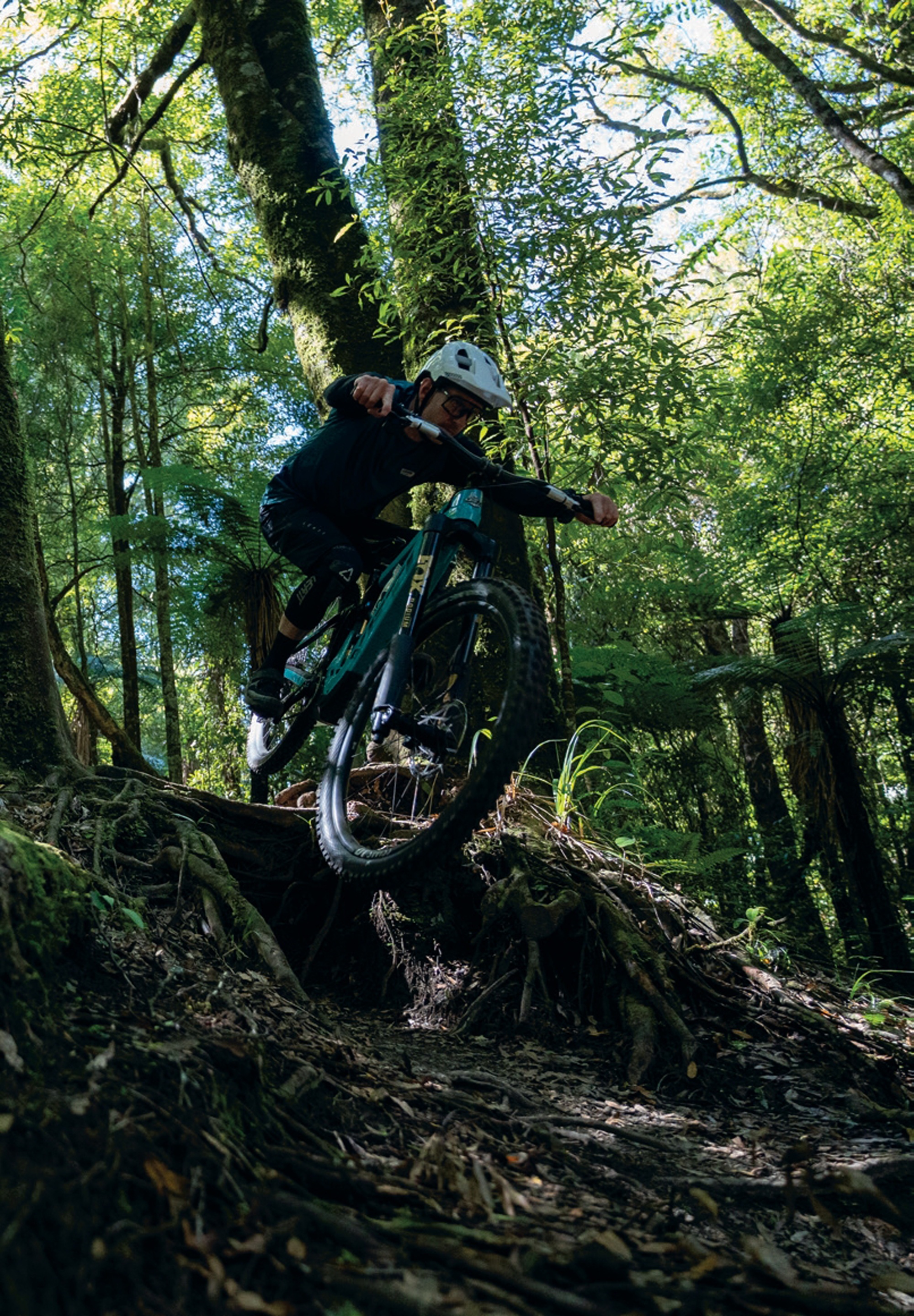
When throwing the LTe down a reasonably technical trail, I got the feeling the bike was just asking for more. The only limiting factors to how fast it could go were my skills and my level of self-preservation. The bike could handle much, much more than I was prepared to give it. Some laps through Rotorua’s Tuhoto Ariki and Kataore native bush trails really shone a light on how good the bike is as a whole.
Swooping turns, both bermed and flat, with roots, were no bother. Even with a reasonably long wheelbase, the LTe was easy to change direction in turns and held a line exceptionally well. At slower speeds, the weight of the fork was evident, but once I opened the taps into some of the faster sections of trail strewn with steps, roots, and heavy hits, I forgot that weight altogether.
The LTe’s suspension rewards speed and aggression, and once at a decent cruising speed, the trail seemed magically smoother. Even under heavy compressions, the bike was calm and predictable, and there were no “wow that was close” squirrely moments. I’ve certainly had moments on other eMTBs where the bike squirms underneath me, feeling like a wound spring as it’s nearing the end of its travel, and as it rebounds it’s a bit like releasing a wild dog to chase a rabbit: I’m not sure what to expect, but sure it’s going to end in carnage!
Although there’s a feeling the bike is like a plough smoothing out the trail, it’s still quite spritely. There’s enough support in the suspension, and the overall light weight of the bike means it’s able to be bunny-hopped and unweighted over trail features, and popping off bumps or jumps doesn’t require excess effort.
On the steep, while braking heavily, the LTe maintained a high level of composure. The balanced geometry and buttery suspension ensured the tyres tracked the terrain, keeping as much traction as possible. I felt comfortably centred within the bike, no feelings of the front end diving and that I’d be pitched out the front. Equally, I didn’t feel like I was a passenger needing to push off the back too far while dropping down near-vert faces, just a level of composure I haven’t found on an eMTB before.
Rough off-cambered sections or getting to the highest of high lines into turns were both areas where the bike shone; again, the suspension, tyres and geometry worked together for pinpoint precision. See a line you want to get to? Go there. No questions asked. It took me a couple of rides to really unlock the confidence to go pretty well wherever I wanted on the trail. As I mentioned earlier in this piece, my skills and self-preservation were the limiting factors. Still, the bike gave me confidence to push both of these further than I’d be comfortable with on many other bikes.
To sum up, the Yeti LTe not only meets the mark for a high performer but surpasses it. It’s an all-around exceptionally fun and capable bike to ride, and the fact that it’s an eBike just opens up more possibilities for how many after-work downhill laps could be ridden and how much steeper and sustained the climbs it could go up, versus an ‘acoustic’ bike. Ultimately, I think the LTe rider’s cheesy grin will be just that bit bigger thanks to the pedalling assistance on offer over a non-eBike equivalent.
While I was testing the LTe, I also had a couple of lower-specced, alloy-framed eMTBs in the stable. Jumping between this $25k beauty and a $9k alloy bike, the difference between the two couldn’t be more pronounced. On every level, the more expensive bike was better – maybe not $15,900 better – but the two ride experiences couldn’t be further apart. In isolation, either bike was capable and fun in its own right. But once ridden back-to-back, the differing experiences showed me that between the high-end and let’s call it low-end of the eMTB spectrum, the experiences are so different they almost can’t be compared, a little like a Formula One car vs. a Honda Civic. They both have a frame, motor, and wheels, and both can be super fun to drive, but from a high- performance aspect, when piloted by a driver (rider) who can feel the nuanced differences between the two, there’s a vast chasm between
Produced in partnership with Bosch eBike Systems