

Leatt Products
Words Lester Perry
Images Jamie Fox
RRP $90—Trail 1.0 Short Sleeve Top | $160—Trail 2.0 Shorts | $230—ReaFlex Hybrid UltraLite Knee Guards
$370—Enduro 2.0 Convertible Helmet
Distributor BikeCorp
Leatt is a brand founded on a quest to offer the highest possible protection, through rigorous research, testing and development. Grown from an idea sparked by Dr Chris Leatt’s mission to protect his then four-year-old son from injury while riding motorbikes, Leatt has become a global leader in research-backed protective gear.
After witnessing the death of fellow rider and friend, Alan Selby, from a suspected neck injury in a motorbike accident, Dr Leatt set about working on a solution to avoid neck injuries that are all too common in bike sports. A few years later, Leatt the brand came to be, hitting the market with a neck brace. This revolutionary neck brace quickly became a global phenomenon and was soon adopted for mountain bike use.
In 2015, Leatt launched its first range of mountain bike helmets, and, by 2020, the band dove headlong into the MTB world, offering head-to-toe safety and gear solutions. Now in its 20th year, and with numerous design awards and industry accolades, Leatt recently began a new chapter here in New Zealand. With a new distributor now in place, we’re sure to see this storied brand continue going from strength to strength, becoming a more dominant player locally.
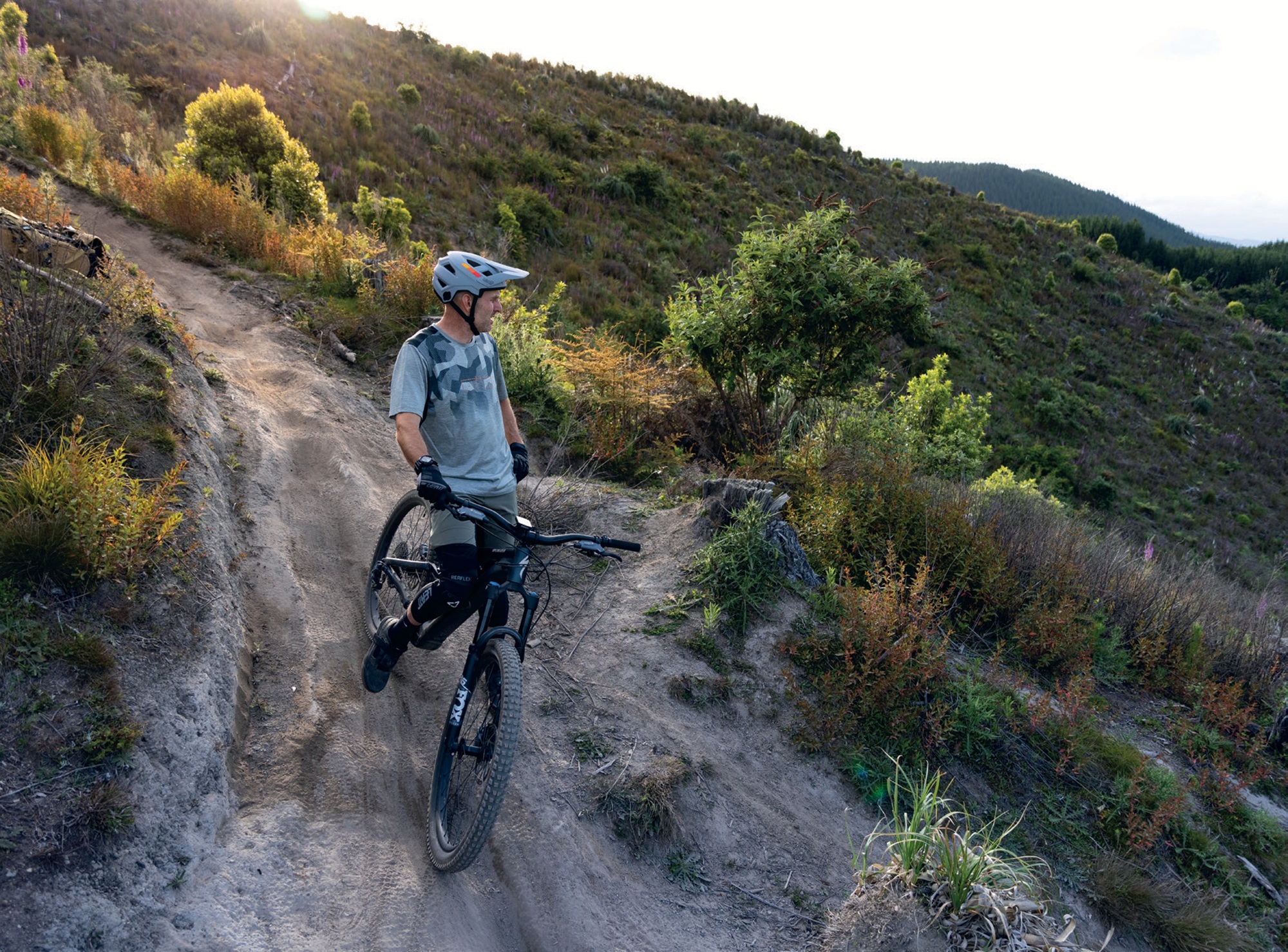

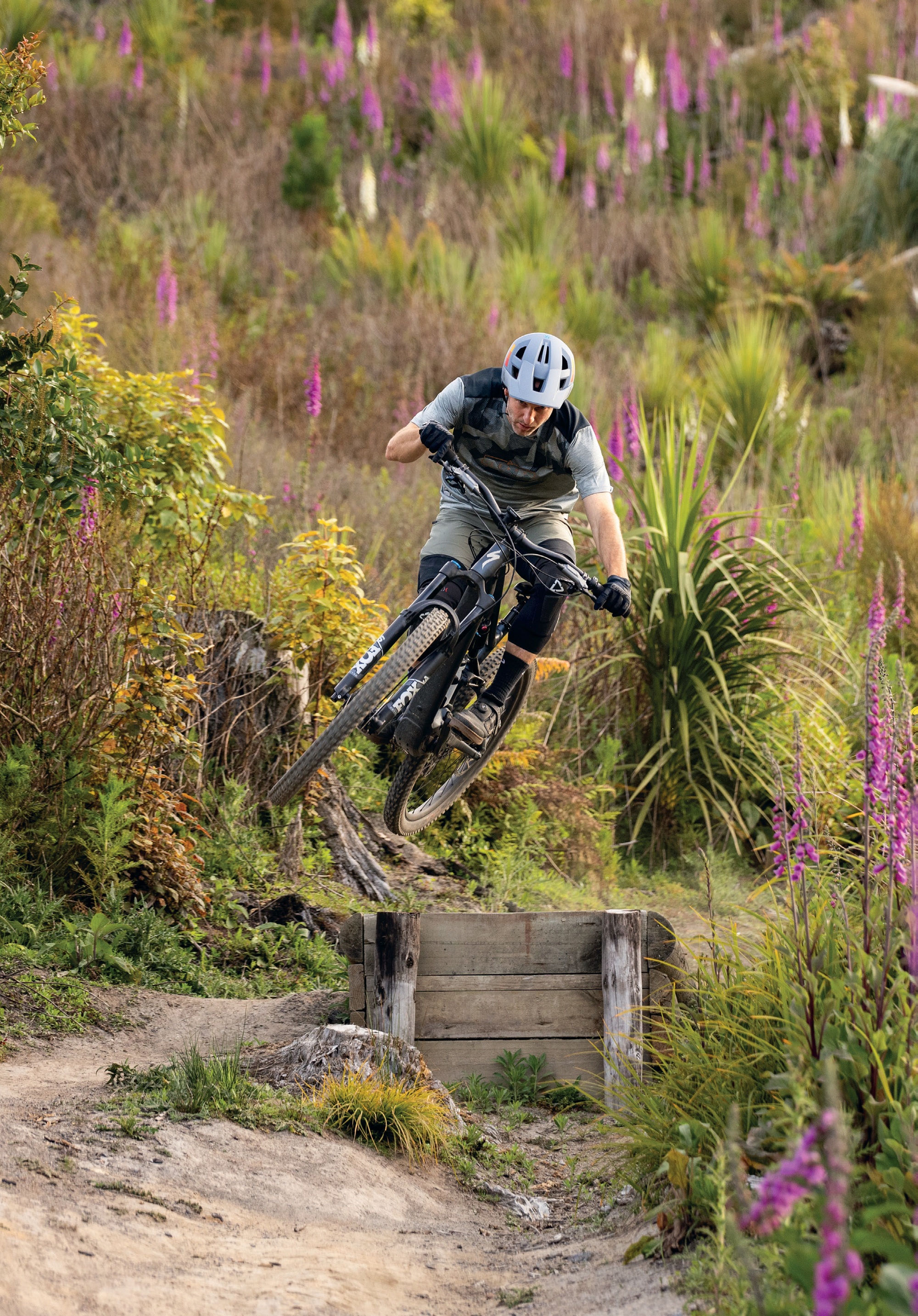
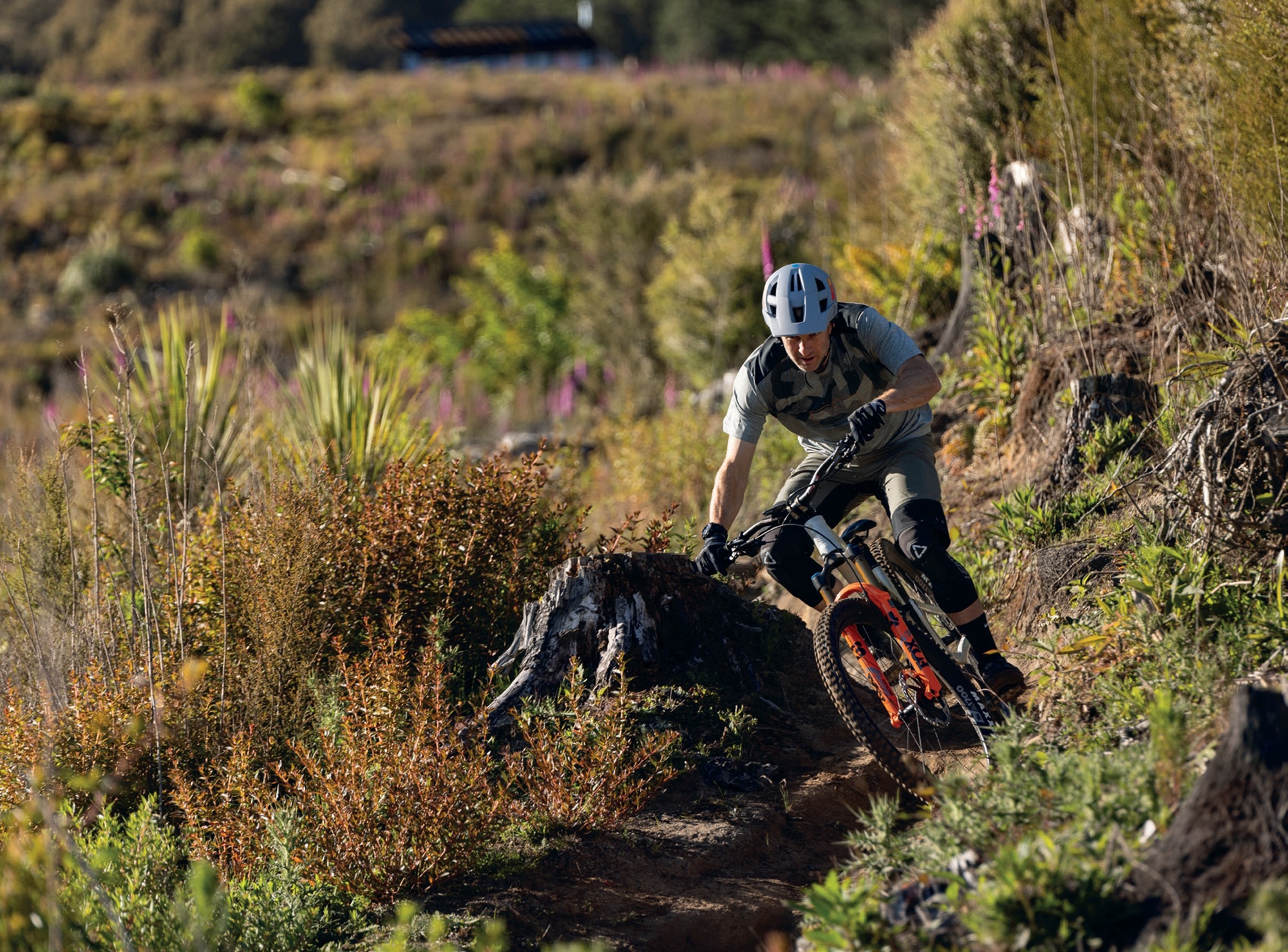
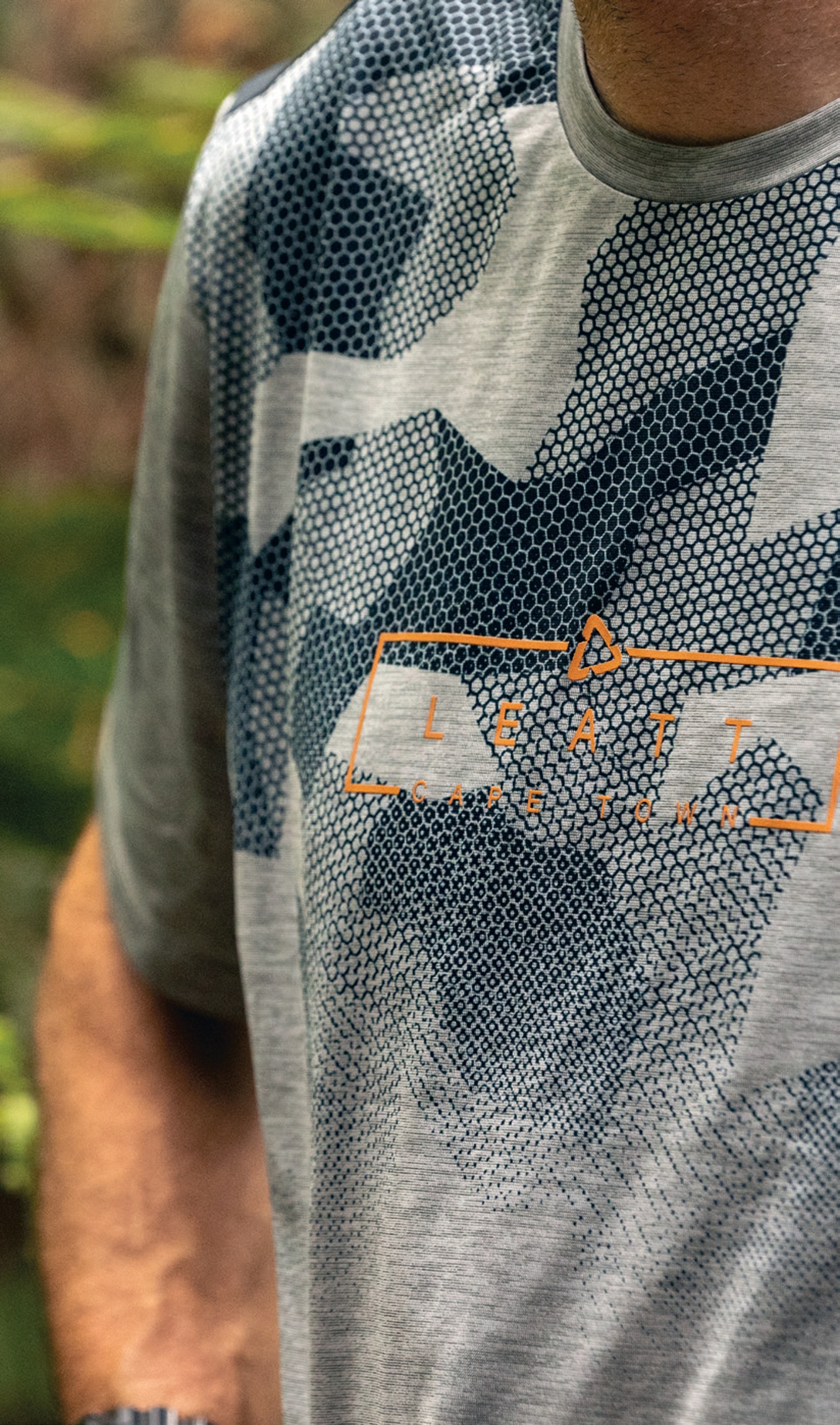
Trail 2.0 Shorts
As with jerseys, we’ve recently seen an influx of riding shorts that do the job but, much like my school report card said; “could do better”. The truth is, most of us are happy to stay in our lane and have no idea what we’re missing out on elsewhere, not keen to branch out from the norm and try a different brand of gear for fear of not liking it.
At first glance, I was unsure about everything going on with the Trail 2.0 shorts. “Is this overkill?” I thought to myself, looking at all the pockets and panelled fabric.
Sizing-wise, I’m a medium or 32” in any type of short and, true to form, the Leatt Trail 2.0 in the medium is spot on for me. With no tension on the hook & loop adjusters on each hip, they’re just right in the waist and, on the off chance I lose some weight, I’ll be able to cinch these up to keep the fit perfect. The length is a little longer than other trail-focused shorts in the market, but it sits nicely over the top of a kneepad and midway down my kneecaps.
The fit is somewhat slim and has a tailored, pre-curved silhouette to suit the riding position of the ‘trail’ riding they’re intended for. The mid-height crotch keeps it from snagging on the saddle, and a double dome snap closure and zipped fly keep the shorts in place and give critical access when needed. Two deep hip pockets ensure what you put in them stays in them, and a zippered cargo pocket on the right thigh has space for anything that won’t fit in the hip pockets. I’ve been surprised at how much I’ve put the extra storage to use, stashing food or a GoPro in there, which in the past would have either been left behind or crammed uncomfortably into a hip pocket. The pocket bags are attached to the outer fabric at their deepest point, keeping them in place so they don’t jump around while riding.
The fabric of these shorts is a lightweight polyester weave with 360° stretch, and most seams are double-row stitched for durability. Key wear areas around the knees and between the legs use a marginally heavier version for increased durability. A softer fabric is used on the inside of the waistband, ensuring comfort against the skin. The inside of each thigh has a small row of laser-cut ventilation, which helps keep things breezy.
The Trail 2.0 shorts come with a snap-in liner short. The main fabric is a mesh weave to keep things drafty, and there’s a nice silicon-backed gripper on the bottom of each leg. Many liners I’ve had supplied with shorts have ended up in the bin after a couple of rides, the chamois being of low quality and ultimately uncomfortable—often leaving me with some decent chafed patches on my undercarriage (don’t ask!). In a couple of cases, literal cuts in my buttocks from the chamois edge! Fortunately, that’s not the case with the Trail 2.0 shorts, which fit well. Even though I initially thought it might be too small, the Dual Density Berenis Chamois is comfortable for lengthy periods, and my undercarriage has no complaints.
What don’t I rate? Given the shape, pockets, and the two weights of fabric used across the short, there are a lot of seams. Granted, almost all of them are a double-row, reinforced type, so there’s probably nothing to be concerned about. However, more seams mean more possibility of one becoming damaged and potentially coming apart during a crash or due to long-term wear. So far, I haven’t seen any issues, but time will tell how the shorts hold up.
All in all, this is a banger pair of shorts. I’ve found the cut comfortable, the storage is excellent, and the liner gets a big tick of approval.
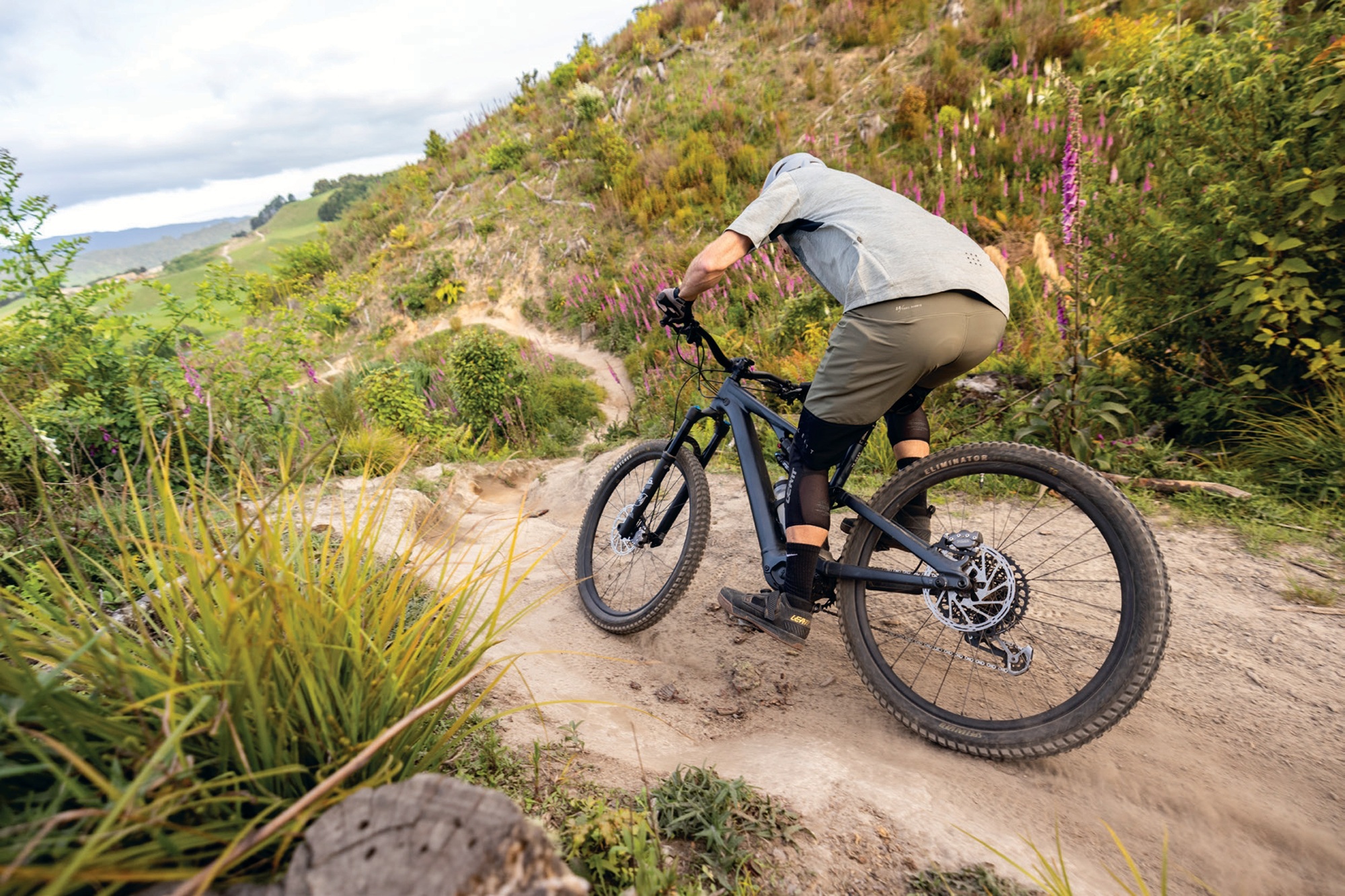
ReaFlex Hybrid UltraLite Knee Guards
Ever since a fateful day three years ago, I’ve worn knee pads of some description almost every time I’m on a bike. Late one afternoon, on a local trail I’d ridden a hundred times, probably more, my bike pitched over and fully committed to a corner. Halfway through the bend, the trail was freshly resurfaced with rotten rock and what was once a grippy turn I could blast through without a thought, was now a loose, jagged surface just waiting for some flesh. Unlucky for me, I was its victim. I had a nasty contaminant-filled gash in my knee, a scrub out at the hospital, a bunch of stitches followed by a few bags of IV antibiotics, and a few weeks off the bike in mid-summer, no less. I’d learned the lesson several times over the years, but this metaphorical straw broke the camel’s back and taught me once and for all. Knee pads are now a must-have on most rides.
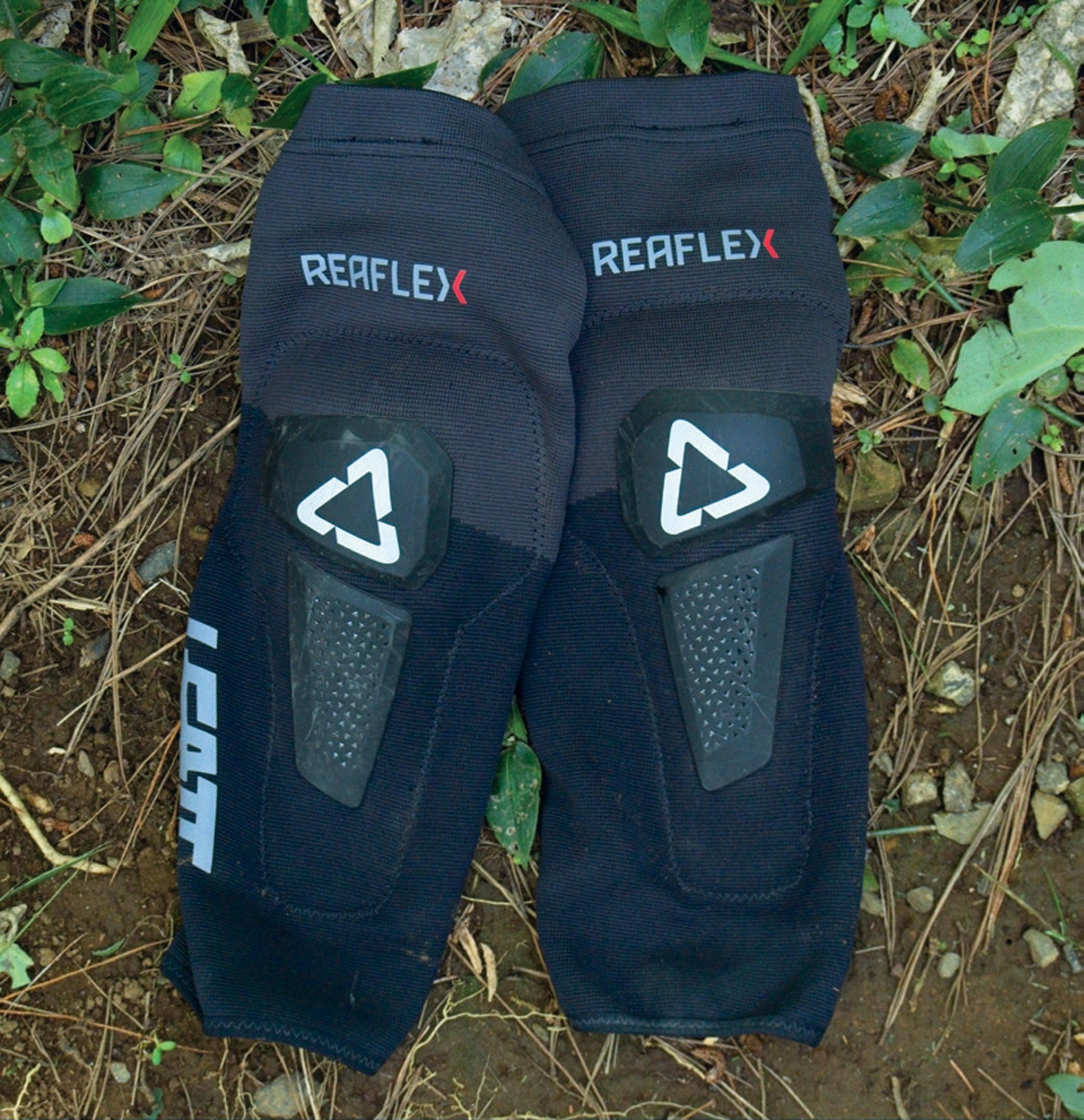
The Reaflex Hybrid UltraLite Knee Guards are slip-on knee protection, focused on protecting while out for a pedal, rather than a heavier focus on pure gravity with less pedalling. The guards meet a CE impact certification of one out of a possible two, meaning more protective guards are available, but these do the job as advertised. On the Leatt safety scale, these reach a score of 12 of a possible 25, putting them in the middle of the Leatt range.
The main fabric through the front two thirds of the guards is lightweight (although not as light as some) and sock-like, with a good amount of perforation to aid airflow. The rear third of the guard is ‘AirMesh’, a moisture-wicking, lightweight mesh that helps with breathability. The top cuff features a non-slip silicone printed grip to help keep them in place.
The main padding is provided by ‘ReaFlex impact gel’. It’s soft and pliable while pedalling, and hardens under impact. The outer layer has knee cap and upper shin protection, helping to distribute impact and deflect and slide during a crash.
Although Leatt sells these as “super slim and lightweight”, they’re a fraction bulkier than other “super slim” offerings. Still, the difference in bulk and the gnat’s hair of extra weight is simply because these guards offer more protection than others in this “super slim” category. The ReaFlex impact gel wraps around the knee cap a tad more than some other lightweight guards, although the actual sides of the knee don’t get any padding aside from the sleeve fabric. You’d want to step up to the ReaFlex UltraLite PRO Knee Guards to get this extra side protection.
As with other Leatt products, subtle details make a noticeable difference in the function of these guards. In this case, above the calf is a soft, rubber-backed strip incorporated into the rear mesh. Not only does this offer an element of reinforcement to the lightweight mesh, but it effectively grips above the calf and helps lock the guards in place, not only due to the friction of the rubber, but it works as a ‘cuff’ that sits on top of the wearer’s calf. It works well, and you’ll never know it’s there, although you’d know the difference if it wasn’t.
The fit is comfortable and cosy, and the stretch of the fabric provides an even tension down the entirety of the guards. They breathe well, and I’d put them on par with other similar guards I’ve used. They are not exceptional, but certainly better than heavier weight, bulkier knee pads. Compared to my knobbly knees, I’ve got large calves and quads; even with my lumps and bumps, the guards are comfortable, and there is no pinching, bunching or tight spots while pedalling. My slightly abnormal leg shape (I jest) means the top cuff on all knee pads slides down a little while riding, eventually finding a spot lower down my thigh than I’d like; these ReaFlex’s are no different. They fit fine and work as they should but, like the rest, the cuff ends up lower than I’d like, and there’s no magic sauce to keep them where they should ideally be. My solution is to tuck the cuff of the guards under a liner short leg to keep everything in place.
With five sizes on offer, from small to double- extra-large, there should be a size to suit everyone. A quick measure-up and comparison to Leatt’s size chart gives prospective buyers confidence in their choice.
I rate the Hybrid UltraLite Knee Guards as a level up from most other lightweight offerings. The fit is spot-on and comfortable. There’s an excellent level of protection on offer, considering how light they are, and the outer shells add an extra element of protection that most lightweight guards don’t have.
Enduro 2.0 Convertible Helmet
Protecting your body begins at the top. If your head takes a bad enough impact, it doesn’t matter how unharmed the rest of you may be; without a functional brain, you’ll be on the sidelines while your buddies are out enjoying their rides. As concussion becomes a more widely talked about subject, and awareness is at an all-time high, people are taking more interest in what their helmet offers regarding protection. Rather than settling for something that passes a minimum safety standard, many of us are now looking for something that surpasses standards, offering the maximum protection, not just a sticker that says it’s safe enough. Never has there been a more important reason to invest in your head than if you’re riding an eMTB. With a bike that weighs over 20kg, and often up to 30kg, you sure want to ensure your head and face are well protected in case that big rig lands on you.
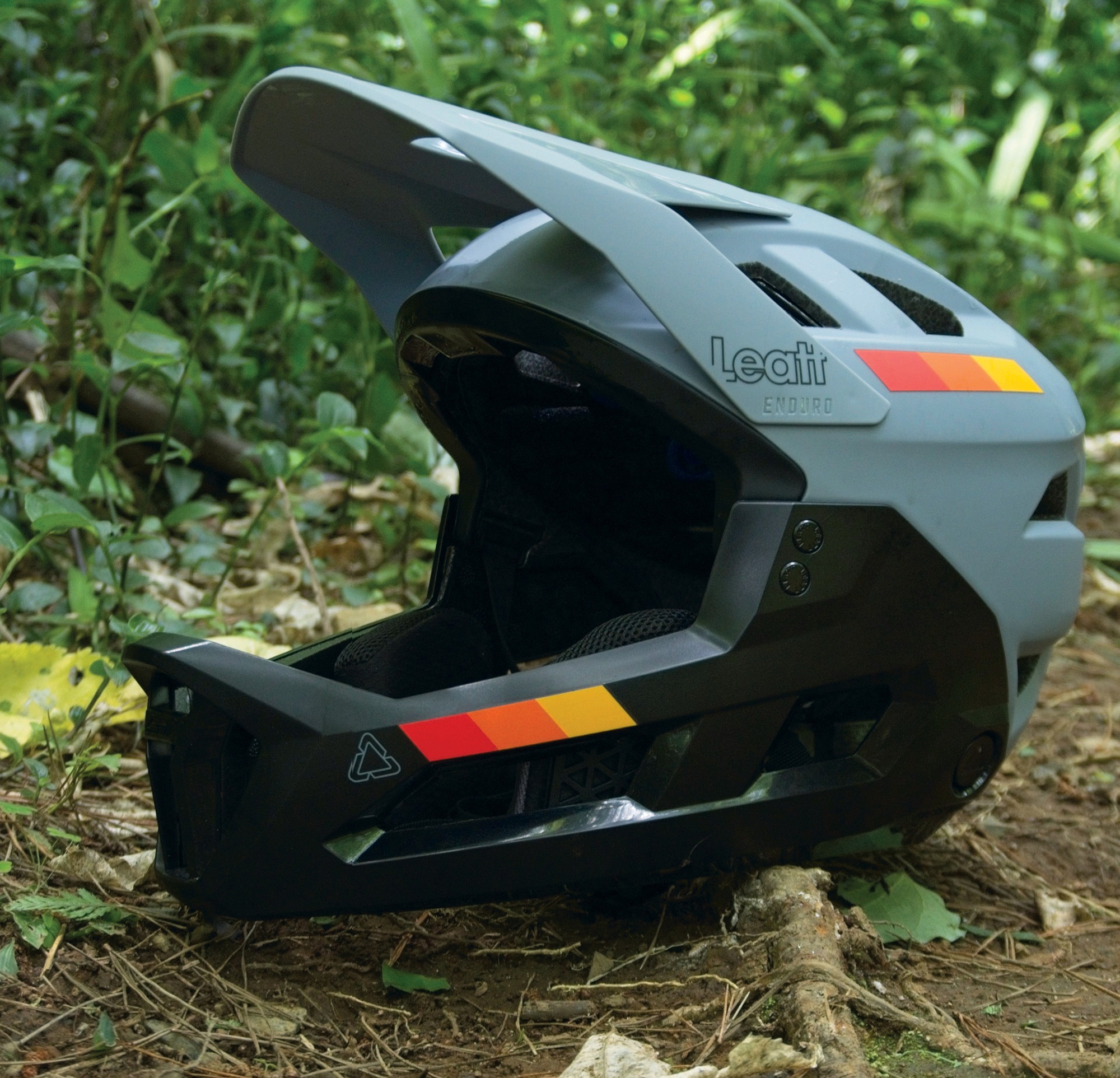
Full-face helmets have their place but don’t suit every scenario, trail system or ride. Enter the Leatt Enduro 2.0 convertible—a versatile helmet designed to cover all bases from cruisy rollers in open-face mode to gnarly steeps with the chin bar attached. The Enduro 2.0 is at home in most situations—it’s up to you how you dress it; chin bar on, or off.
The main helmet comprises a lightweight polymer shell with Leatt’s patented 360° Turbine Technology fitted (more on that in a bit). Securing the helmet firmly in place is a FidLock buckle and a classic ratcheted dial adjuster on the back, with three vertical positions to get the fit just right.
The 360° Turbine Technology is a crucial technology across Leatt’s helmet line. It’s a group of small disc-shaped rubber ‘turbines’ that twist and compress to decrease peak brain acceleration by up to a claimed 30% at impact speeds associated with concussion, and to reduce peak brain rotational acceleration by up to 40%.
The peak is adjustable and suits the overall styling of the helmet. There’s enough vertical adjustment to put it in the highest setting and have your goggles on your forehead for a climb if that’s how you roll. The visor will break away if you clip it on a low-hanging branch or during a rag-doll of a crash, popping off to save torsional forces being transmitted to your head and neck; safety first, safety second.
The shell has 20 vents to keep the draft flowing and, even at slow speeds, I’ve been impressed with how well it breathes. Strategically placed rear vents double as a sunglasses dock and do their job as they should.
The chin bar is simple to remove and refit with a button on either side just below the ears. Firmly press the button on each side and the chin bar releases. Reverse the process to re-fit it while ensuring the two locators up by the temples line up correctly, and Bob’s your uncle. The chin bar passes ASTM impact testing, offering confidence that it’s up to the task. It’s a sturdy system and is firm once in place, integrating exceptionally with the main helmet, offering some comfort that it will stay put in a crash and protect your face.
Putting the helmet on once the chin bar is in place is noisy. A lot of creaking comes from the junction between the helmet and the chin bar. Fortunately, once the helmet is on, the noise disappears, although it was pretty disconcerting the first time I put it on!
Given the extra engineering and structure required to incorporate the removal mechanism and chin bar safely, the Enduro 2.0 in open-face mode is a touch heavier than regular open-face helmets at 409g in a medium size. The chin bar itself doesn’t weigh much at all at 245g and, once fitted and in full-face mode, the helmet’s complete setup weighs 654g, putting it at the lighter end of convertible helmets.
The Enduro 2.0 is comfy on my head, and the padding is quite thick compared to similar helmets. There are no hard points anywhere, and the overall shell looks normal when worn; no giant mushroom here. Before wearing it, I thought the Turbines might touch my head while riding, but I haven’t noticed this. This helmet gets a big tick on the comfort front. As with anything fit-related, different head shapes suit different helmets, so I’d recommend trying before you buy or at least checking returns policies when purchasing online.
When it comes to testing the actual safety of the Enduro 2.0, alongside the legal safety standards they meet, I can only rely on Leatt’s testing and their force reduction claims; some heady statistics proved not only in Leatt’s research lab but also by people I’ve met who have firsthand experience with the safety of Leatt helmets.
I’d recommend the Leatt Enduro 2.0 convertible helmet to anyone doing all sorts of riding, perhaps travelling to unfamiliar areas to ride and not sure what to expect. You’ll have the right helmet for the task wherever you end up. If your riding crew decide to do a lengthy trail ride: Chin bar off and open-face mode. A last-minute decision to punch out shuttled laps? Chin bar on and full-face mode engaged. For eMTB riders, adding a chin bar is an absolute no-brainer, but there’s still the versatility to run the helmet without the chin bar for a cruisy lap with the kids or a nip to the shops.
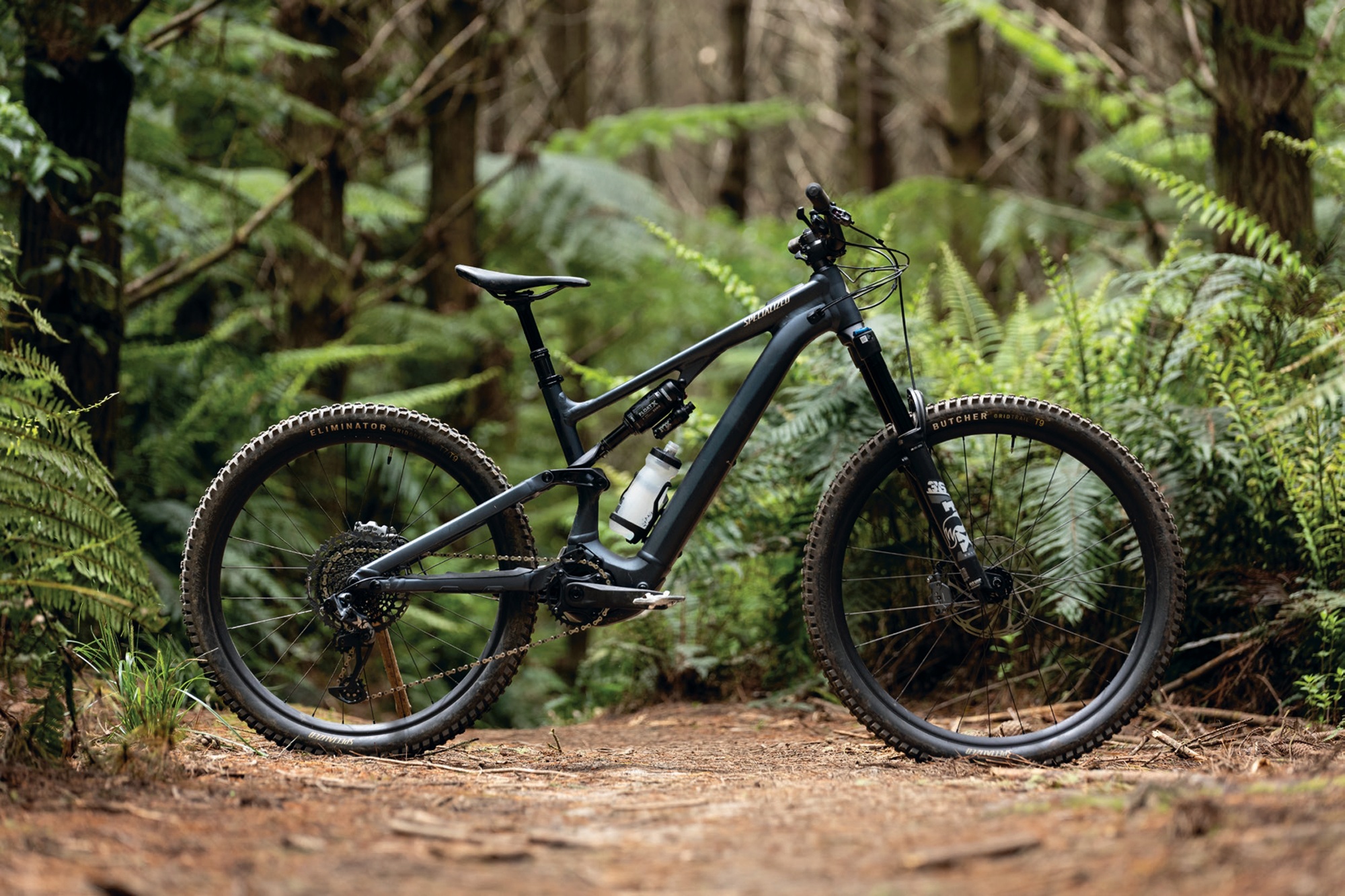
Specialized Levo SL Comp Alloy
Words Lester Perry
Images Jamie Fox
RRP $11,500
Distributor Specialized NZ
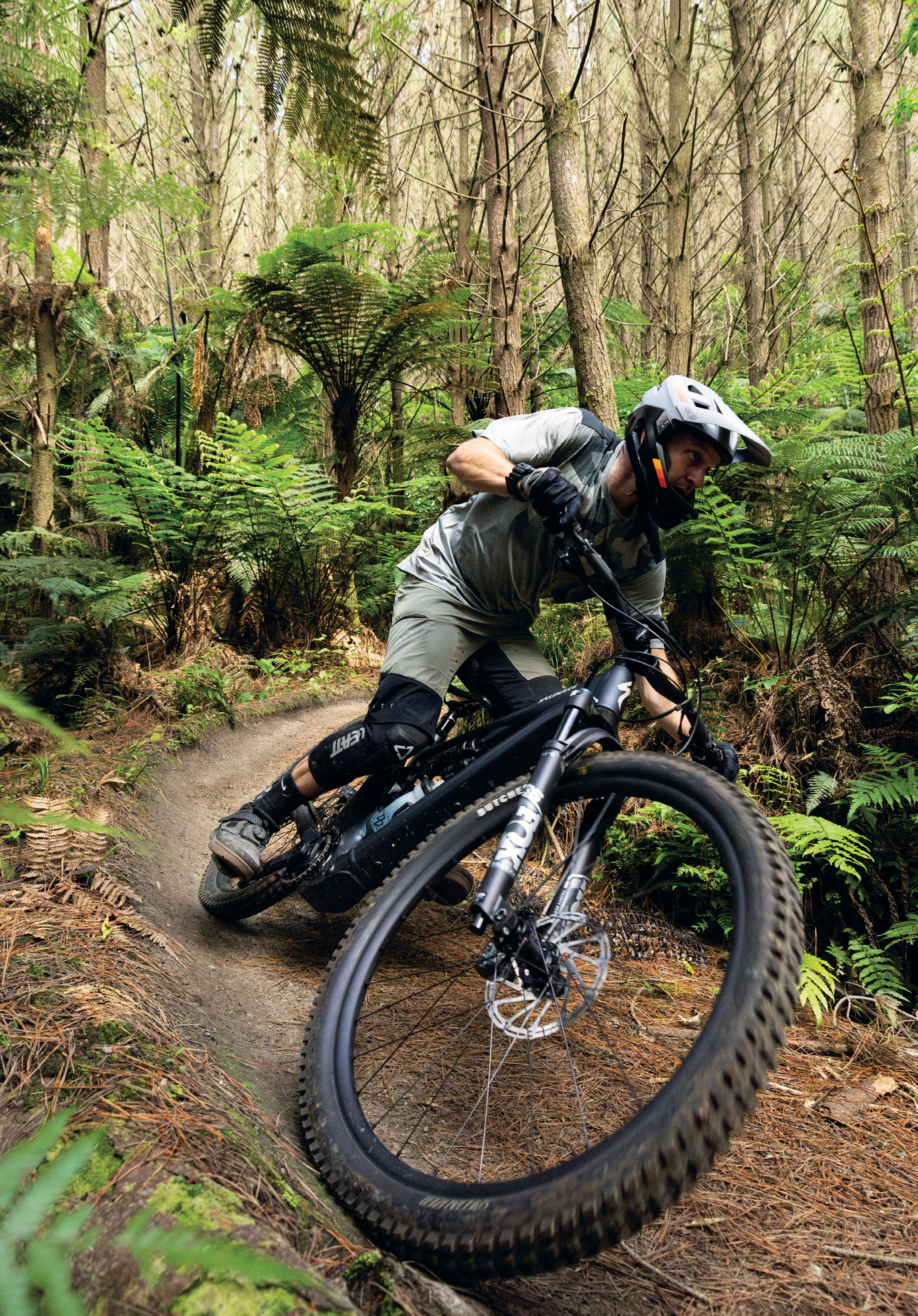
The Specialized Turbo Levo SL debuted in 2020. With its discreetly integrated battery and motor system, it looked more “normal” than the competition’s eBikes at the time. The Levo SL set the standard for eMTB aesthetics and was a lighter, more agile alternative to the standard Turbo Levo, Specialized’s full-powered bike that launched five years earlier.
Now in its second generation, we’ve seen an evolution in suspension, updated geometry and improved motor efficiency. I’ve spent roughly two months with this bike, changing its many adjustments and razzing it around my local—and some not-so-local—trails.
Chassis
The SL2 Comp Alloy is the gateway into the SL lineup. With its alloy frame, it’s what I’d call the heavyweight of the SL range; the frame comes in at a kilo heavier than the carbon equivalent, so although there’s not a vast difference between the two, a kilo is a kilo. Considering the motor and battery are identical to those of its higher-end carbon brothers, the Comp Alloy would be an excellent platform for future upgrades; decreasing its weight (although not by a drastic amount) and adding to the overall ride experience with better components.
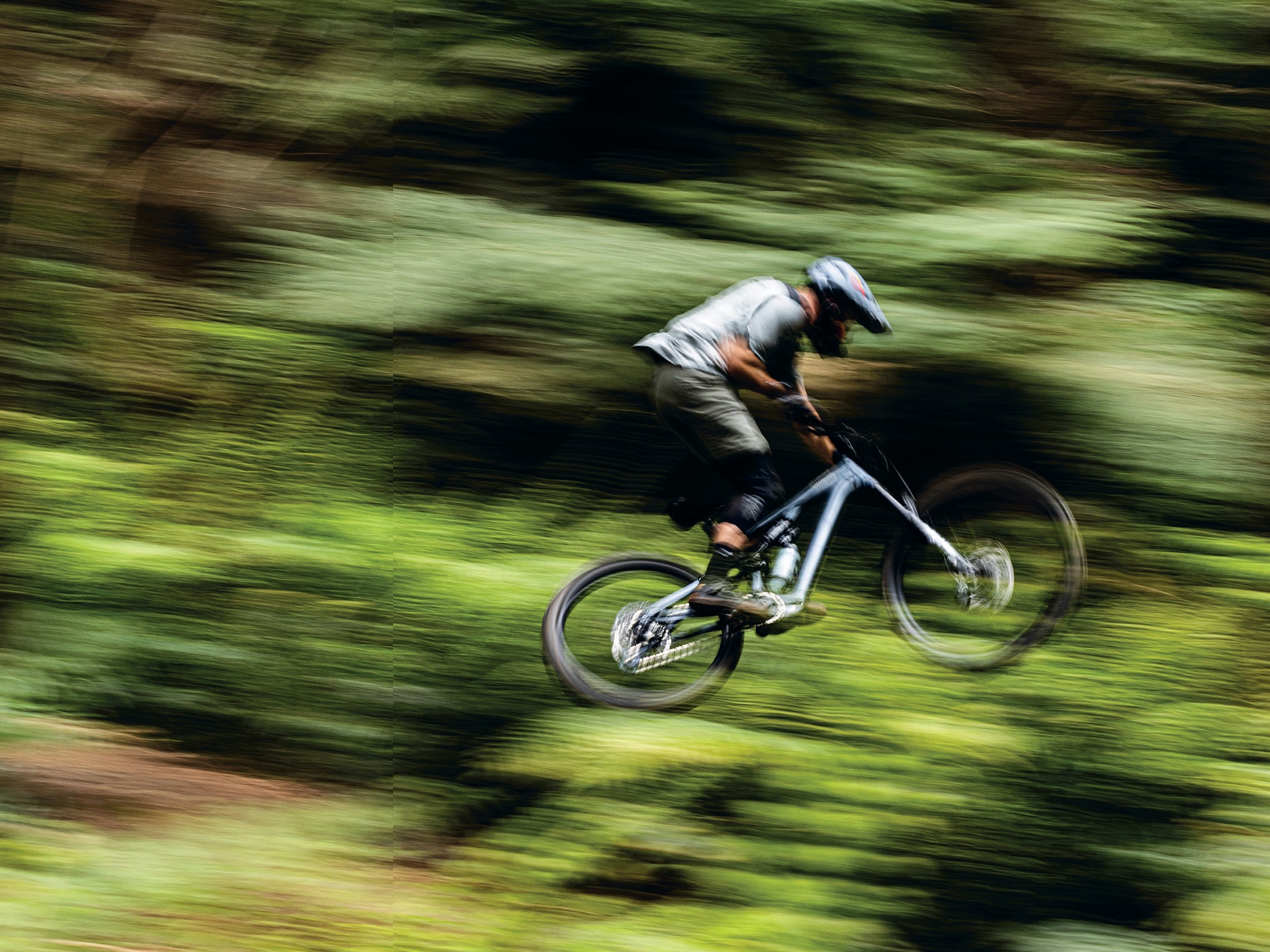
With a 160mm front suspension fork and 150mm travel in the rear, the Levo SL2 strikes a healthy balance of brawn and butterfly. There’s enough travel and the geometry is designed to not hold you back on the nastiest of descents, yet the bike is light and nimble enough to pick your way through tech, rapidly change direction, and even bunny hop or manual through sections with surprising ease.
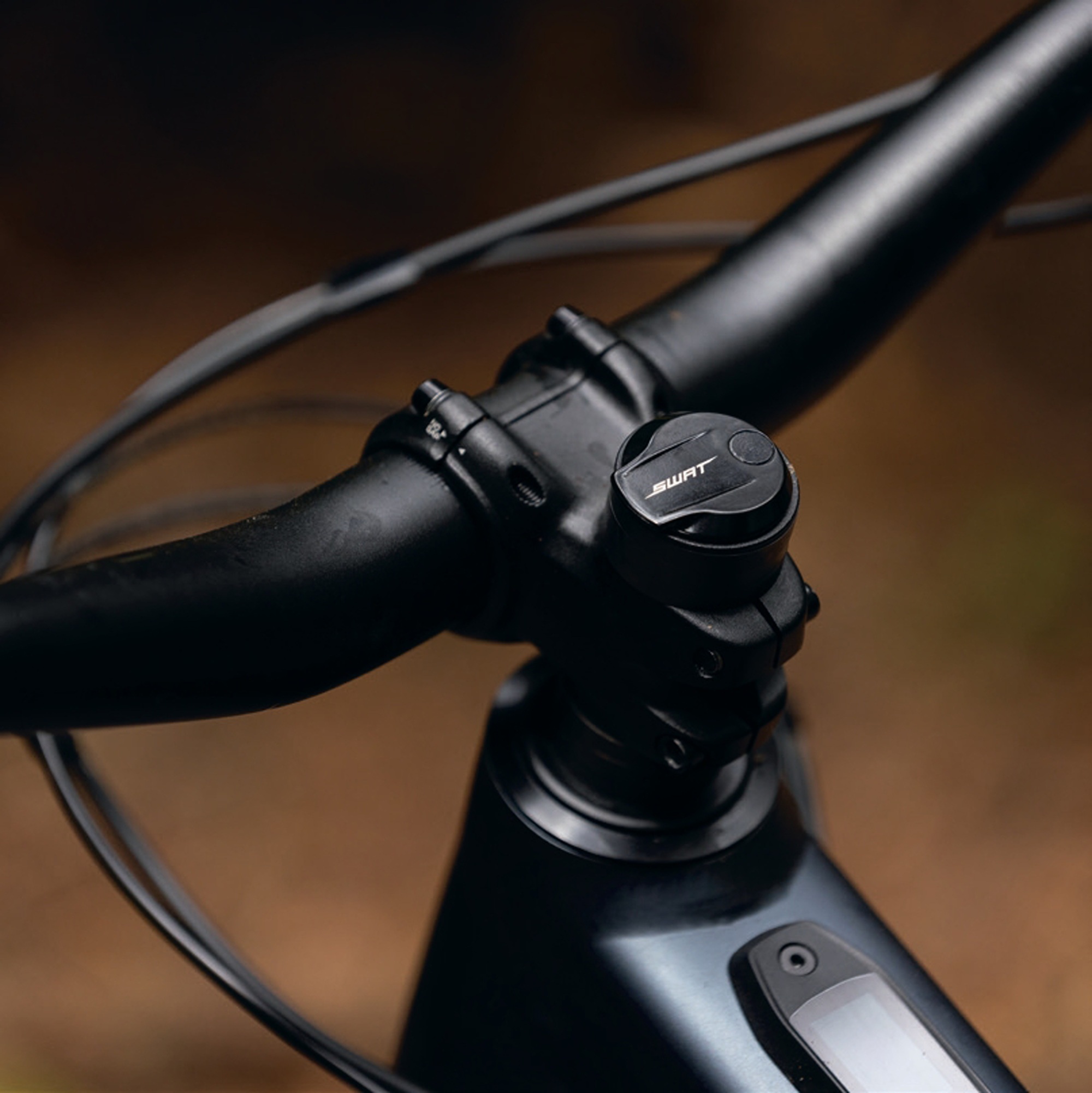
This bike could be viewed as a couple of different bikes, able to be configured in a number of ways thanks to the breadth of adjustment available: the head angle is adjustable between 63 degrees (slack), 64 (stock), and 65 (steep). Adjusting this is almost as easy as replacing a headset bearing; remove the stem, headset top cap, compression ring and bearing, and lift out the upper headset cup. No tools are required. Drop in the supplied ‘adjustment’ headset cup; depending on its orientation, you’ll either get down to 63 degrees or up to 65.5 degrees. Refit the headset components—and job done. There’s no need to touch the lower headset cup at all.
The bike has a mullet wheel configuration, a 29-inch wheel up front, and a 25.7-inch out the back. Thanks to a flip chip on the Horst pivot (near the dropouts) that lengthens the chainstays by 10mm, the rear wheel can be swapped out for a 29-inch if you want more roll-over capability without nuking the machine’s handling. The bottom bracket is adjustable to a minor degree by flipping its off-centre lower shock mounting hardware and raising the bottom bracket by 5mm from stock. It’s a scant amount but will offer a smidge more clearance for the pedals and motor housing over technical terrain, although I haven’t found this to be needed in the stock ‘low’ setting. It’s worth noting that each adjustment made will affect all geometry numbers. Specialized have a chart in the manual explaining what the numbers look like with different adjustment configurations.
I toyed with the head angle a little, riding with it in the stock 64 degrees to begin with, then in the steeper 65 degree setting. The stock 64 degree setting was a good middle ground for most trails, although it felt a fraction slacker than ideal on flat or mellow trails. So, I fitted the adjuster cup, setting it to 65 degrees. The one-degree steeper head angle increased the manoeuvrability on anything mellow and tight, but it wasn’t as stable on choppy descents. I never felt the need to slacken the bike to 63 degrees, but if I were headed somewhere to ride steeper, faster trails, say Queenstown or Nelson, the slacker setting would be ideal. The stock 64 degrees seems to be the perfect middle ground for general riding.
Given all the adjustment options, this bike can adapt to optimally align with your riding style and the trails you ride.


Genie Shock
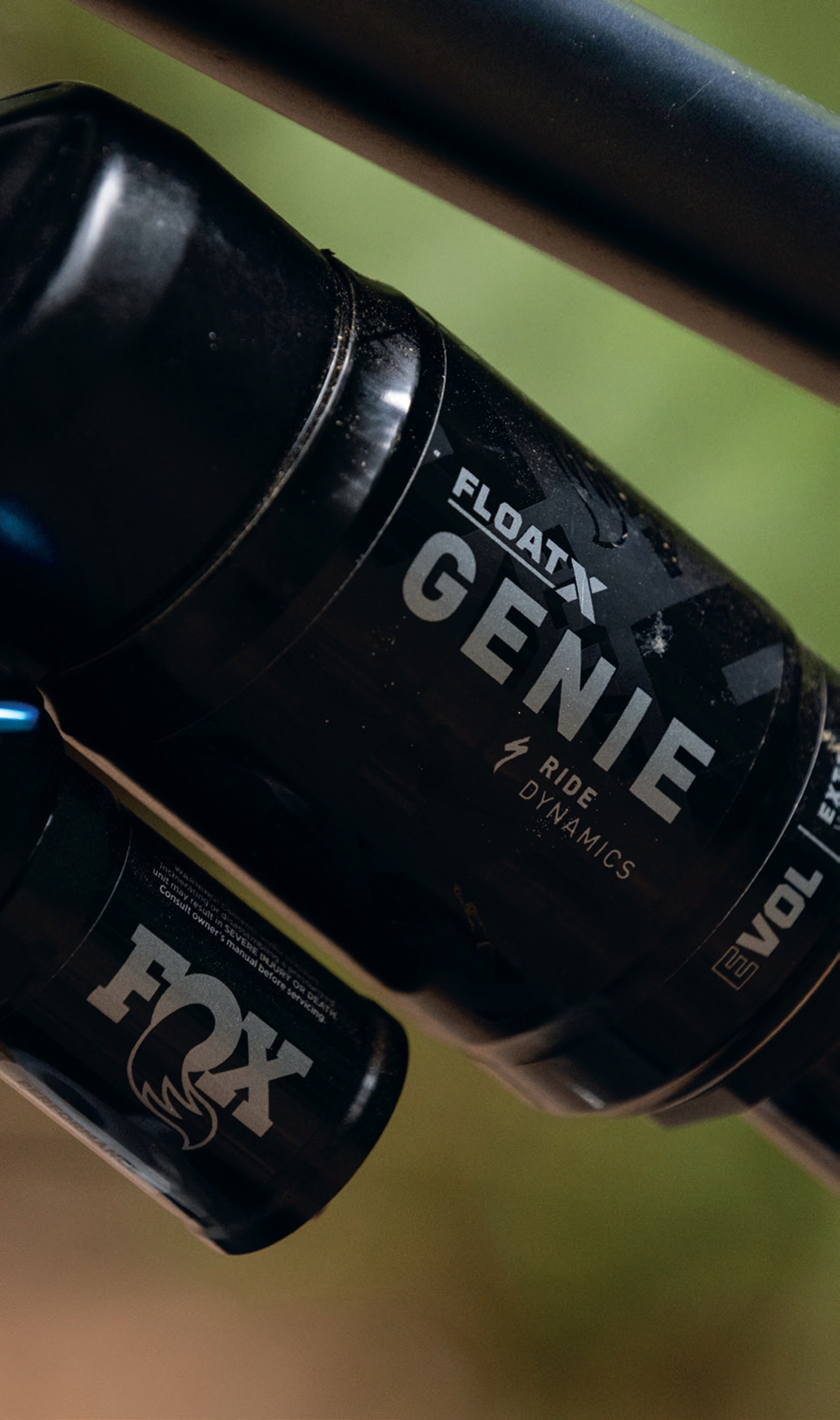
This latest iteration of the Levo SL features the Specialized developed, Fox-manufactured, Genie shock. This unit launched to fame on the latest Specialized Stumpjumper, claiming a coil-like feel and a tuneable mid- and end-stroke.
By making the main air spring larger, they’ve enabled the shock to maintain small bump sensitivity and relatively linear progressivity through the first 70% of its stroke. With 30% of the stroke remaining, the shock closes off most of the total air volume, essentially creating a smaller volume air spring active for the end of the stroke, causing a much steeper ramp-up and drastically increasing bottom-out resistance. On a bog standard air shock, in most cases (depending on the bike design), you sacrifice small to medium bump compliance and sensitivity to achieve decent bottom-out resistance, and vice versa. Bottom-outs increase once you soften the shock in a quest for buttery small bump and mid-stroke sensitivity. The Genie manages to deliver small bump sensitivity while maintaining super end- stroke ramp-up, and bottom-out resistance.
After my first ride on the Genie, I was amazed at how linear the shock felt, and it certainly delivered on the coil-like claims with a buttery smoothness. Although it performed well, I wanted a bit more support to push against while pumping and jumping, and felt it was moving through more travel than was necessary, causing it to wallow at times. Mid-stroke tuneability is in the shape of plastic volume bands fitted in the air can, much like many other shocks. They’re simple to fit and equally easy to remove. Let all the air out of the shock, pick off the snap ring that holds the air can on, slide it back, snap the two halves of a volume spacer together over the shock body, slide the air can back into place, refit the snap ring, air it up and hit the trails—all you need is a small pick—or in my case, a tiny screwdriver from my son’s tool kit that worked as one—a shock pump and five minutes.
Once I slid the air can off, there were no bands to be found, which explained the overly linear feel. I fitted three bands of a possible four, aired back up to 33% sag, and confirmed my choice with some front-yard testing. It wasn’t until I hit the trail that the extra support really brought the bike to life, increasing how playful and lively the bike was on the track.
The end-stroke is also tuneable by adding circular chips to the shock’s interior air chamber. It’s a slightly more involved procedure, but it can still be done without removing the shock from the bike. The end-stroke ramp up and bottom-out resistance was fine for me in its stock setup, so I didn’t change anything here.
Once dialled in, the shock performed like the literal magic carpet Specialized intended. Thanks to the Genie’s effectively softer-than- normal spring rate early in the stroke, the small bump sensitivity was impressive, and there’s an amazing amount of traction on offer, it’s really noticeable how well the rear wheel tracks across bumps while pushing through a rough section or corner, compared to many other bikes.
Spec highlights
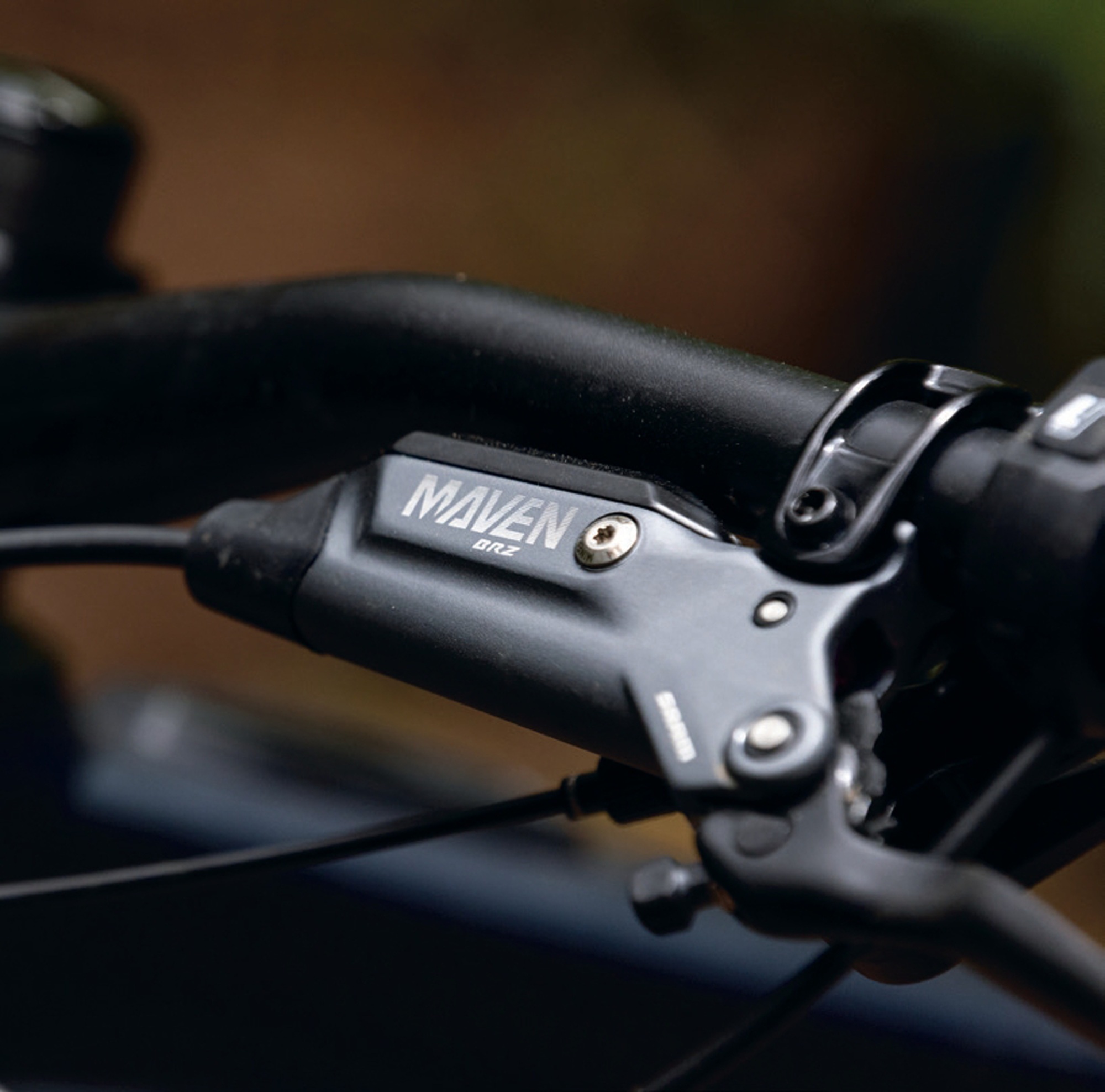
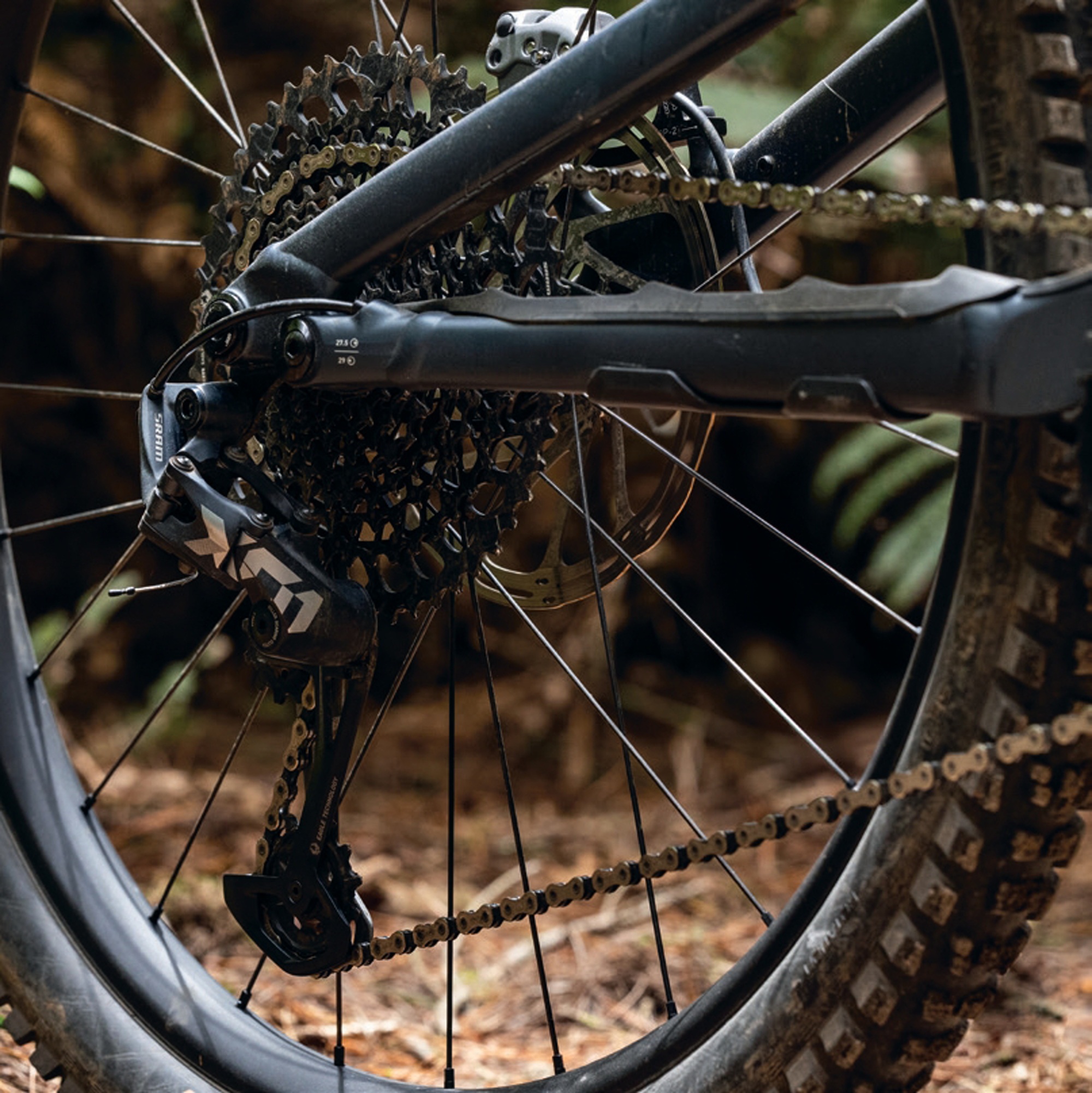
Fork: Fox Float 36 Rhythm | grip damper 160mm travel. The fork is stout enough to handle the heft of the bike, and did an adequate job, but could benefit from better damping and adjustment. A worthy upgrade, or step up through the SL range to get these benefits. Brakes: SRAM Maven bronze | 200/200mm rotors. Mavens get the big tick from me, the power and consistency are amazing and they add a level of confidence to an eBike that I don’t think can be gained by any other single component. Drivetrain: SRAM GX eagle shifter, chain and cassette, coupled with a SRAM X01 derailleur. Does the job admirably. Once it eventually wears out, I’d replace this with a SRAM T-type system as it’s far superior on an eBike.
Crankset: SRAM S1000, 165mm length. Short cranks are the best on eBikes, and 165mm is a great choice.
Wheels: In-house Specialized alloy rimmed set. They do the trick but, considering that the bike had hardly any use when it turned up but the rear wheel already had a small flat spot in it, I’d say that much like many OEM specced alloy wheels, these rims are on the softer side.
Tyres: Front—Specialized Butcher | grid trail casing | gripton t9. Rear—Specialized eliminator | grid gravity casing | gripton t9/t7. No complaints here. Reality is that, with the extra weight of an eBike, most tyres perform pretty well. Good to see a heavier Gravity casing specced on the rear, although with their softer compounds, the square edges are worn from the knobs quite quickly.
Cockpit: We get some plain Jane—but effective—alloy parts here. The handlebar has 20mm rise and a comfortable shape—no real complaints, but an easy place to upgrade.
Seatpost: X-fusion manic 170mm. This post fits the price point well, there’s no noticeable play in the post and it’s nice and smooth, but the return is a bit slower than ideal.
Motor unit
At the heart of the Levo SL2 is the new SL 1.2 motor, Specialized’s latest—and a noticeable improvement on the previous SL 1.1 generation. It offers a quieter, more natural-feeling ride, delivering 50Nm of torque, up from 35Nm previously, with 320 watts of power. Although there’s enough power and torque to get you through most scenarios, the light weight comes with the feeling that the motor is not doing all the work, you’ve got to play your part too.
The SL2 has a 320Wh battery, and a 160Wh extender is available. The SL series bikes are lightweight in all aspects of the driveline, compared to the standard non-SL Turbo Levo models, which are powered by the Specialized 2.2 motor pushing 90Nm, with a 700Wh battery. The range extender can also be used on the full-powered bikes.
The burning question everyone has regarding eMTBs is; “how long does the battery last?” The answer inevitably is always; “it depends”. There are so many variables at play that it’s hard to compare even the same bike between riders, let alone different riders on different bikes. I’ll put a stake in the ground, though, and you can make some assumptions from there. Fully kitted, I’m pretty well bang on 80kgs, and my local trails are either up or down; there’s a minimal amount of flat ground, so I’m either climbing or descending.
The climbs are pretty steep, and there’s sporadic pedalling down most of the descents. On a ride where I used Turbo most of the time while climbing the gravel road climbs (some very steep) and Trail mode everywhere else, I can get 1:45 to two hours out of the battery. The variance in time is solely down to how hard I’m riding; a solid, fast pace, and I’m looking in the vicinity of 1:45, but a little less effort on the climbs and I can get to two hours. On the same ride, if I backed the assistance down and asked a bit more of my legs, 2.5 hours or three at a stretch, may be attainable. For rides made up predominantly of flat sections, if I stuck to Eco mode, I think I could hit the 3.5 hours Specialized claim is achievable. The truth is, though, I don’t want to ride like that, so I budget my rides at 1:45 hours ride time and go from there. Once the battery is down to 10% charge, the bike will slide into Eco mode to help you limp home.
The power delivery is very natural; there are no surprises or sudden accelerations, and the motor simply does what it should and multiplies your power with a smooth ‘acoustic bike’ feel. There is a slight lag when initially putting effort into it, and this took a little time to adjust to, but I soon adapted to it. The SL1.2 motor rewards a cadence of around 75-90rpm for those looking to get the most out of each pedal stroke, so if you’re one to rely on the torque of a motor to get up a pinch, rather than shifting to a lower gear—this bike’s not for you.
Mission Control App
I didn’t faff with the app too much; I just synced up my phone with the bike, pushed some assistance settings to ‘max’ and got stuck in. I wanted to ride this like a standard bike and not get bogged down with tweaking, tuning and apps. It’s nice to have the ability to fine-tune assistance levels simply, and if a user wanted to maximise battery efficiency, one could nerd out with the settings. Software updates for the bike are done via a connected app, no need for cables.
MasterMind TCU
An upgrade over the SL gen 1 is the use of the MasterMind TCU (Turbo Control Unit). The screen is seamlessly integrated into the top tube and comfortably readable at a glance. Modes and screens on the TCU are controlled via the simple-to-use handlebar remote. It’s a nice touch to be able to micro-adjust through assistance levels in 10% increments if you want to get specific assistance while out on the trail, rather than relying on the pre-programmed three settings.
The ride
The Levo SL2 is the first lightweight, low-powered eBike I’ve ridden. So, my observations are compared to full-powered eMTBs and regular old pedal bikes.
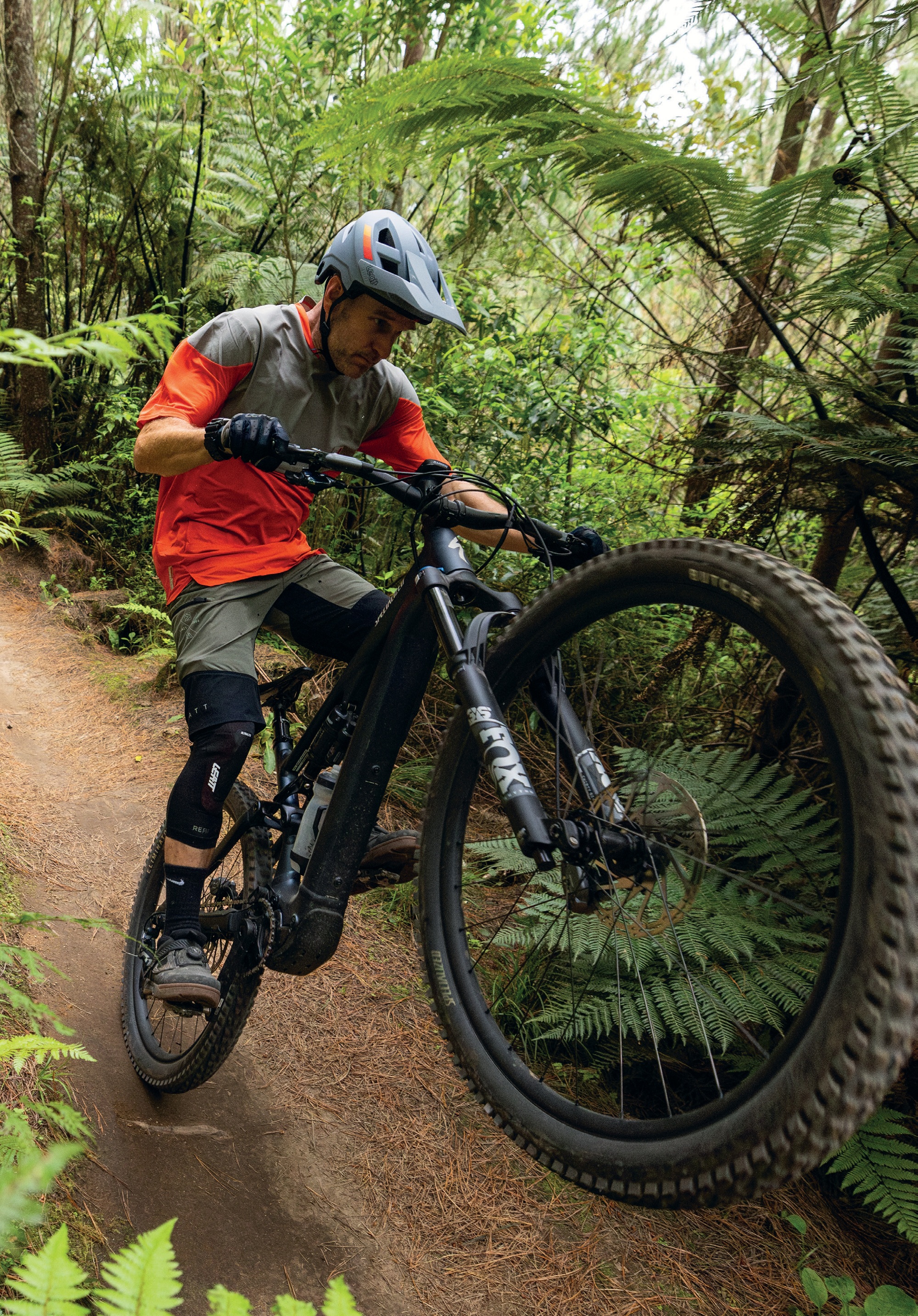
Taking the SL2 for its first ride, my immediate thought was; ‘damn, this actually handles like a normal bike!’ My main gripe with full power bikes in the past has been that they don’t suit my riding style, they’re fun in their own way, but their weight means they’re more like a cruise liner than a jet boat… and it’s a jet boat I want! Precise, nimble, manoeuvrable, responsive, confident and playful are the current acoustic bike marketing buzzwords, I guess. Unfortunately, most of these boxes can’t be ticked on a full- power, full-weight eBike – as mentioned, their characteristics align closer with the cruise liner.
Descending on the SL2 takes the best from an acoustic experience and couples it with the best from an eMTB. The SL2’s higher weight than a normal bike combined with its capable suspension gives insane stability and predictability while descending but, being lighter than a full-powered eBike, combined with its balanced geometry, means it’s drastically nimbler and more precise down a hill than its overweight brethren. The ability to change lines and unweight through sections really sets this lightweight bike apart.
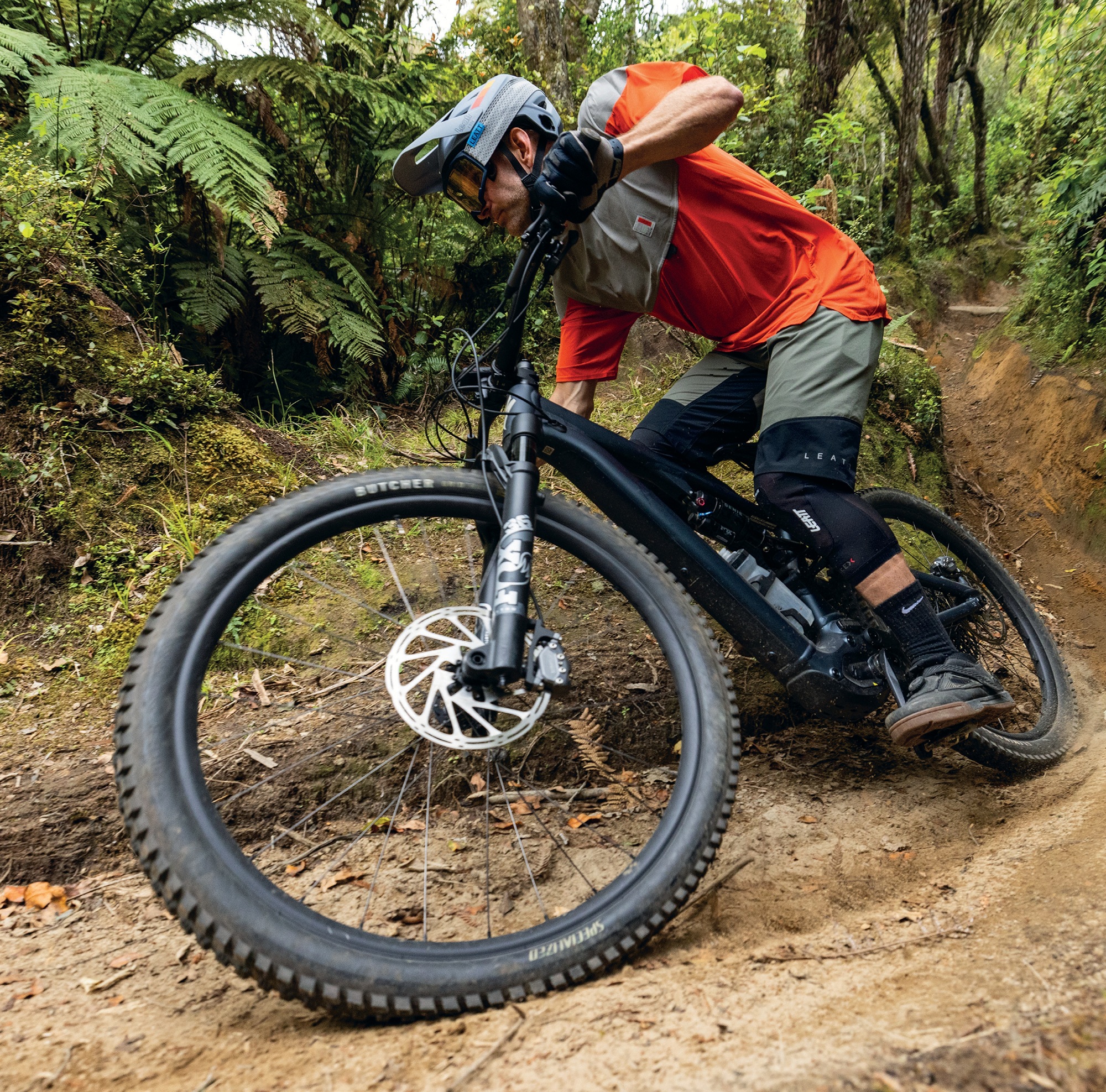
The more I rode the SL2, the more I was amazed at how well it corners. I didn’t need to change any components or make any adjustments at all to make it perform; I just got on and rode. Even in its stock setup, it handles turns exceptionally. Balanced geometry is a piece of the turn- shredding puzzle, and so too is the lower centre of gravity of an eMTB, but the traction on offer sure makes a difference, too; part of this will be thanks to the weight of the bike (over an acoustic one), but the suspension is up to the task. The SL2 is a leap above any other eBike I’ve thrown a leg over in the cornering department, and it is better than some trail bikes I’ve reviewed.
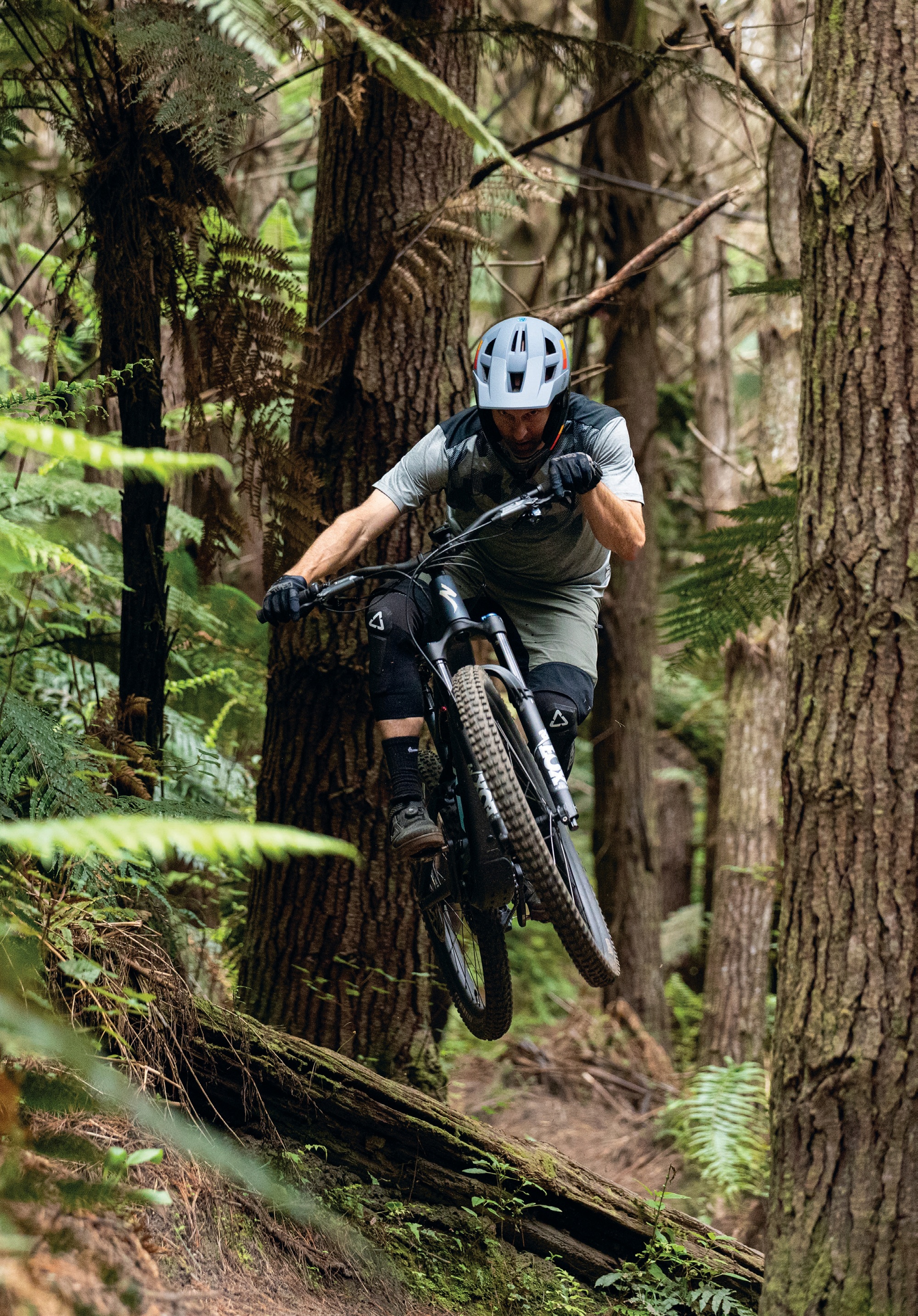
Jumping on the SL2 is great, and surprisingly so. The weight is nice and balanced, and it is predictable taking off everything from lumps and bumps to larger, steeper lips.
The bike cruises along flat trails where there’s no need for high power similar to a full-fat one, just more nimbly and playfully, not weighed down by additional motor or battery heft.
Compared to high-powered eMTBs, the SL2 didn’t give me superpowers to tackle super steep climbs—you know, the ones where you can barely keep the front wheel on the ground, even with your weight right over the front. Instead, the SL2 meant I could make it further up super steep pitches than I would on a trail bike, before I ran out of steam but, unlike a full-powered bike, I definitely felt like I needed to use my own strength, rather than just chopping into Boost mode and have the bike ‘pull’ me up the hill.
Without the power, torque or battery capacity of a full-fat eMTB, the SL2 still takes some effort to ride, and I found I can still get a similar workout to a regular bike while riding it, just covering more ground and not blowing myself up to maintain higher speeds. Riding a full-powered eBike I find I’m still getting a decent cardio workout, and it’s quite normal to be sitting up at high heart rates for long periods, but most of the time (unless I’m sitting in Eco mode), it feels like there’s not much leg strength necessary. The SL2 hits a sweet spot and, thanks to coupling it to my Garmin, I could see my own power input and proof that I was pushing similar watts to a normal bike, just going faster for them.
The SL2 let me ride how I like to ride. It’s light enough to be playful, but hefty enough to offer the composure and stability only extra weight can give while descending. Until this bike, I wouldn’t have considered owning an eBike as my only mountain bike but, after a couple of months aboard the Levo SL2, I may have found the bike that would make me switch sides.
Riding into Consciousness
Words Liam Friary
Image Cameron Mackenzie
I am often caught between the want—or rather, need—to ride and the constant chatter inside my head telling me to be available, productive and hustling. The latter serves me well in getting things done; respond to notifications and publish this here magazine on a deadline. However, in between these moments I need to find peace without the constant distraction and that’s when pedalling in the woods comes to the fore. This time need not be long but it’s restorative, and it allows me to jump back into said task with good mood and plenty of energy. You’d think this would settle the debate in my head about whether I should go for a ride or not but, sometimes, I still need to convince myself it’s the best idea.
Summer offers long days, great weather, family time, holidays and (hopefully for you!) some respite from normality! To celebrate, head out for a long challenging ride. For me, these types of ride serve as a metaphor for life’s journey; teaching us valuable lessons about perseverance, self-reliance, and the beauty of slow progress. It’s a far cry from the everything-at-pace mentality that the modern age demands of us. As we climb steep hills and descend tricky terrain, we’re forced to confront our limitations and push beyond them. These moments of struggle and triumph on the bike often lead to profound self-discovery and a deeper appreciation for our own resilience.
Perhaps most importantly, riding offers a much-needed escape from the relentless pace of modern life. We are so much more than sedentary beings scrolling on our phones and working away at laptops. In a world dominated by constant connectivity and instant gratification, the simple act of riding a bike allows us to disconnect and reconnect—with ourselves, with nature, and with the fundamental joy of human-powered movement. As we pedal through diverse landscapes, from urban streets to dense bush, we’re reminded of the beauty and vastness of our world—and our place within it. This shift in perspective can be profoundly rejuvenating, helping us return to our daily lives with renewed energy, clarity, and a heightened sense of what truly matters.
It’s not about the bike
Words & llustration Gary Sullivan
This week I completed an experiment. It wasn’t scientific and it proves nothing, yet I still think the result is worth sharing.
The weather has been iffy. In the first instalment of the experiment, I rode a thing called the Forest Loop on my Surly Krampus.
The Forest Loop is a thing that has been developed in my home town of Rotorua which gives more or less anybody a decent serve of the splendours of the location without being particularly challenging. It is what we call Grade 2 which, around here, means a metre wide path with very few roots or rocks, no drop-offs or anything very steep, and pretty well weather proof. It provides a nice view of three lakes, a variety of forest and 34 kilometres of rolling trail. There are countless ways to adjust the route for personal preference, but the official version is very well signposted so it would be difficult to get lost. It serves two useful purposes for me. Firstly, any newcomers to town who want a ride, can be sent on it. Before the Forest Loop, it was almost impossible to send an initiate into the woods without a guide. Maps are useful, but Whakarewarewa is a complex place. Now, it is simple – just follow the signs. The second benefit for me, is that it provides a good outing when it’s too wet to go into the rest of the trails.
When it’s raining, but I want to rack up some kilometres, the Forest Loop is a good, tried and true choice.
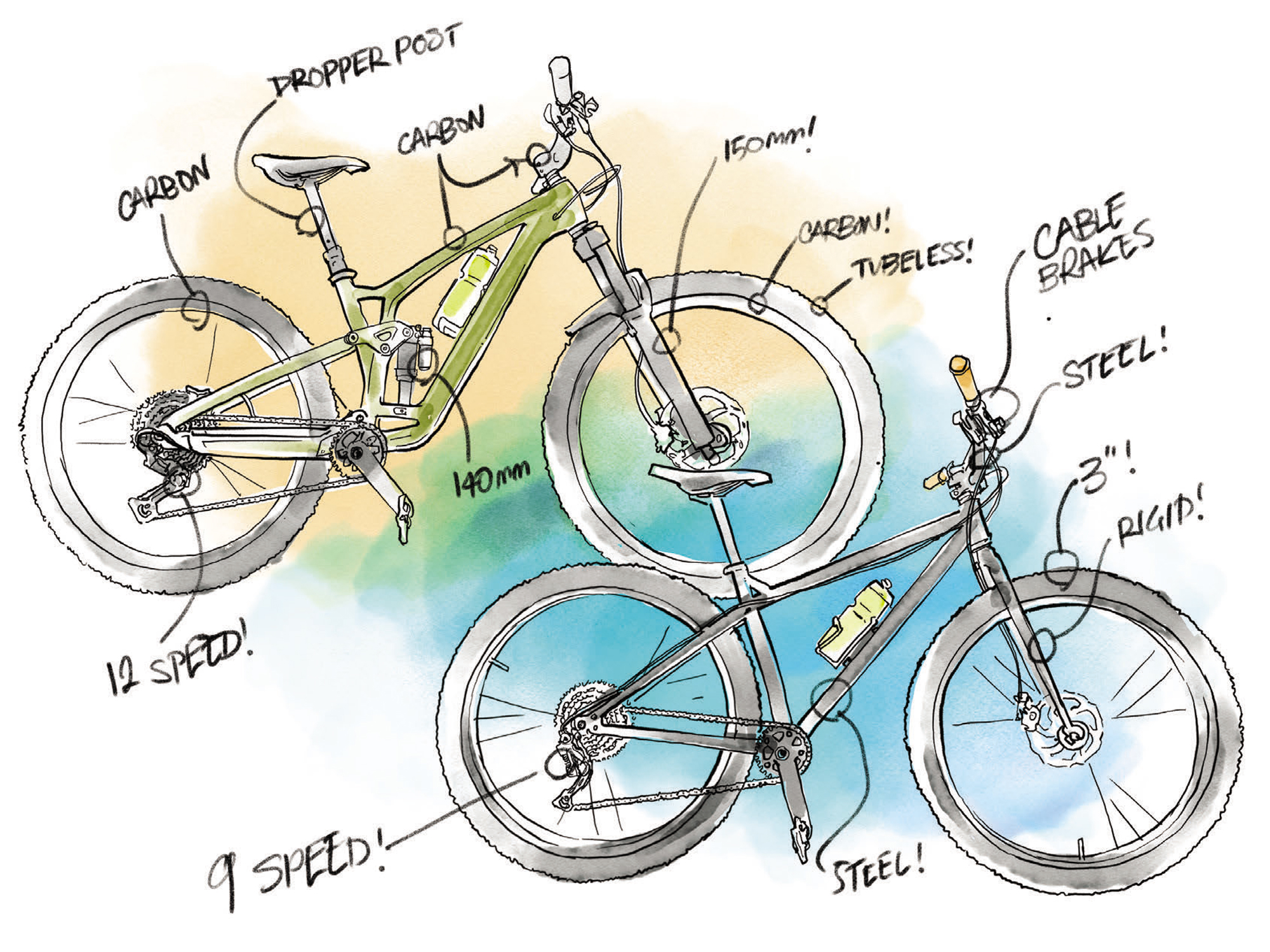
The Krampus is a machine I acquired to do a long bike packing tour on, which, for various lame reasons has not yet happened. Meanwhile, the bike is fun for some applications, on certain days. It’s the original version of a concept Surly more or less invented, 29+. The wheels are 29 inch, and carry three inch tyres.
No suspension, simple and inexpensive running gear, no dropper post, not that much to wear out or worry about. I have added and subtracted a few things over the years but, currently, it sports some bars which are very wide, have a lot of rise, and a cross brace like an old school motocross example.
Once again, when it’s raining but I want to rack up some kilometres, it’s a good choice.
Mostly out of habit, I started my GPS recording device and beetled off up the first climb.
It turned out to be a pretty decent day; the rain was light and stopped a few times, and there was even a brief appearance from the sun.
My route ended up following the Forest Loop until the last section, which is a boring concrete path down the side of the highway. I took a bit of singletrack and a couple of forestry roads to stay on dirt, in the trees. To my surprise, I got back to the van in a hair over two hours. That represents an average speed of 17kph. That’s a good chunk faster than my usual mountain bike ride, but I figured that was because my usual rides involve going up several long, steep climbs where I am going so slow that my GPS device sometimes pauses because it thinks I am stationary. The Forest Loop has a total of 600-odd metres of climbing, but it is never very steep – and is widely distributed over 34km. Still, pretty fast by my standards.
That’s why, a couple of weeks later, I decided to take the same route; this time aboard my late model, comparatively sophisticated, trail bike.
I tried to emulate all the variables. It was a fairly crappy day, but maybe a bit nicer than the first example. Breakfast was matched exactly, coffees calibrated to be of equal quantities and strength. Same outfit, different print on the cotton T.
My ride was very nice, although I confess I was maybe trying a bit harder: the first outing didn’t become part of any performance experiment until after it was completed. This time, I knew there was a sort of race on.
I got back to the van in a time that was faster than the first one. By a minute. Well, a minute and 13 seconds if you want the details. Heart rate, a measurement I sometimes wish I didn’t know about, was fairly evenly matched, and top speed showed only 2kph of difference.
OK, there are dozens of places in the woods I wouldn’t even try to ride on the Krampus that are fun and light work for the Fuel. But still, I’m amazed by how two rides that felt so utterly different to complete were more or less the same in terms of how long they took.
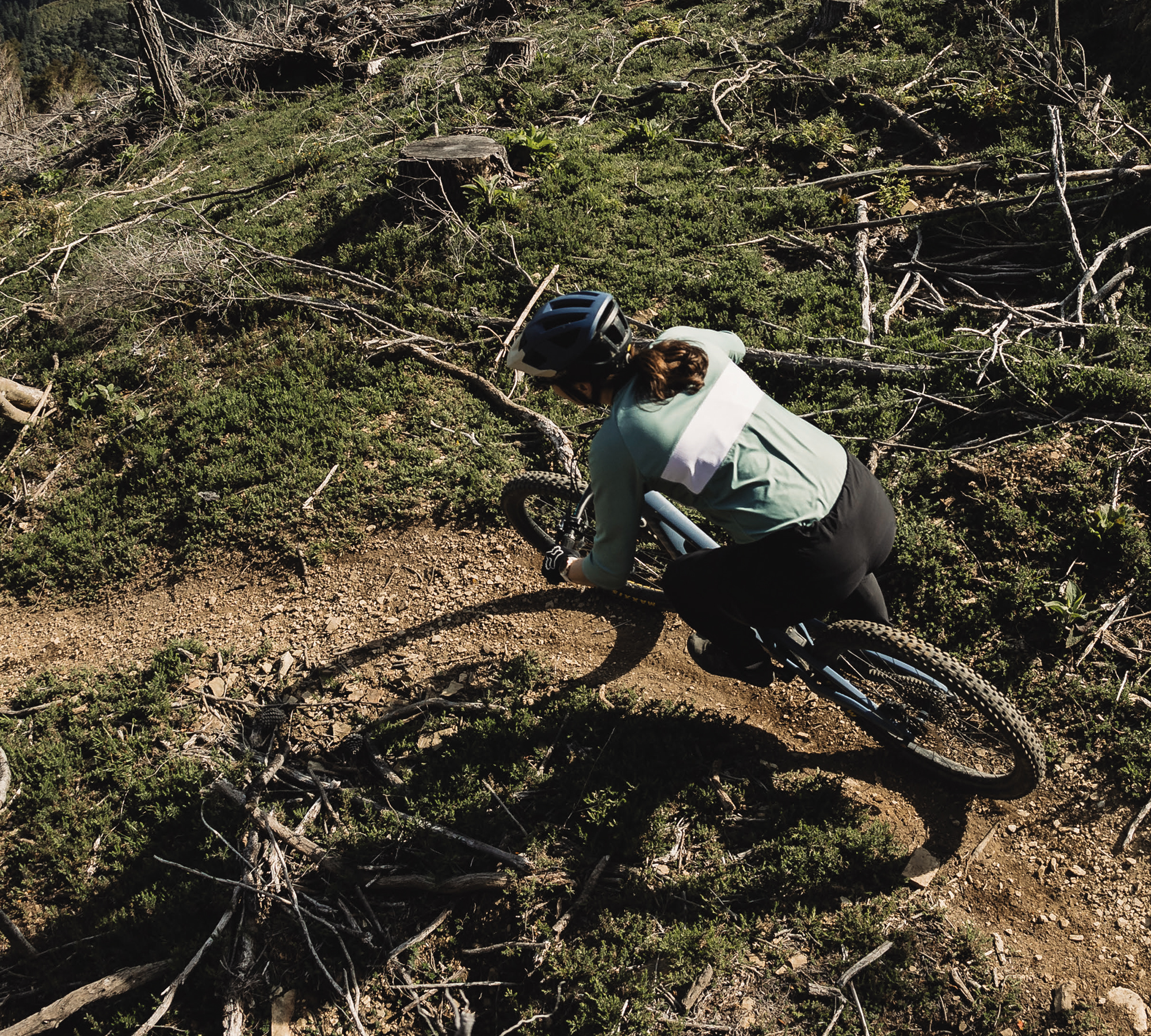
Big Timber: Where would we be without it?
Words Lester Perry
Image Cameron Mackenzie
Once upon a time, Aotearoa was covered mainly by a blanket of native bush. You know the stuff? It’s what most mountain bikers love to ride: large trunks, matts of roots dispersed with fertile dirt, and leaf litter (Beech leaves if you’re lucky).
And this bush was the habitat of many native NZ species. Early Maori cleared what land they needed for agriculture and living space, but it wasn’t until European settlers came ashore in the early 1800s that the axes really got swinging. In the space of roughly 200 years, we (humans as a whole) have cleared a fair chunk of NZ’s land mass, leaving just 24% of it covered in native bush. Forty percent of this lump of land we call home is now pastoral farmland, and 6% is commercial forest, which is also home to a large percentage of NZ’s mountain bike trails. As sustainable as commercial forestry operations now aim to be, there’s no denying that this – combined with pastoral farming – has altered NZ’s ecosystem permanently.
While driving the black band of road that dissects farmland throughout this fine country, I often wonder: what would NZ be like if it were still fully forested and, more specifically, what would mountain biking be like if it were?
Anyone who’s spent time on the end of a spade digging a trail in the native bush would agree it’s hard graft, and working the earth through native bush with a digger is a chore requiring time-consuming finesse and, unless you’re comfortable destroying native roots and eco- systems, then it’s all but impossible. With diggers off the trail builder’s menu when they’re working in native, the speed of trail building would be slow, and the extensive networks we currently see would be a figment of imagination.
If, theoretically, all our trails were in native bush – and given the time necessary to build them by hand – the cost of a build would render them basically out of reach financially, and trail building companies, of which NZ has a number, would be almost non-existent. A lack of professional builders would mean volunteer builds would rule. Lord knows how difficult it is to get a regular crew of keen volunteers to commit to a build under the canopy of pines, let alone the challenges native bush brings.
Native trails are my favourites; their environment and the fact they’re generally hand built give them an inherited technicality and often unique style of flow. It would be amazing to be riding native trails every time we went for a ride. Digger-built flow trails – be gone!
I’m not a hater, though; pine plantation trail networks have enabled NZ’s MTB scene and industry to boom, thanks to their accessible, well-groomed, quickly-built trails. The trail is less directed by the lay of the land or preservation of native trees and more by wherever the digger driver points their machine. With only a small number of roots to dodge, or undergrowth to clear, these trails come easy. On many trails, pine needles help protect the surface through winter and, come spring, a leaf blower and a rake can help rejuvenate much of the trail surface. No one likes losing their favourite trail to logging. Still, with commercial forests running on a 25 – 35 year logging cycle (usually the shorter), it’s inevitable that at some point, one of your favourites will be gone. Once trees are felled, there’s a relatively clean canvas to work on, the opportunity for new trails, and the commercial operations that usually build them. But let’s not forget all the logging slash that’s caused significant problems in the last few years, or that trails built in clear fell generally take much more upkeep and are often terrible to ride due to erosion through a wet winter.
Although I’d love to see a country blanketed in native bush again, I can’t imagine NZ would be such a mountain bike mecca if it was. It’s a little Yin and Yang but, ultimately, big timber will continue to thrive with or without MTB trails. I fear that, without it, the growth and popularity of MTB trails in NZ would be stifled, and we wouldn’t be the global destination we are.
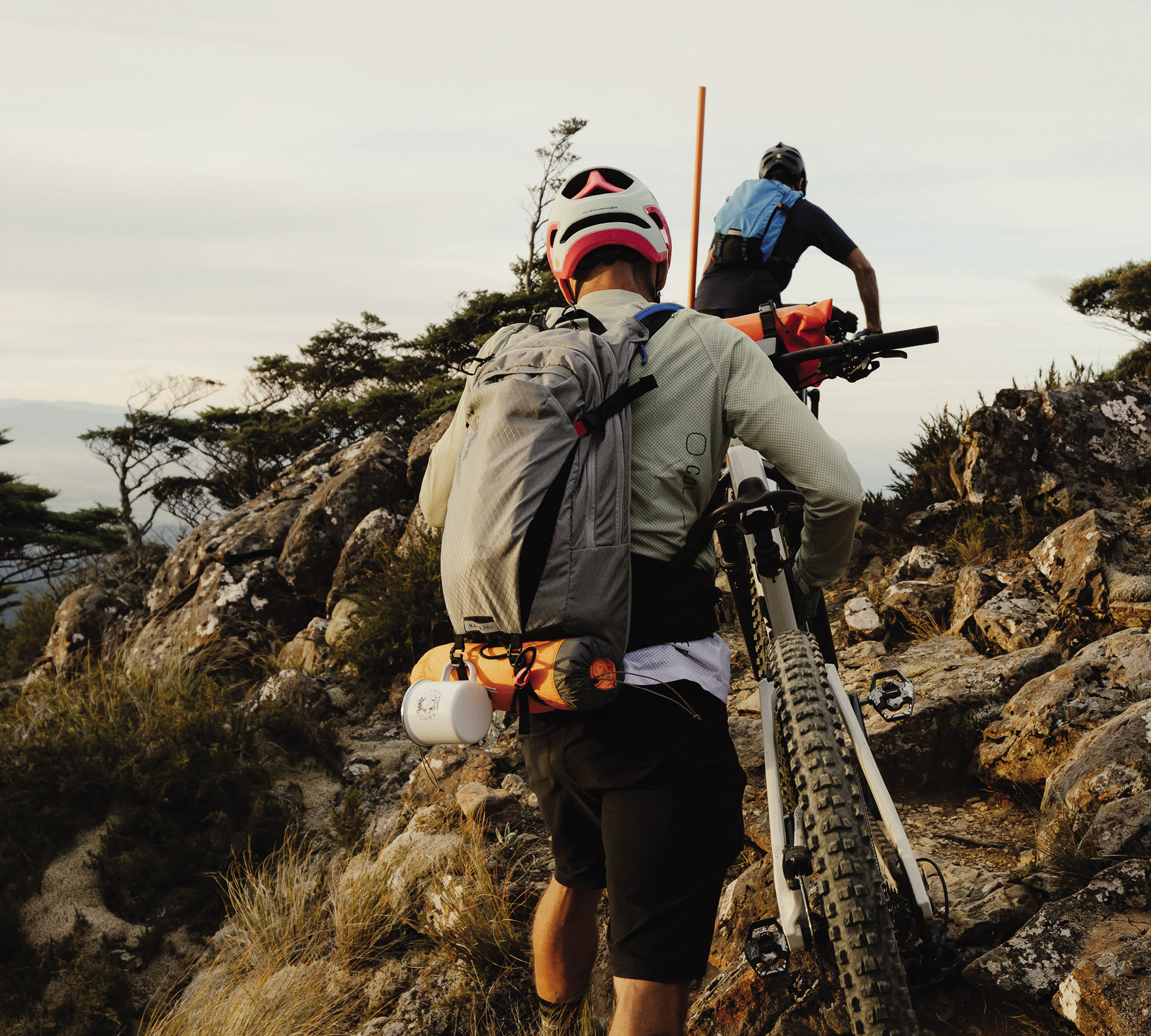
CamelBak H.A.W.G Pro 20
Words Lester Perry
Images Henry Jaine
RRP $299
Distributor Southern Approach
There’s a particular style of trip where bike bags strapped to your frame either aren’t suitable for the route you’re attempting or simply don’t provide enough capacity for the required gear.
When Kieran Bennett and I took on our ‘Starevall or Bust’ two-day mission in the summer of 2024, we had an Aeroe handlebar cradle and dry bag each. That was handy — but with the trail being steep and technical in many places, the option for a rear rack was off the cards, and frame bags would have had to be custom made for our full-suspension rigs (and even then, wouldn’t provide the capacity we needed). CamelBak’s range of Packs was the answer — in my case, the H.A.W.G Pro 20, while Kieran went with a similar, but smaller, MULE Pro 14.
The H.A.W.G pack is designed precisely with missions like ours in mind. Twenty litres capacity, supplied with a 3-litre bladder, and room for another if needed. I opted for a single 3L bladder and a water filter, which, if you’ve read the trip report, you’ll know was a necessity!
Stowage is split into three main areas; nearest to the body is the hydration bladder sleeve. Outside of this, another large ‘full’ pocket features two large internal pockets, one of which is designed to hold a spare eBike battery if you’re that way inclined. In this section, there was enough capacity for me to stow a dry Merino top, a pair of shorts and a couple of freeze-dried meals. A smaller zipped pocket is on the left side of the back panel, down near the waist belt, although I didn’t use it on our trip. It would be ideal for smaller bits you may need to take with you but do not necessarily need easy access to — for example, a wallet or passport.
The next layer out has a medium-sized pocket featuring a couple of smaller zipped mesh pockets to store little items — in my case, tools and spares behind the zips, and some snacks in the main compartment. Across the top, there’s a fleece-lined pocket that is ideal for stowing glasses – and is large enough for goggles.
The outside of the pack features a stretch compartment, ideal for items that you might need quick access to — in my case, a jacket and bag of trail mix, and a First Aid Kit that we fortunately never required. The clips on either side have small hooks to clip helmet straps to for carrying.
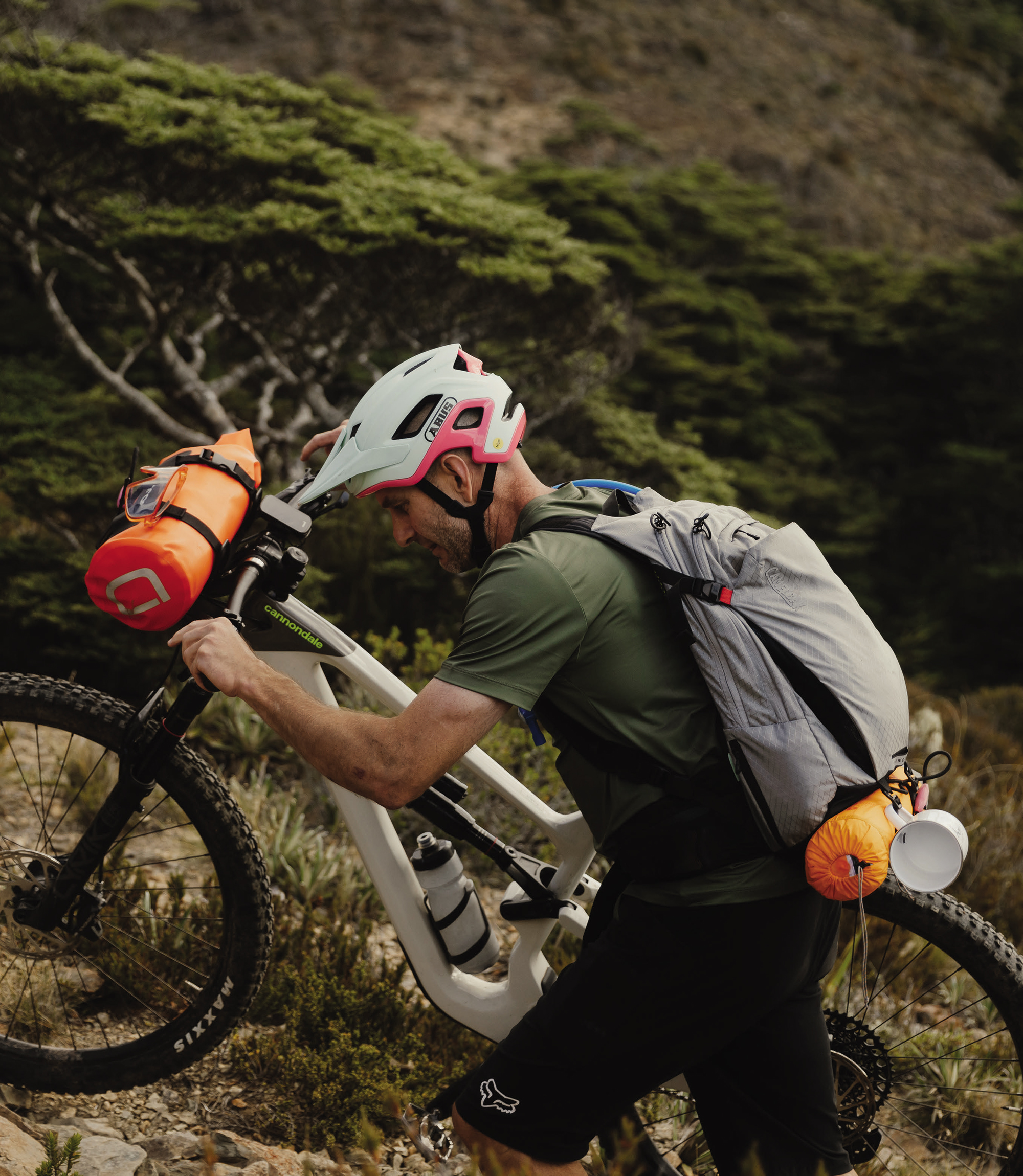
Weight is supported on the hips with a sturdy waist belt and, handily, there’s a zipped pocket on each side for quick access to gear when you don’t want to remove the pack to access. There’s a good amount of room in these pockets. I stashed a disposable camera on the left side for quick access and, on the right, I had some lollies, a multi-tool and a tyre plugger.
The H.A.W.G Pro is the first pack I’ve used with the Air Support Pro Back Panel — a 3D mesh back and harness that supports the bulk of the pack, holding it away from your body as much as is feasible, allowing for maximal airflow between the wearer and the pack. Although it’s still noticeably warmer than no pack, thanks to the Air Support back panel, it feels much cooler than some smaller, more traditional packs I’ve used. The back panel provides a level of rigidity to the whole system and, combined with the harness setup (including the sternum strap), secures the entire pack nicely. It’s well supported, even while fully loaded and tackling rough terrain. Thanks to the secure fit and rigidity, the top of the pack works well for resting the bike on while carrying over hike-a-bike sections — something we spent hours doing while hiking up Mt Starveall.
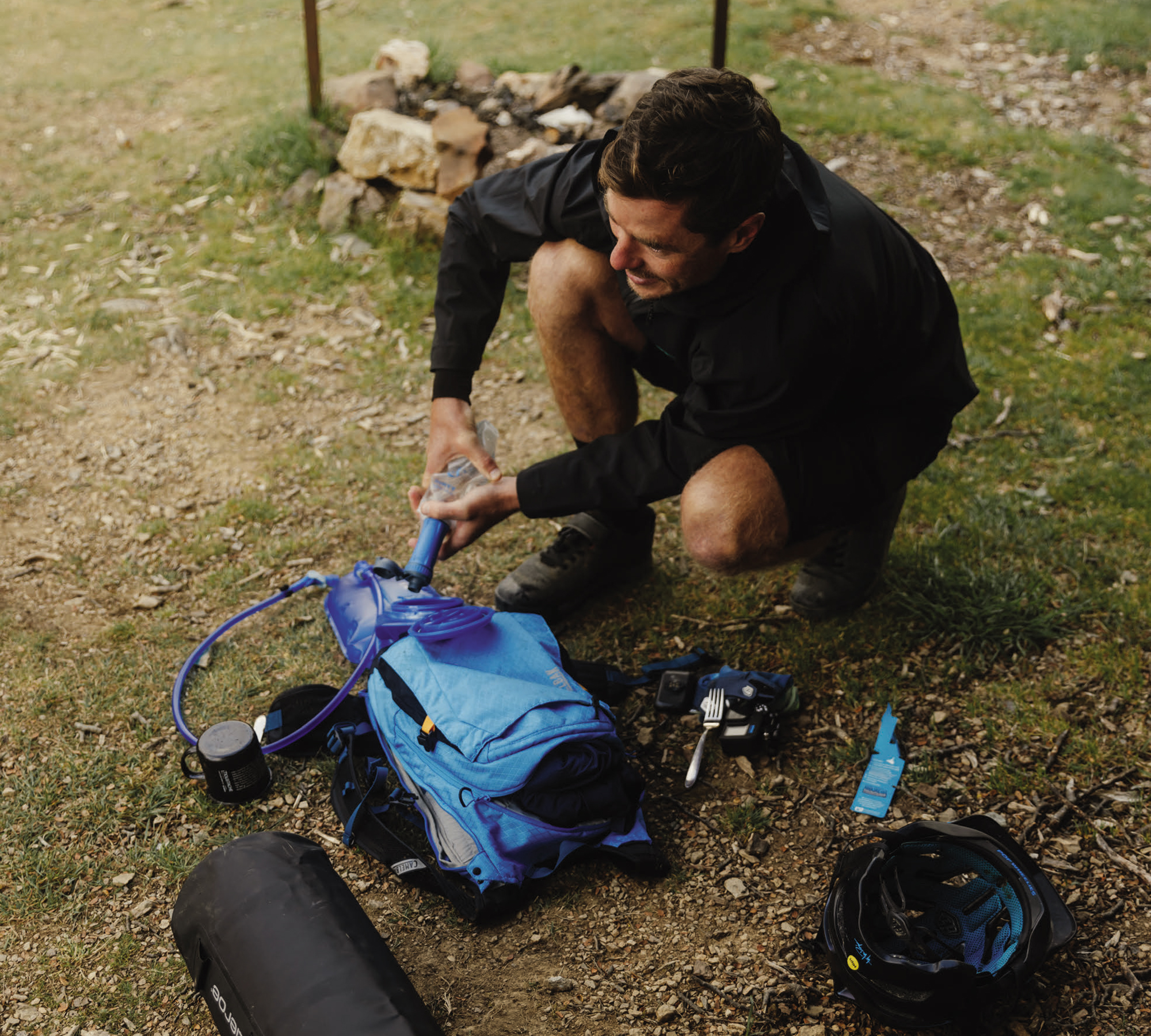
Two straps wrap around the base of the pack and, once cinched down, they help compress the load, helping keep everything in place; handily, they’re long enough to strap on more gear. In my case, I secured my Thermarest Sleeping Mat to the base and saved valuable volume in the pack itself. There’s myriad uses for these simple straps: tent poles, rolled-up jackets, or (most importantly) baguettes — the possibilities are endless.
The pack is supplied with a snazzy little tool roll and, while it’s great in theory, I found I couldn’t get my preferred selection of tools and bits to play nicely with it. The tool roll stayed home while on the Starveall mission, and I brought my small tool bag along.
As far as hydration goes, I can’t fault the 3-litre ‘Crux’ bladder. Although I’m not a super fan of the huge screw top, it does the trick and is long forgotten once it’s tucked safely into the pack. CamelBak redeemed themselves with their market-leading (in my opinion) bite valve and “magnetic tube trap” that keeps the drinking hose nicely secure when not in use, and snaps easily back into place.
The only niggle I’ve found with the H.A.W.G is on the outer stretch compartment. The clips that secure each side and help compress the load are not a traditional bag clip design, I assume, to allow for the helmet hooks. More than once, I had issues getting the clip to close correctly on my first attempt; unless the clips are aligned perfectly, one side can stick out and not be clicked into place correctly. This led to the clips popping open a few times on our trip. It’s annoying but not the end of the world. With some attention, they work fine and are secure when clipped correctly.
When all’s said and done, I’m a big fan of the CamelBak H.A.W.G and its versatility. It’s large enough for an overnighter, and once cinched down, it’s compact and lightweight enough for just a few hours in the backcountry without feeling like you’re carrying a flappy, half empty pack.
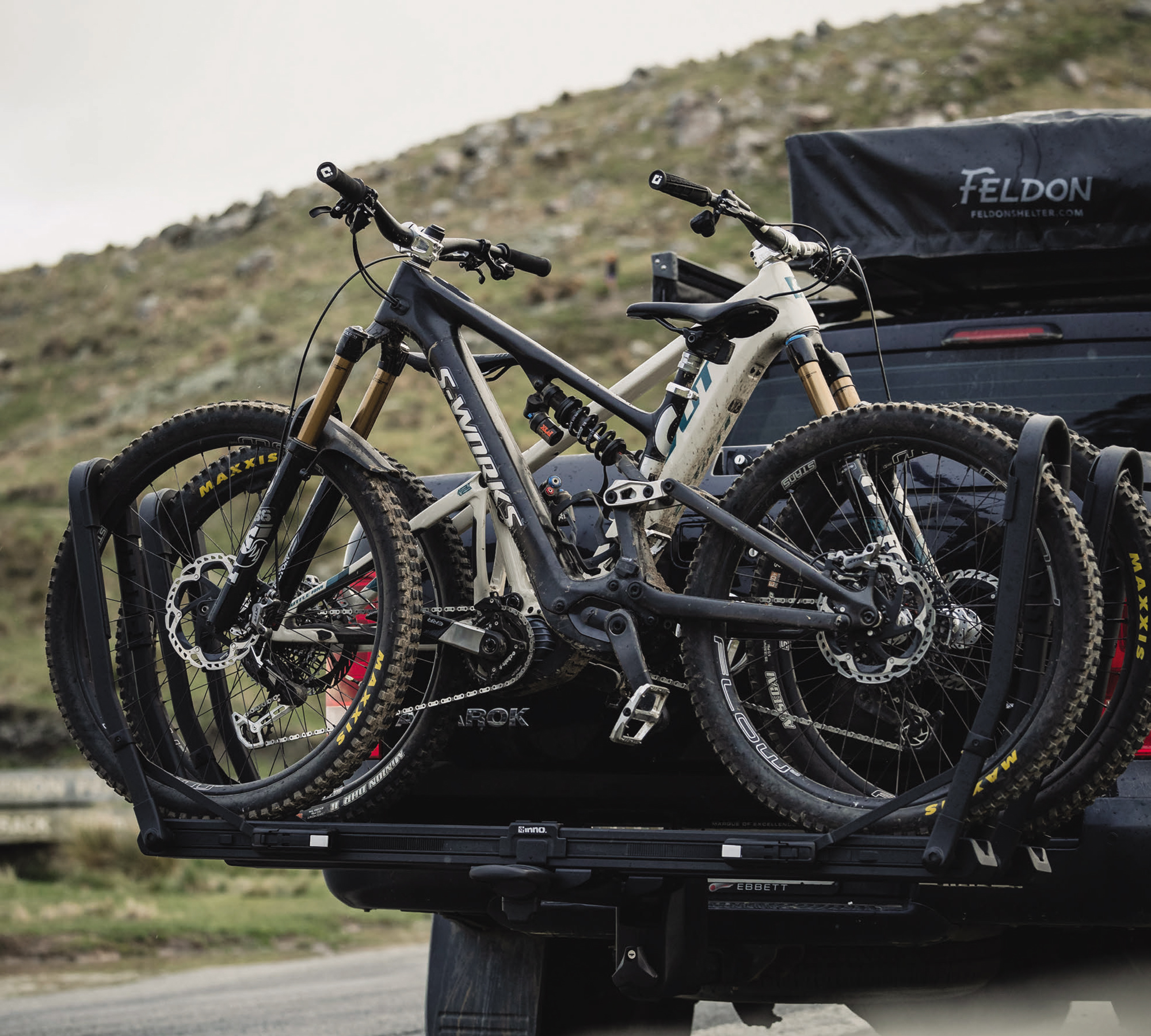
Inno Tire Hold HD Rack
Words & Images Cameron Mackenzie
RRP $1249
Distributor Racks NZ
The concept of a platform bike rack is nothing new, with many of today’s mainstay manufacturers producing several different models each.
Whilst common, there’s seems to be a new brand on the block every other month, each offering a bigger, beefier and “better” option than the other guy – and Inno’s no exception. Up until recently, Inno is a brand I’d not heard of, let alone knew was available in the local market, but I quickly took notice when I stumbled upon their latest Tire Hold HD rack, offering what looked to be a significantly sturdier rack than anything else I’d seen thus far.
Bike racks have been a pain point of mine over the last few years – never seeming to get more than two years out of a Yakima rack before it bends, breaks and/or rusts past the point of safe use. Whilst the way I use it – leaving it attached to the back of my truck year-round and lapping the country in search of the perfect MTB photo – may be a hard life for a rack, they’re a tool, and I expect more. I mean, who has the time or strength to be lifting their 25+kg rack on and off the car and into the garage for storage between weekend Woodhill trips?
Inno’s latest offering, the Tire Hold HD rack, steps things up, offering large weight carrying capabilities, a wide range of tyre size compatibility, and a design that removes any frame contact – one which, up until 2015, was unavailable on a rack outside of the US.
Fitting Inno’s rack onto my truck was a relatively straightforward affair, although, it did require a few small mods to make it all play nice. The rack features a little depth stopper that helps hold the hitch in the same place – presumably for easy alignment as you take it in and out – which I had to remove in order to get the pin holes to align. Their locking pin has a moulded plastic handle, but is of such a size that it prevented it from being able to be threaded in. Removing the plastic handle from the bolt (albeit forcefully) sorted the problem, and it now threads in easily utilising the 8mm hex key head.
As my bike quiver has evolved, so too have my requirements for a bike rack, so the idea of a rack built largely out of aluminium, with the ability to carry up to 34kgs per bike, hold strong and handle off-road use held big appeal.
The strength of the rack is clear when looking at the size of the hardware and pivots featured throughout. The main pivot, which allows the rack to fold, features no-play and is actuated by a smooth and easily accessed grab-handle at the further-most end of the rack. Whilst elements of the plastic components used throughout make me a little nervous, the cowling encasing the main pivot is a welcome sight, helping to keep a lot of the nasty road grime and dust away from one of the key parts of this system.
Loading bikes is where this system shines. With the way in which the ratcheting arms work, the arms stay put once extended, allowing for one arm to be set in position, a bike rolled or placed up against said arm, and the last arm folded up and tensioned using one hand.
Unloading requires a little more coordination and the use of both hands. I find you need to pull the arm back towards the centre of your bike to take the pressure off of the ratchet, and have your other hand depress the release switch on the tray. My only gripe with this is that the ratchet mechanism requires you to keep the level pressed in whilst you slide the arm back, at times leading to you ending up in some creative body positions.
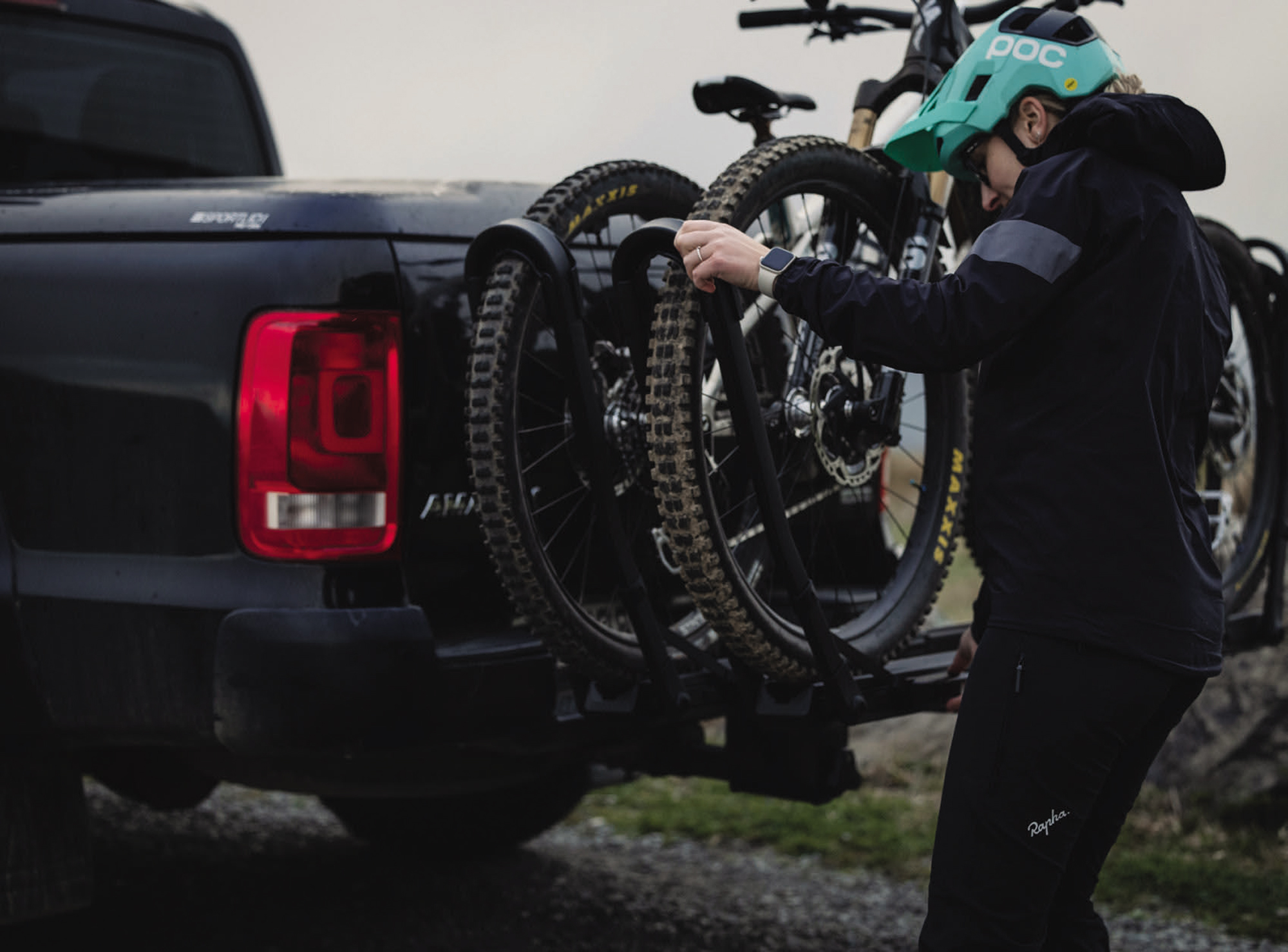
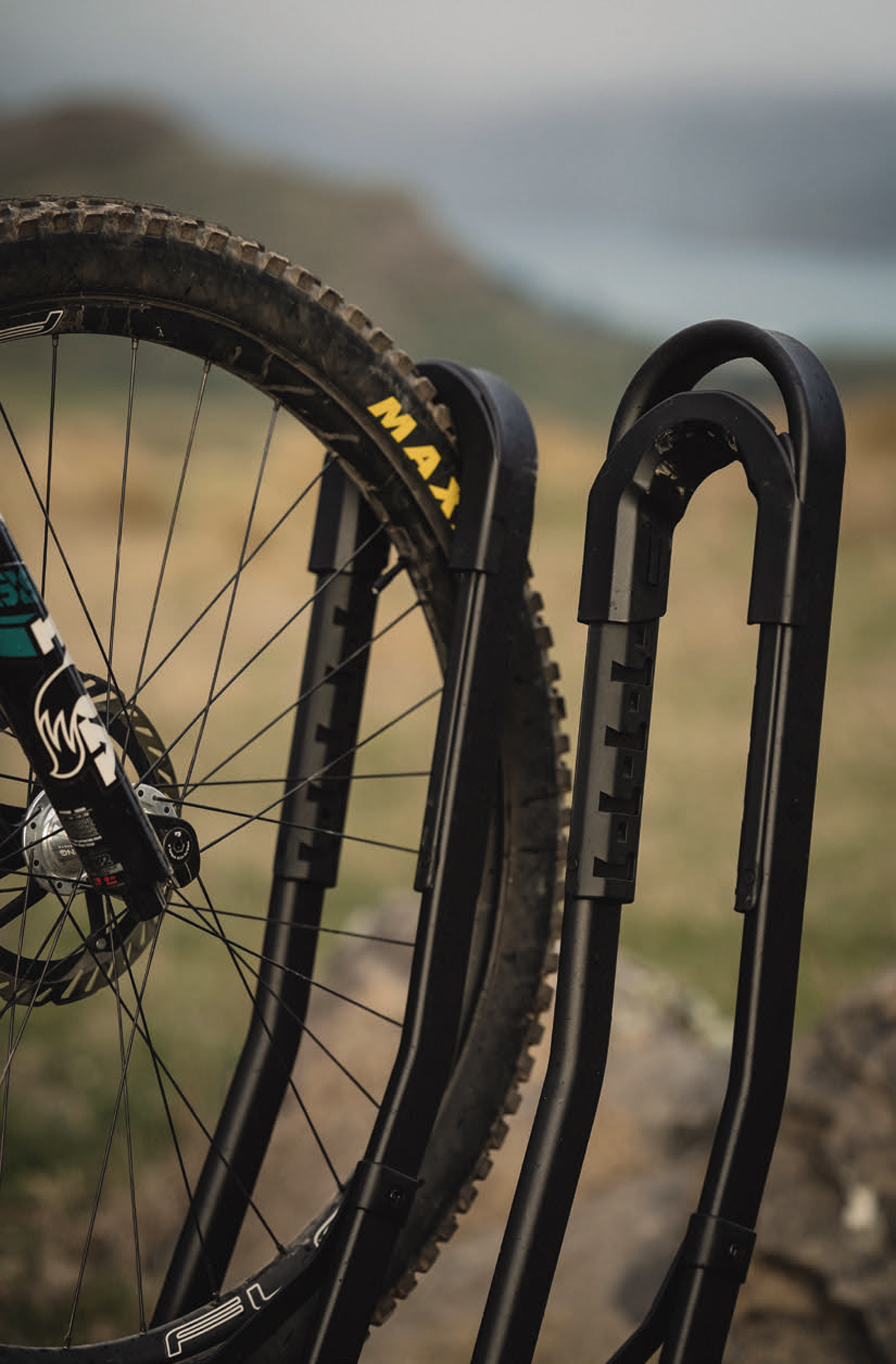
The tyre holders/arms feature a hard-plastic cup which acts as the key point of contact against the tyres and needs to be adjusted depending on the size of your wheels. Doing so is straightforward, but isn’t something you’d want to be doing each time you load your bike. As in our case, if you have a mullet-wheeled bike, or ‘his and hers’ with varying wheel sizes, you find yourself placing the bikes on the rack in the same order and orientation each time to avoid any hassle.
Each carrier bolts onto the main arm of the rack using a t-track style system (similar to what you’d find on roof rack type bike carriers), which allows for close to 30cm of fore-aft adjustment. This range of movement in pairing with the ability to place your bike anywhere on the carrier and adjust the balance of the arms to affect its position means the days of bikes mating is all but over.
Where other racks would creak and rattle, Inno’s HD rack hasn’t made a peep. Even with 45kgs of carbon and lithium swinging off the back down rough, corrugated gravel roads and mild 4×4 tracks, the bikes held rock solid and would barely wobble even, as the truck bounced around. Long journeys are much the same – hassle free and without movement.
The Tire Hold HD is designed exclusively around a 2-Inch hitch, so for those using a smaller hitch receiver or a tow ball, you’re out of luck when it comes to running this heavy-duty bit of kit. Inno offer similar models using a lot of the same materials and construction, but only for those whose vehicles don either a 1-1/4” or 2” hitch. For the towballer’s, sadly you’ll be needing to look elsewhere for the time being.
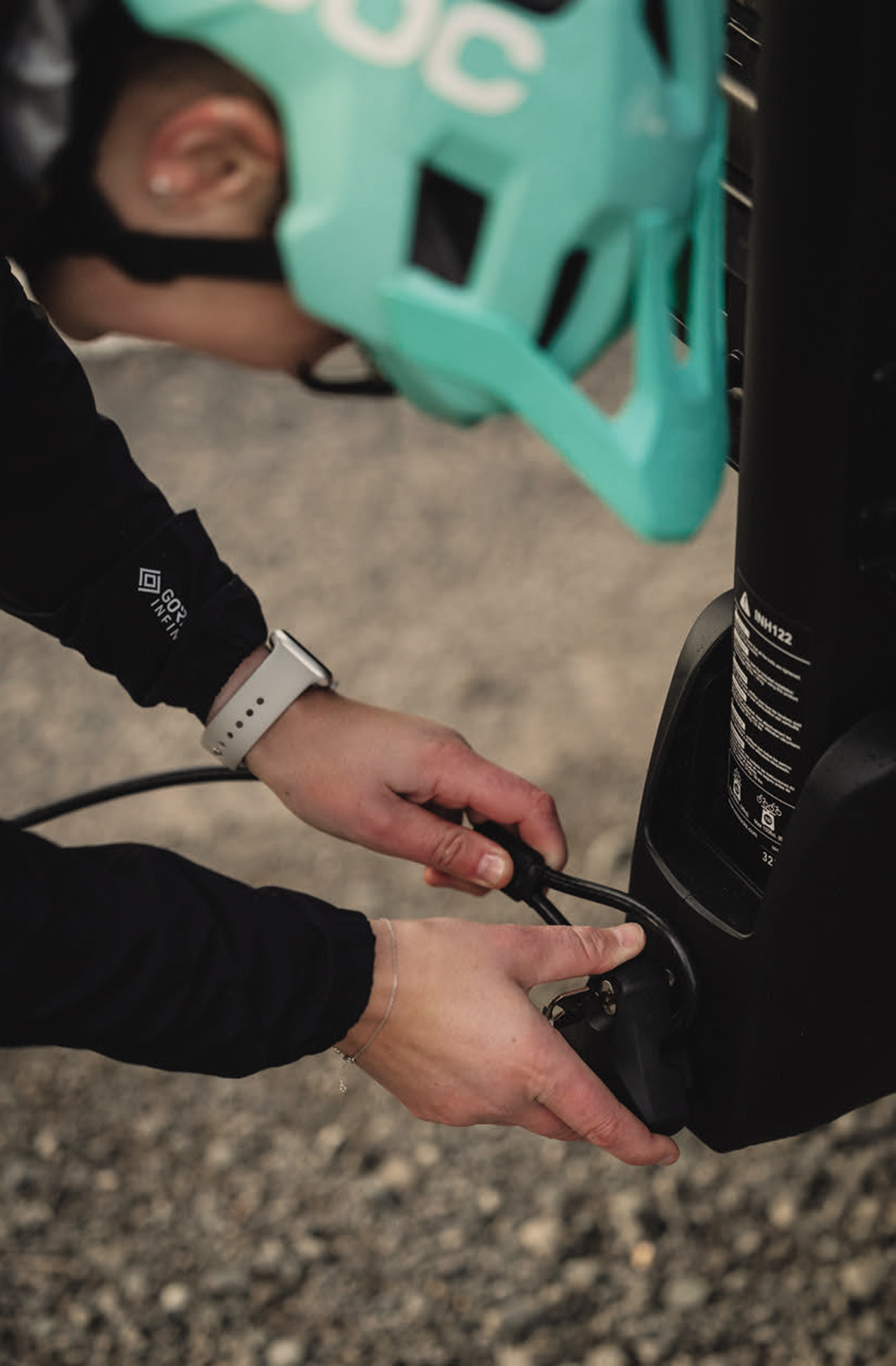
The ability to lock your bikes onto your rack is a feature you tend not to utilise all that often, but is one which you want to be well thought out and reliable when you need it. Unfortunately for the Tire Hold HD rack, the locking solution is the one feature which really lets it down. Their solution to security is a basic double-loop cable which requires being fed through itself on one end, and the other being clamped down by the hitch’s expanding wedge handle. The cable itself is something out of a primary school bike rack and wouldn’t take much to cut through or pull out of the locked handle. With the bike rack loaded, locking the cable in place would require you reach underneath the rack and fiddle around with a small key, realigning the handle on a small spline, and clamping said cable loop in place.
An easy solution would be to buy an aftermarket bike-lock and chain the bikes together, but for $1249, you’d hope they could come up with a better solution – perhaps wheels locks like the ones found on the Rocky Mounts or 1Up models.
My only other peeve of Inno’s rack is the inability to expand the carrying capacity after the fact. The Tire Hold HD is available in a two or four bike model, but neither option can be changed with the purchase or removal of an extension. Having that ability is helpful both ways – being able to shorten it for around town when it’s just you, or being able to take a car full of friends on riding trips, without the need to have two racks sitting in the garage.
Time will tell how well the Inno rack lasts but, for now, I’ll be keeping this one fitted, at least until I need to carry more than two bikes – and will be carrying my own lock.
CamelBak M.U.L.E Pro 14
Words Liam Friary
Images Henry Jaine
RRP $279
Distributor Southern Approach
I’m always scheming or planning an overnight trip, particularly during that time between the clocks springing forward and winding back again (boooo!). How much gear we actually need on a trip, and what we are going to use to carry it, is always a big consideration.
I don’t mind having some weight on my bike, but I always like to try and keep it free to move, so having a decent backpack with enough storage is an absolute must. Extra hydration is also key when pedaling off into the backcountry for hours and days at a time, making a reservoir a must have. For these trips you need to pack ya meals, snacks, layers, jackets, power bank and locator beacon at the very least, along with other essentials.
The M.U.L.E Pro 14 is aimed at big days out and comes with loads of genuinely useful storage arrays. The back panel is most excellently called ‘Air Support’ and really does help reduce sweaty back syndrome. It also features the brilliant Crux Reservoir which holds three litres of water. As well as a compartmentalised main storage chamber, the M.U.L.E. Pro 14 has a hip belt with cargo carrying capability (another must) and a removable bike tool organiser wrap thingy. You can also insert optional ‘Impact Protector’ spine protection armour into the pack.
When loaded up and out on the trail, the CamelBak M.U.L.E. Pro 14 isn’t that noticeable — and that’s a good thing! For a very spacious pack, it’s just so damn comfy – no pesky annoyances. The combo of stability and security is adequate without having to wrench the bag around my torso. My overnighter stuff was all packed into the CamelBak M.U.L.E Pro without hassle and if you need to pack a sleeping bag you can do that, thanks to two straps that have little hooks on them; I used these to secure my sleeping bag to the bottom of it. Again, when riding, the bag felt snug and secure — I could feel its weight, but it was well distributed. All contact points for the bag have been carefully considered, with each strap being made up of a cross-hatched mesh, along with a sponge centre for maximum ventilation. The traditional shoulder straps have a runner system for easy adjustment of the chest strap too, which reduces that cutting sensation on the armpits which can be a bloody nuisance with an ill-fitting and heavy backpack.
The M.U.L.E Pro 14 hosts a very spacious 3L bladder suitable for whatever your trail adventure. The reservoir is easily accessible via a full-length zip down one side of the bag — the bladder can be removed and refilled with ease, thanks to its helpful handle design and large opening towards the top. The quick release hose connection reduces faff in feeding it in and is great for cleaning as well. The drinking tube has a magnet on it, so it stays secure while you ride. I think the magnet is great for making a solid connection but, when riding and moving, you need to twist it – which can be a touch difficult.
Overall, the light open mesh absolutely lets the back breath whilst remaining secure. The hip straps and lumbar pad really help distribute the weight nicely. A handy addition is the mesh pocket on either side – big enough for a multi tool or snacks for quick and easy access. The best pocket, though, is the sneaky one on the left-hand side of the pack where the waist strap meets the bag. This little pocket is well protected and will fit your cell phone for snapping memorable moments. It meets all my requirements for storage space and stows enough water. The comfort reigns supreme and it does its job very well. Now, I just have to find some more time for backcountry missions?!
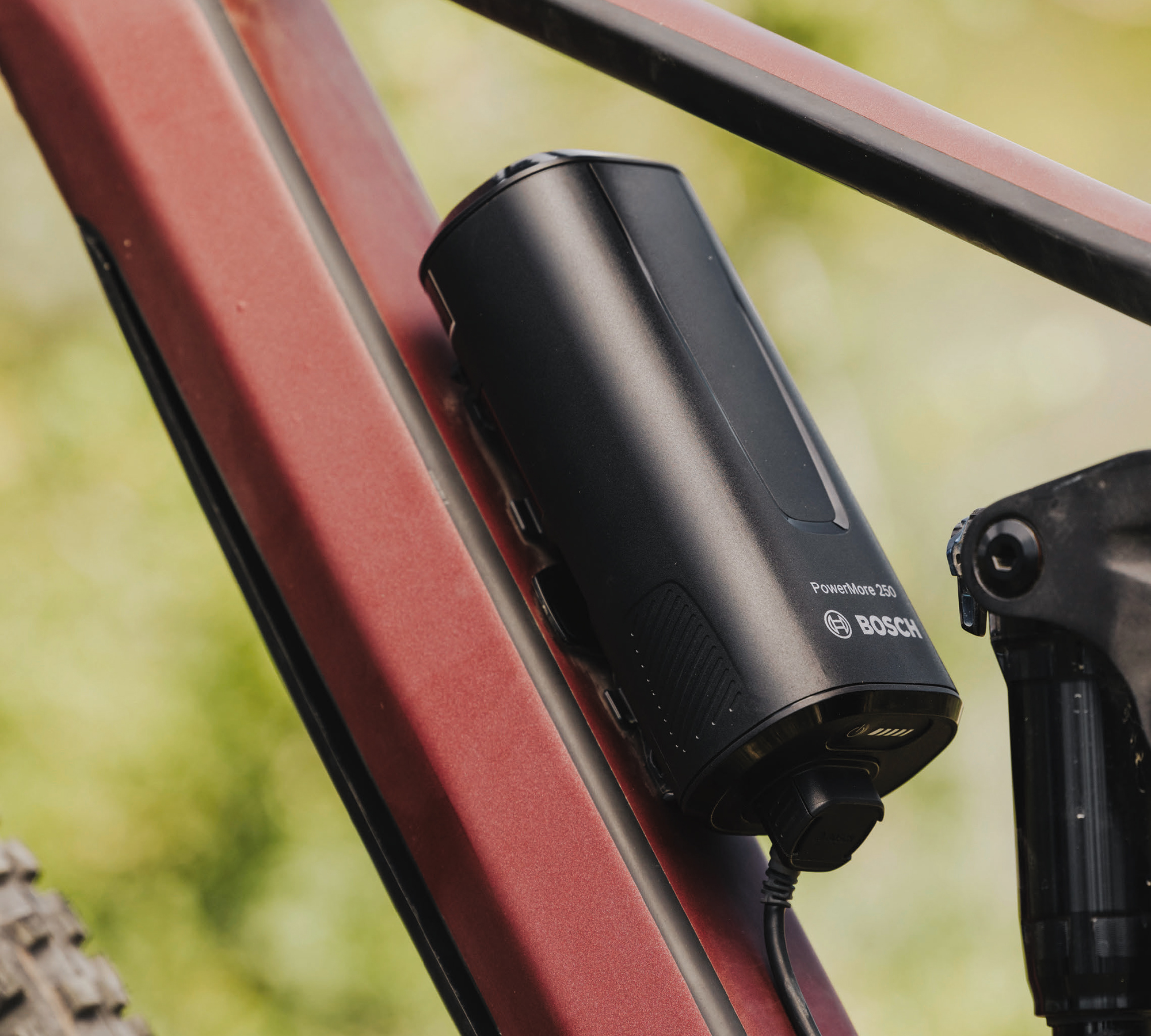
Bosch PowerMore 250 Range Extender: Push the adventure, not the bike
Words Alex Stevens
Images Supplied
If you had a chance to read our last issue, you might recall our review of the Mondraker Dune R with Bosch’s lightest drive unit; the Performance Line SX.
We loved the natural ride feel of this bike and thought that, being a lighter set-up but still with plenty of torque and power, it would be ideal for backcountry and hike-a-bike missions, especially with the addition of a battery range extender.
With Bosch’s PowerMore 250 Range Extenders now available in New Zealand, we’ve had a closer look at this system and can confirm we like what we see. Here’s how it works.
About the size of a drink bottle and weighing in at just 1.5kg, this extra battery provides 250Wh of capacity and can increase range by up to 60 per cent. It’s exactly what you need for a big day out when the plan is to push the adventure — but not end up pushing the eBike home. Knowing that you’ve got extra juice in the tank gives you the freedom to explore further without that niggly range anxiety.
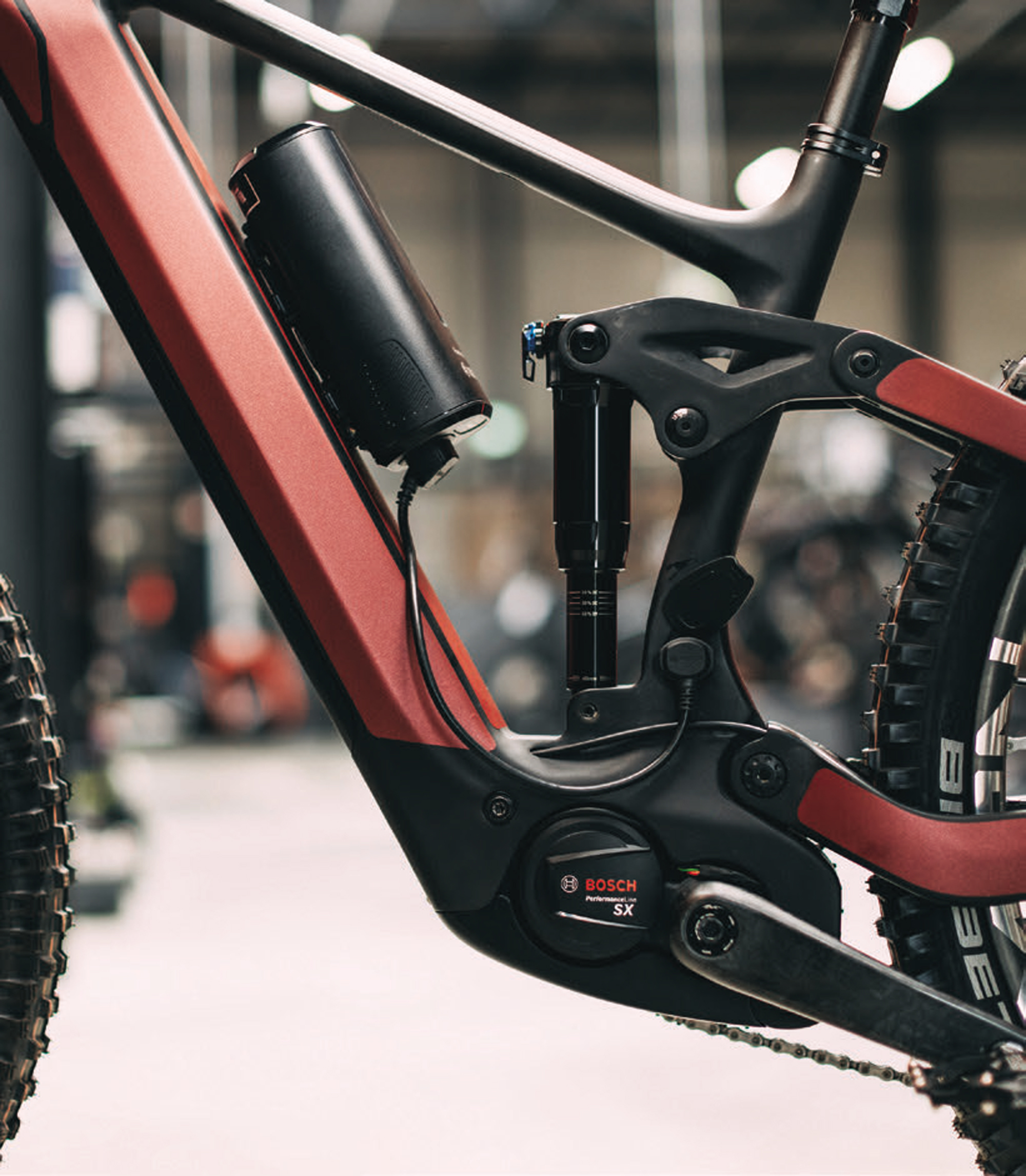
The PowerMore 250 is designed to fit neatly in the water bottle holder on the down tube and connects to the charging port via a cable. The cable doesn’t come as part of the package because the cable length varies depending on the size of the bike frame. It may sound like a hassle remembering to order a separate part but better to have a system that actually fits your eBike rather than making do with a one-size-doesn’t-fit-all workaround.
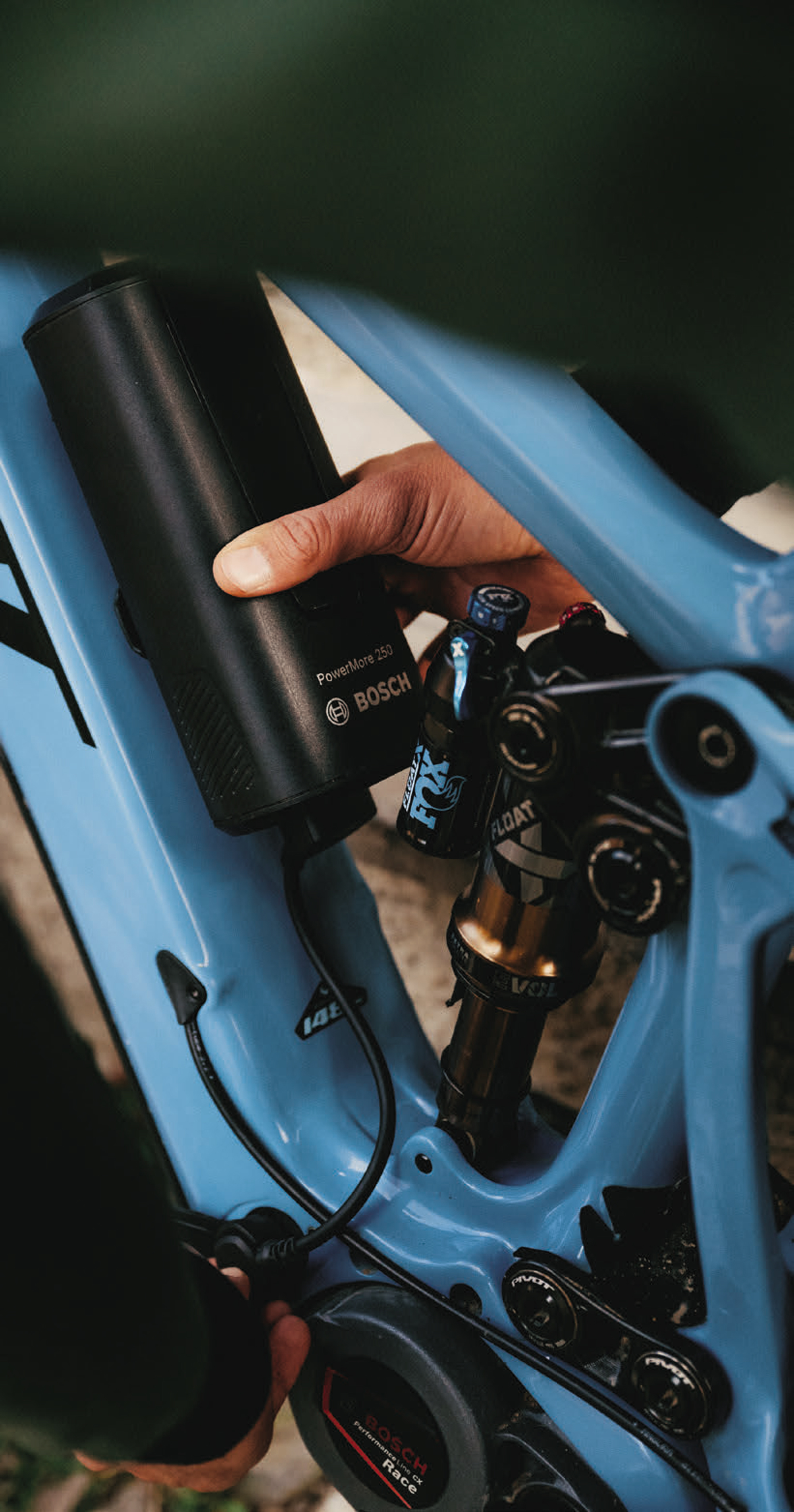
Cable lengths range from 50mm to 750mm and all you have to do is plug it into the PowerMore 250 and into your charging socket on the frame. The PowerMore cable also comes with two different connector variants: cable routing in the direction of the battery holder and cable routing facing away from the battery holder.
You’re probably asking, is 250Wh enough power? Remember, this is designed to boost your range, rather than act as your main battery. Bosch’s vision for the future is that all batteries in the smart system will become DualBattery- capable, meaning they can be combined for longer and/or more demanding riding.
Saying that, though, you can actually use the PowerMore 250 as a single battery — should you need to. We’re not really here for a quick trip to the dairy, though, so let’s get back to the main purpose: big rides.
If you’re riding an eBike with a mid-range drive unit like the Performance Line SX and adding an extra 250Wh on top of the 400Wh from the Bosch CompactTube 400 (which is presumably what Bosch had planned since these products were all released at the same time), you’ll probably find your legs give up before the bike does. The main advantage here is that you’re carrying less weight.
One thing you will need to check before you get too excited about range extenders, is whether the PowerMore 250 is compatible with your eBike. Even if you’re running a Bosch eBike System it will need to come with Bosch’s Smart System from model year 2024. Check if that’s the case via the Bosch Flow App (settings > My eBike > eBike Pass > Components) or eBike display (Settings > My eBike). If ‘PowerMore’ is an option on the menu that means you can retrofit PowerMore 250. Alternatively, your local Bosch eBike dealer will be able to tell you.
Why can’t PowerMore 250 be retrofitted to all eBikes with a Bosch system? As we all know, Bosch are big on safety features. In this case, it’s about making sure the eBike meets special requirements including, for example, reinforced receiver tubes at the attachment points in the frame.
So, there you have it, an answer to the question we all want answered: how to fit more riding into your life. If you’re on a Bosch-powered eBike, check your Flow App to see if it’s compatible with the PowerMore 250. Spring is here and it’s time to start planning some missions.
The Life and Times of Travis Brown
Words Liam Friary and Travis Brown
Images Cameron Mackenzie
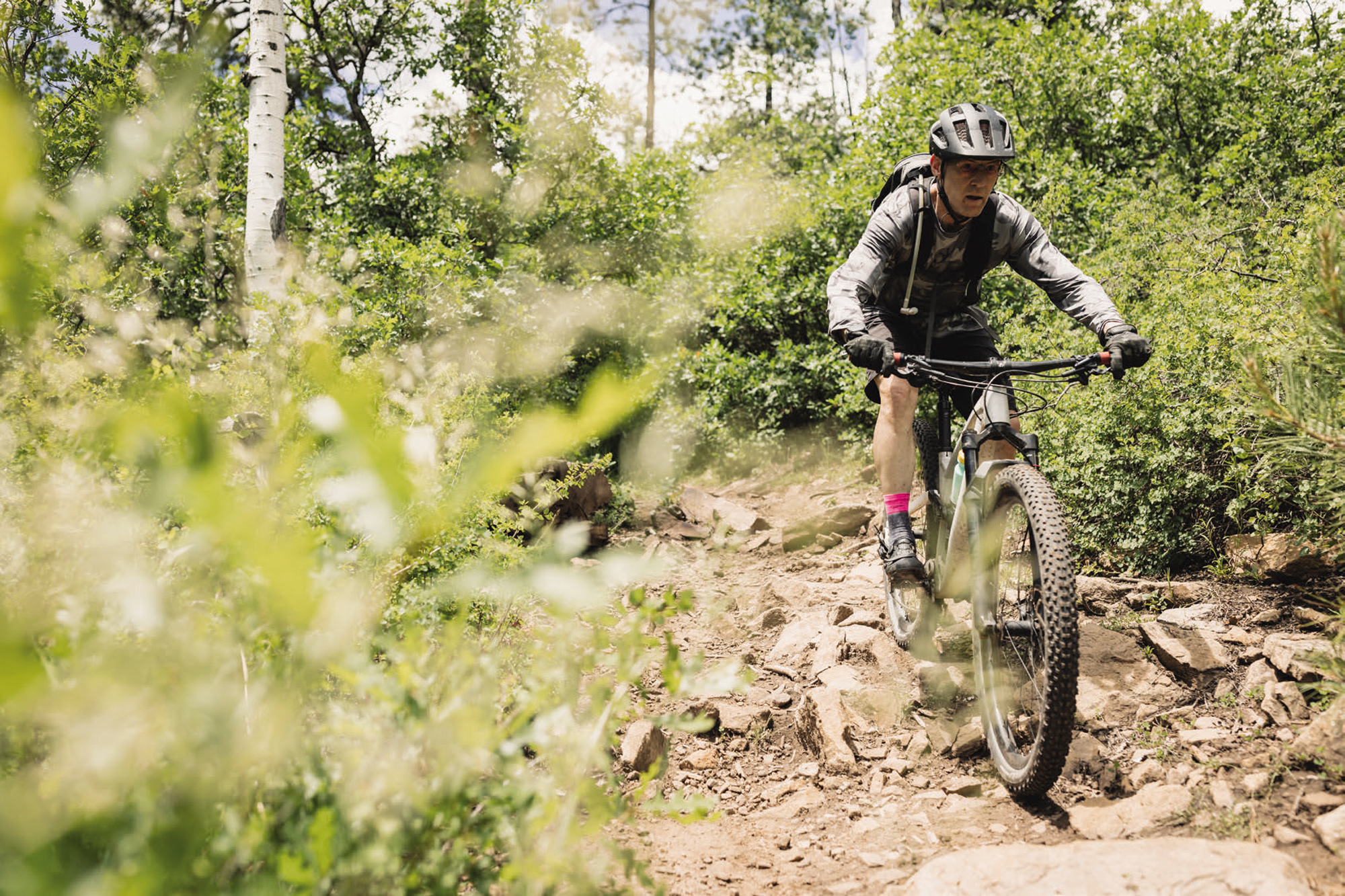
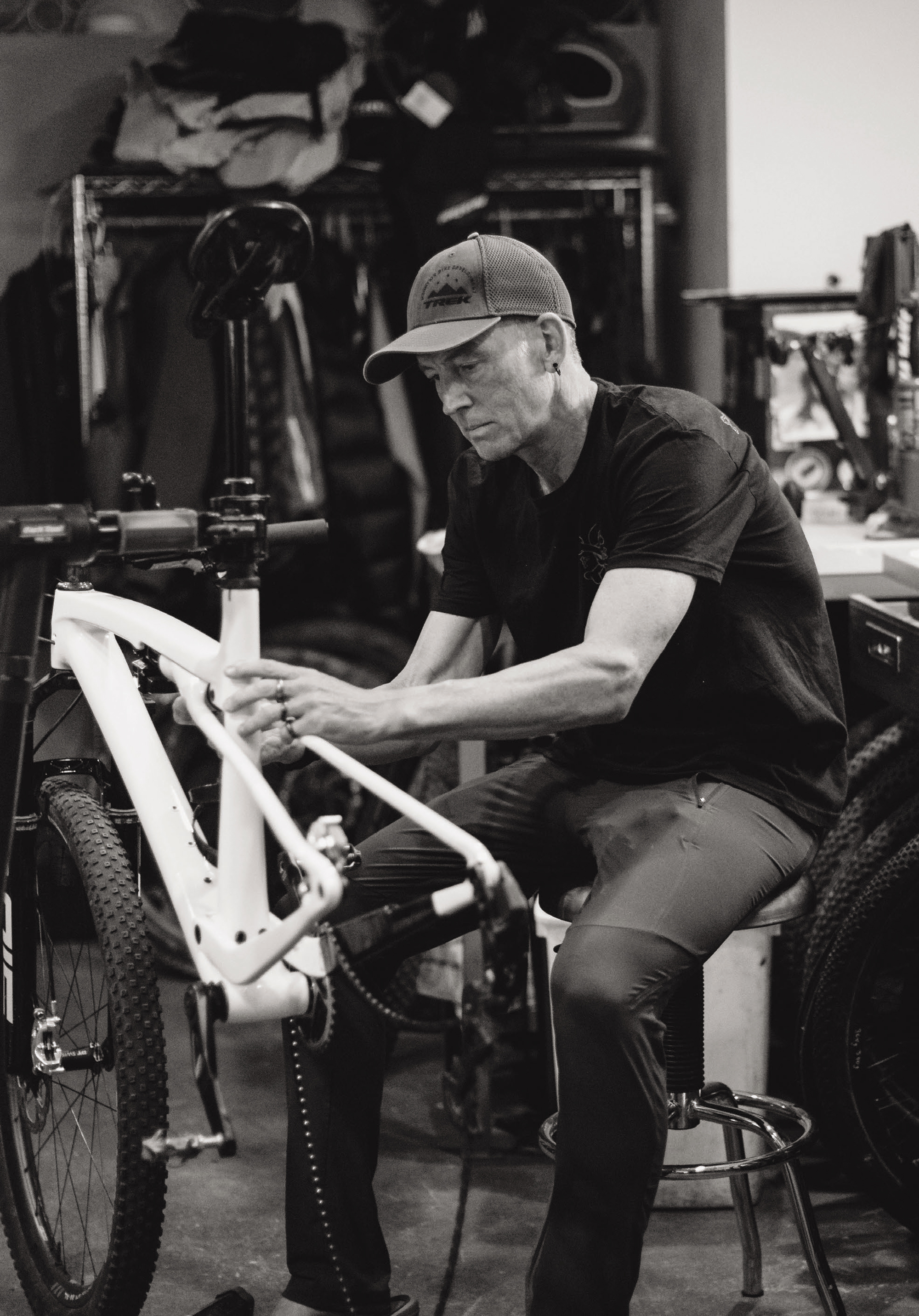
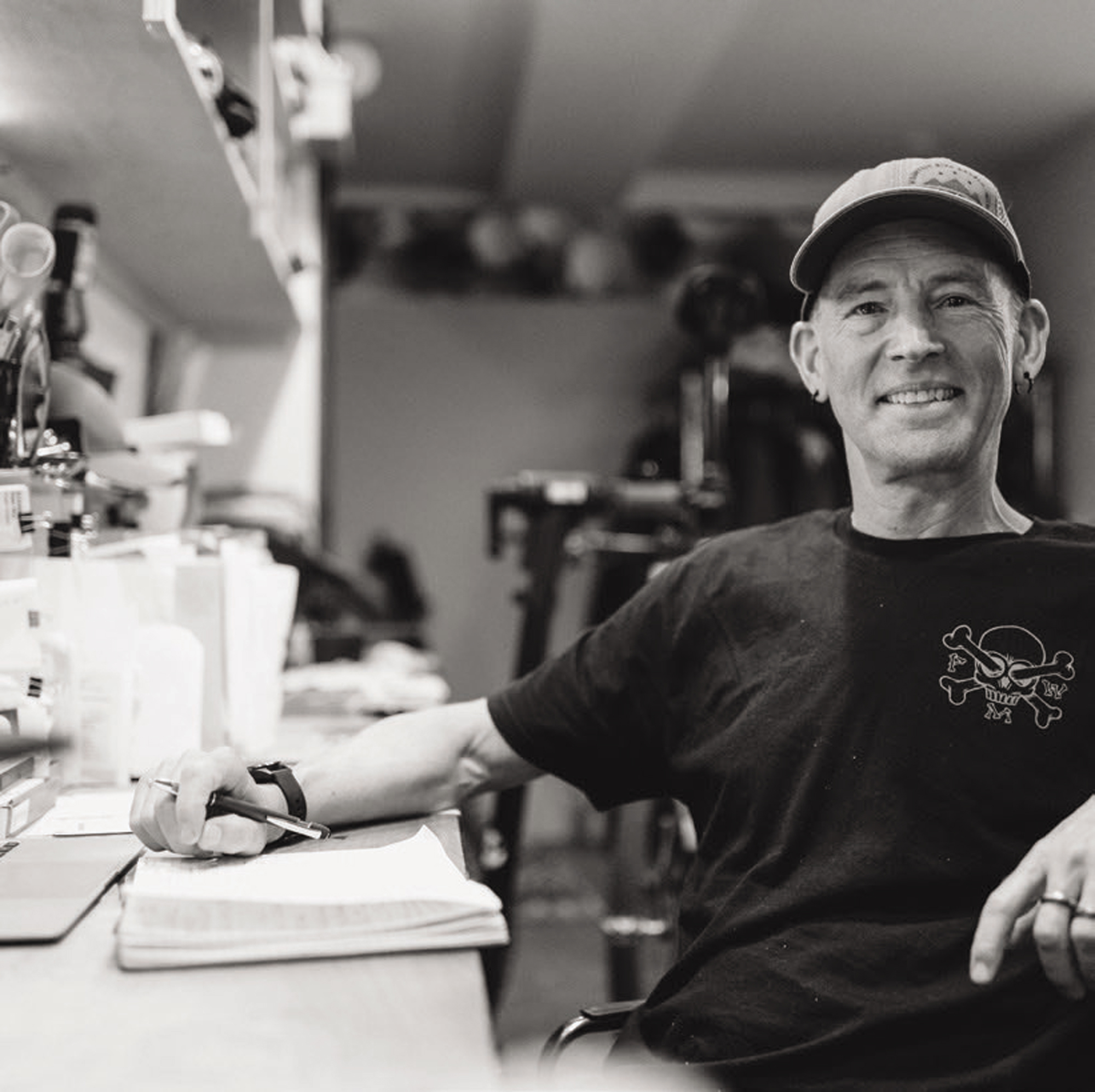
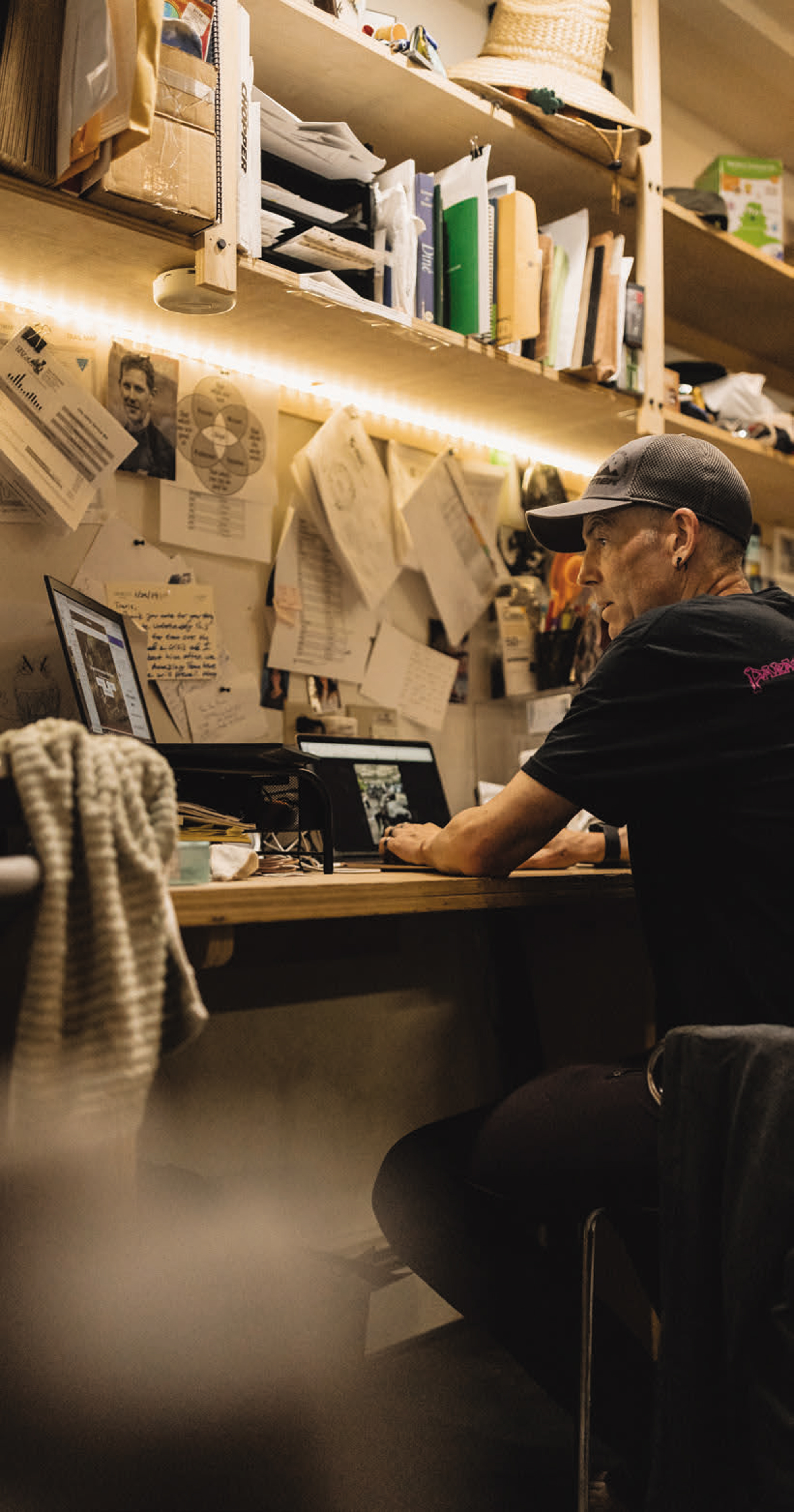
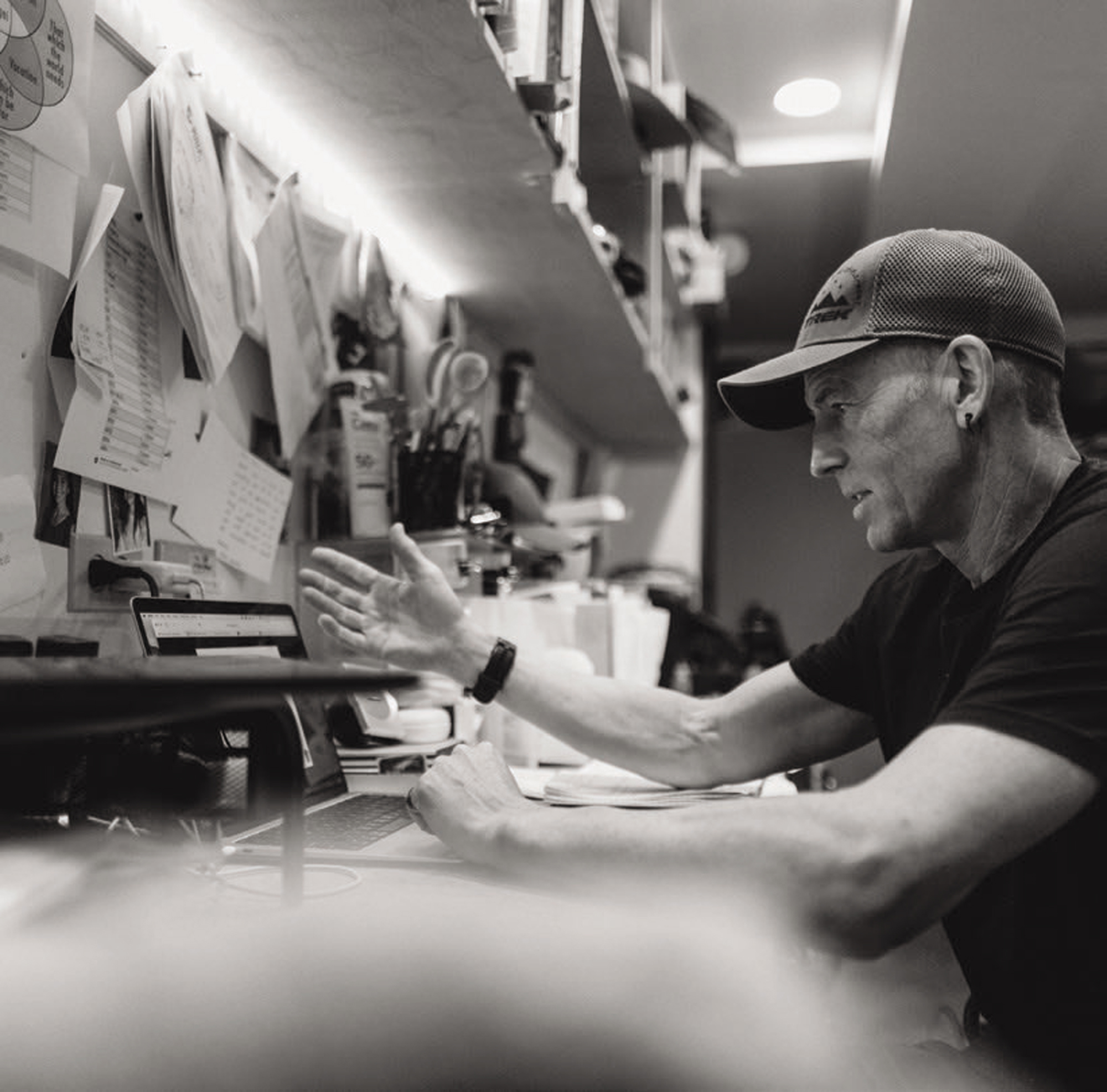
Skipping our winter on a recent trip to America, I got the opportunity to not only sit down with, but ride and hang out with, the mountain bike icon, Travis Brown. The man – or, more aptly put: legend – doesn’t need much introduction, but for the new kids on the block here’s a brief history.
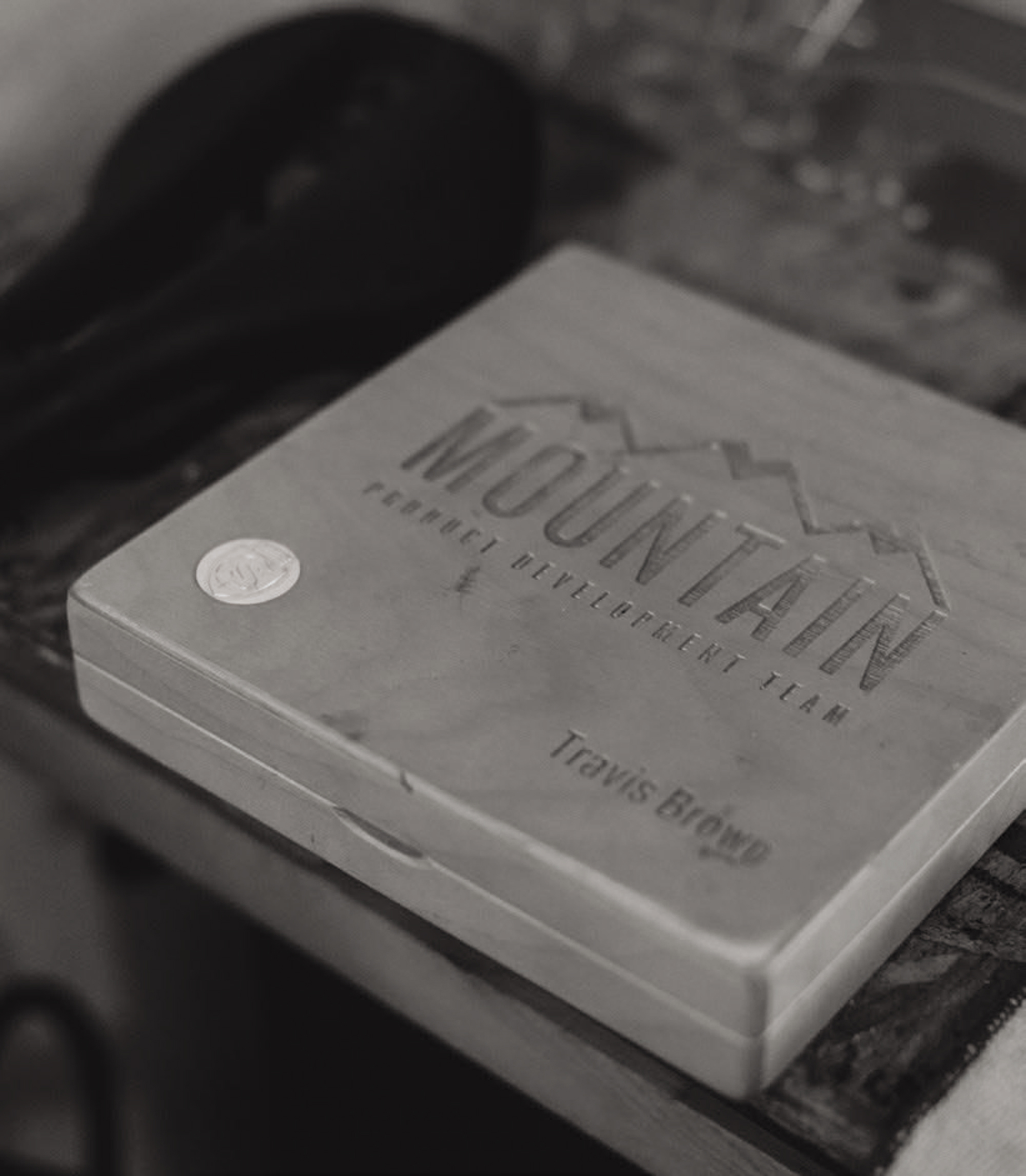
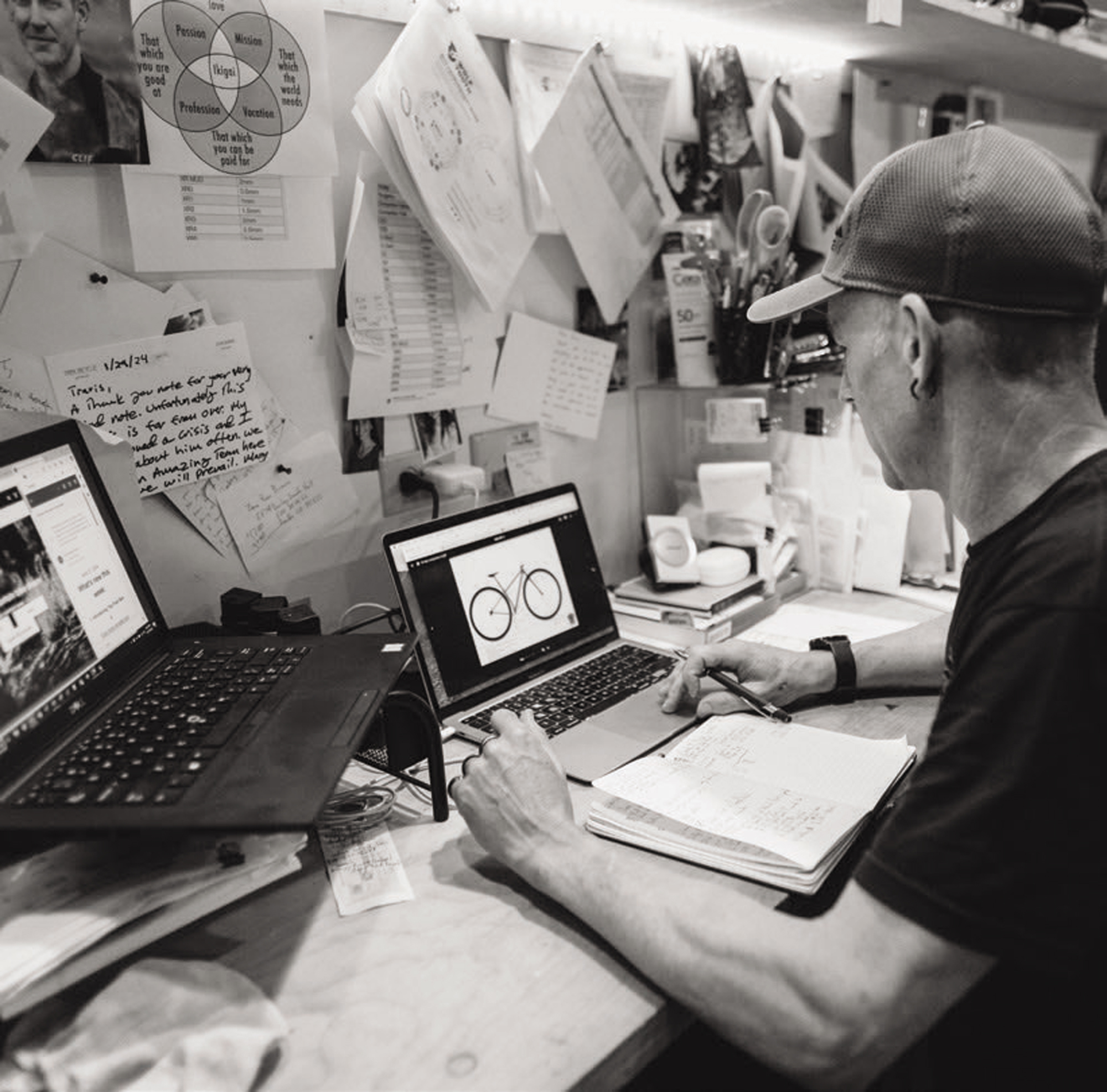
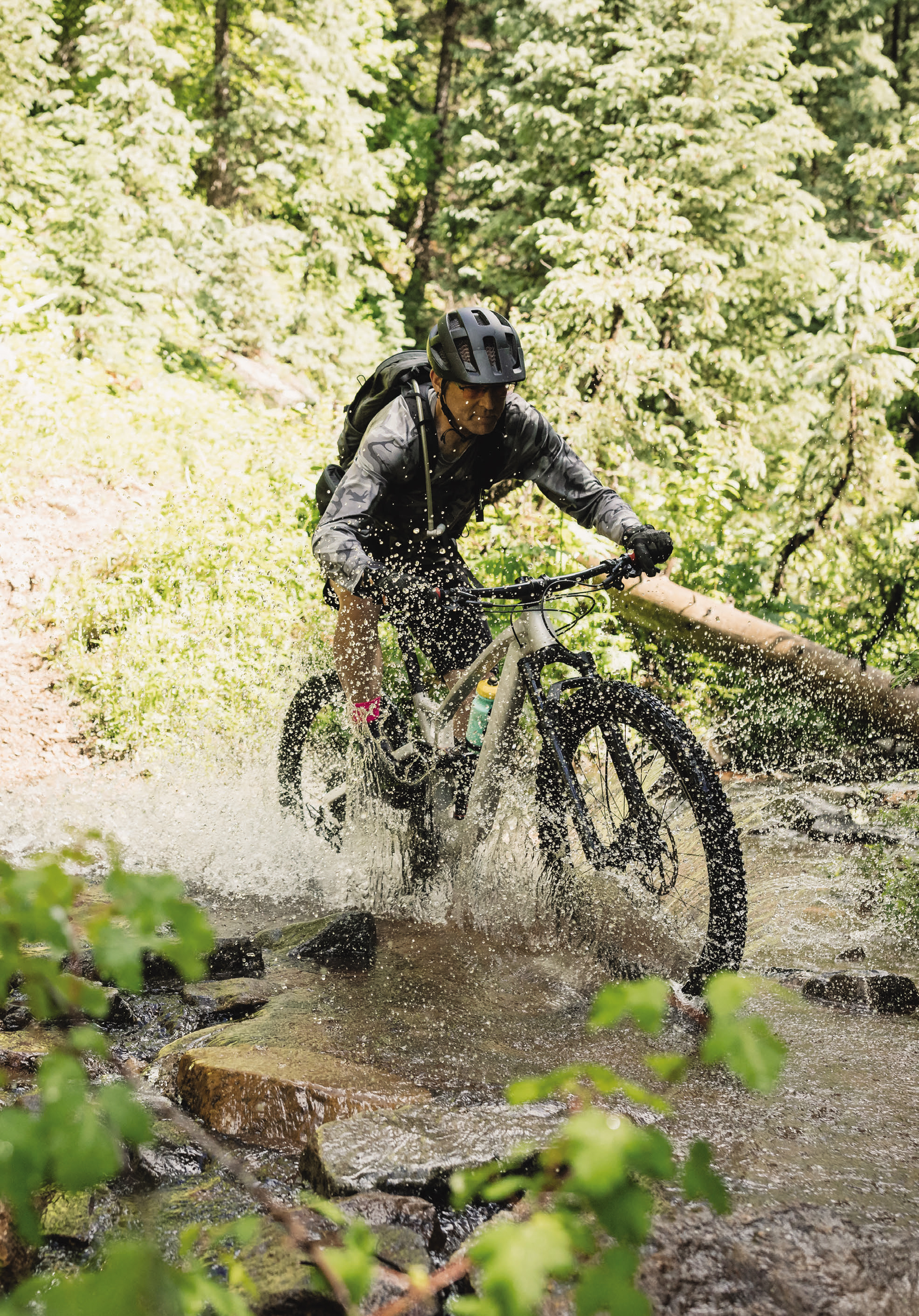
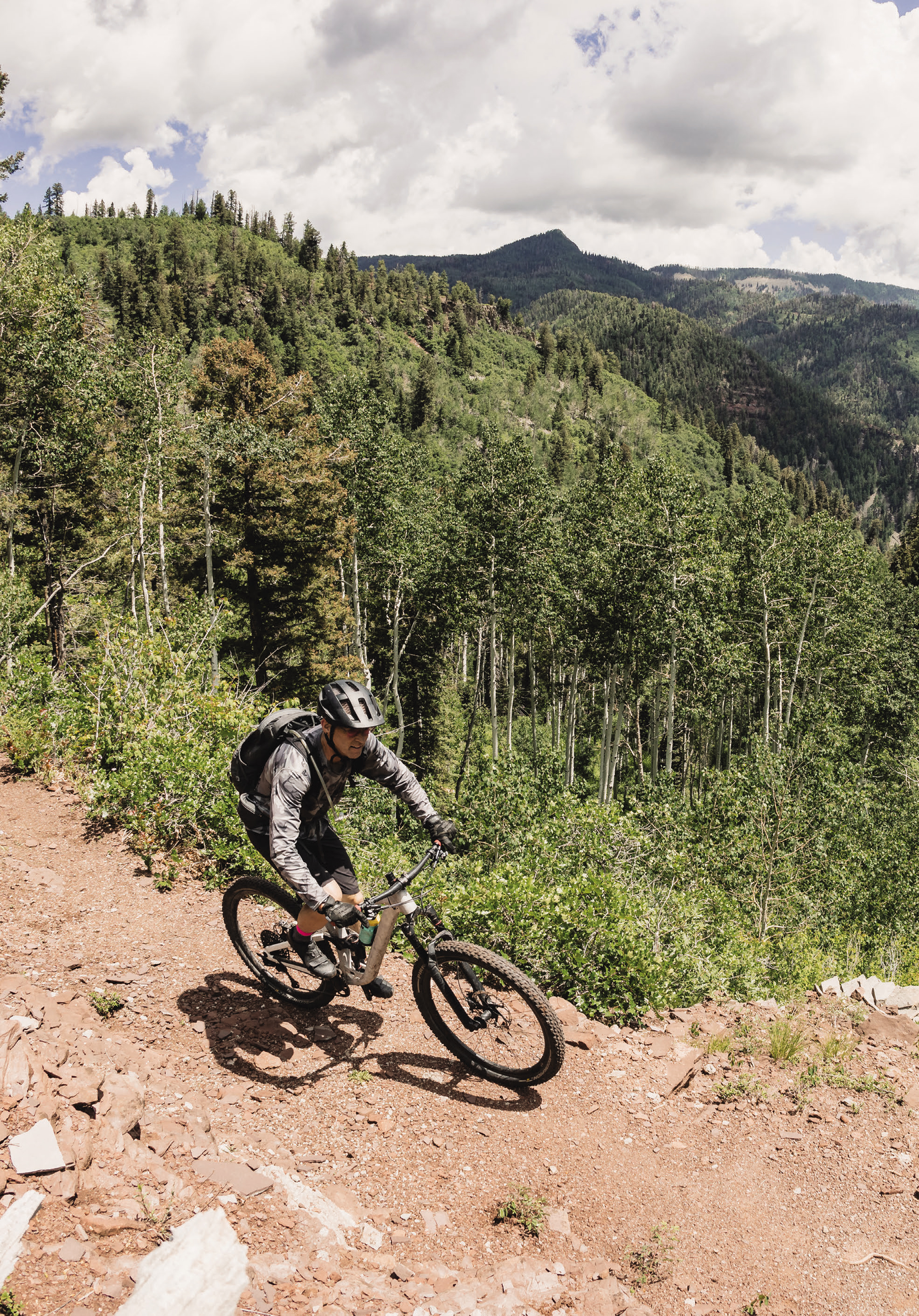
From the early 90’s, Travis Brown’s professional riding career left an undeniable mark on the sport. He was a regular on the World Cup circuit and claimed multiple national championships in both cross-country and marathon disciplines. At the pinnacle of his racing career, Travis represented the USA in the 2000 Sydney Olympics. After his pro career started to wind up in the mid-2000’s, his attention turned to product development with Trek. These days, he’s the field test manager, running an entire crew of riders who are working on products that we’ll see in the future.
This is the candid conversation I transcribed whilst on a weather hold between a busy riding schedule in Travis’ hometown of Durango, Colorado, in the USA.
Let’s start from the beginning: where did it all begin, for you?
“Well, I grew up in Durango. And went through, you know, student athlete life here — the local junior high school and high school. I did all the ball sports for a while, and Junior High track and cross country (running). Then started focusing on track, like, endurance sports, and did that through high school. I think, like a lot of young people with prestige or hype, whichever term you want, with the Olympic games and professional athletics, that was an aspirational thing — kind of a silly thing — but something that was stuck in my head.”
From an early age?
“Yeah. Running was the first thing where I thought, maybe I’m good enough to dream about that. And that ended early on with some chronic Achilles tendon issues. So, at that point, I changed my focus to cross country skiing. This was in high school. And that was, kind of, a new potential for me. Being in Durango, I always had friends that mountain biked. So, I would train with them in the summer as cross-country skiing training. I then went to the University of Colorado, with a ski scholarship. While I was there, I tried a mountain bike race — because we would train on mountain bikes. In the summer, I was riding as much as the people that were racing mountain bikes. I watched a lot of mountain bike races here before I started racing. It would be live in-person or on TV, as there was pretty good coverage. There were a lot of professionals here in the early days of the sport, like Ned (Overend), who was a local hero. So, that idea that it was something you could actually make a living at, was kind of early seated in my mind.’
When did you do your first mountain bike race?
“I think I did my first race, the Iron Horse Mountain Bike Race, in ‘88. I was going to school in Boulder and ski racing. It was in the year I graduated from high school. The race went great, I was super fit I think at that point; it was [all] beginning, so I think I raced sport or expert — I think after a couple races I got upgraded to expert, in ‘89.
“I actually decided I was going to race quite a bit in expert category. I remember racing the Colorado Point series — which was a big deal at the time — then went to Nationals in Mammoth and won that, and that’s when Worlds were here in Durango (‘90) and I was living in Boulder at the time. I decided I was going to do the qualifying race, so did the pro race here and made it into the elite race for Worlds. Probably just through stupidity of not knowing, not questioning anything, I had a good race and was 10th in that Worlds so then I started asking myself the question like, alright is this the path forward? You know, as a sportsman. If that’s something you want to do – is it going to be skiing or is it mountain biking? I debated internally. They’re very complementary sports but, you know, at some point you’re going to have to specialise [in one] if you want to be competitive at the top level.”
When did you go pro?
‘91 was my first full-season pro, and I raced for Manitou. And that was before the Answer licensing relationship with Manitou. So, that was Doug Bradbury actually building bikes in Colorado Springs and me coming down from Boulder and seeing his shop. The way we got the budget to go racing was through the Japanese importer for the bikes. They were selling them for ten thousand dollars in Japan back then. You know, it was really high prestige. They were like, yeah, a professional racer will help us sell, will finance the race team. Doug called me up and he said, let’s go racing. And after that World’s performance, I had a few options. But, this was one that just resonated with me and I’m really grateful for that because Doug has one of the most natural design engineer sensibilities of anyone I’ve met in the (cycling) industry, and he let me participate in that process and that was kind of the beginning of understanding, you know, the technical aspect of building bikes and geometry. So, he built me a bike and said, ride it and let me know if you want to change anything. And, at that point, I had not studied bike geometry – I didn’t know anything from anything – but I rode it with his stock geometry.
I asked for a bike that was like two inches longer and he was like alright, I’ll build it for you if you want. But, back then, it was like way outside of the box. And again, that was just me not understanding what the standards were. It worked good. That was the bike I raced. There were other people probably realising small tweaks from road geometry to mountain bike geometry were not enough, so the wheelbase started getting pretty long and it was good when you’re really tired at the end of the race and you just needed the bike to go straight with stability.
Then what happened?
“It was the second year – ’92 – as a racer with Manitou; I kind of outgrew that program and so I had a lot of options for the ‘93 season and signed with a team that was a Volkswagen Schwinn, which ended up falling apart in the spring. I told my parents I wasn’t going to graduate school — I was going to race. I had no sponsor to start the race season.”
And was it just budget constraints?
“Well, the person who was putting that program together was not transparent as far as all the deals with co-sponsors had been signed. So, it was going to be a big team, and we were all left holding their dicks in our hands. The season opener at that point was Cactus Cup in Scottsdale, Arizona. I went there as a privateer on a Dean titanium because they were a local Boulder company. I’m like, I’m kind of hosed here, I just need a bike. They were really gracious in helping me out. And I went there and was sick, didn’t race that good. At this point, I’m like, maybe this is a really dumb idea. And I’m sure my parents were thinking that; it’s a dumb idea. It’s a really dumb idea. But I stuck with it and moved back here (Durango).
“I worked in a dental lab and rode — the dental lab made me enough money to get to races. At that point, you know, all races had some prize money. Like if you’re doing well, you could actually make some money and prize money to supplement a budget for a race season. Then Trek decided at that point that it was time for them to have a professional mountain bike team. And so they called Zap Espinoza at Mountain Bike Action. They called him first and said, we’re starting a mountain bike team, and we need riders — who’s left unsigned and who’s available? And he recommended me. Late in the spring (’93), they hired me, and I was the first mountain bike racer they hired. The first professional mountain bike racer the company had. So yeah, that was the beginning of my career at Trek.”
Sheesh, tell me about your pro career from there…
“It was great! I went World Cup racing and got to see the world and got to live my life to its potential as a professional cyclist, but wanted to reach the pinnacle of the Olympics. So, pursuing the U.S. National Championship and trying to get on an Olympic team was a big driving force for me. And, you know, when I switched from skiing to mountain biking it looked like the Olympic part, and being an Olympian, was not going to be part of the picture because mountain biking was not at the Olympics. Then, in ’96, mountain biking got into the Olympics.
“The qualifications for the Atlanta (Olympic) team were held in ’96; it was six races, three in the in the ‘95 season, three in the ‘96 season. I was probably not a favourite to make the only two spots for the team, but I kind of made a level up jump that year and started getting good points in that points chase. By the sixth race, I think Tinker had already qualified. He had an automatic qualification, maybe from a World Cup win. Then, from everyone who was left, I was leading in the points — so that was amongst myself, a teammate, and a few other people that were in the mix — and I was leading going into that sixth race. Then, the day before that sixth race, I’m on really good form, practicing an A and B line, trying to do the A line as fast as possible, squeezing seconds out of the technical feature — and I crashed and broke my collarbone. So that dream was kind of crushed at that point.
“The highlight was that I took the time off and then came back. You kind of revaluate your choices at that point with the let-down, but I decided it was worth continuing to pursue racing and that lifestyle. So, I came back — I think with a new drive — and I won my first big National race in a really close battle with (John) Tomac in Park City, Utah at the end of that ‘96 season. Then in ‘97, ’98 and ‘99 I started winning a lot of races in the US. A similar Olympic qualification process was in place. During the first World Cup, in the spring of 2000, I broke my leg. So that seemed like, all right, this is just happening all over again. Another revaluation of all your choices. I concluded that if I don’t make it, that’s fine; that’s just what’s in the cards. But, if I don’t completely dedicate myself to the recovery, I’ll regret it. So, I was disciplined in my recovery and pushed the boundaries of what the doctors said I should do and came back and was able to hit the last two Canadian World Cups and get more points than the rest of the people — and just squeaked in on that Olympic team.
“So, I got to have the Olympic Games experience that year. In the same year, I’d won the National Championship after many seconds and thirds. I’d kind of checked all those boxes at that point. You know, there was a lot of satisfaction from that and from going through that process, especially being with one company (Trek) long-term and being into the product, into things and asking all the questions like, well, if we change this how would it give me an advantage? I was always asking the engineers about possible opportunities.”
So, that’s how you ended up working for Trek?
“As a racer, I would try stuff that other racers weren’t willing to try because of the risk. And I learned a lot through that process, and I developed a lot of relationships with the engineers and product managers. As my racing career was winding down, I made it clear that I wanted to move into a product development role and focus full-time on that and they (Trek) very graciously gave me the opportunity to do that.”
How did your role with them develop?
“I was focused on the development role as a rider and I was racing a lot still, so it was pretty clear that we needed more than just me out there focusing on testing — so I started building a group of field testers around me to help me figure stuff out. People with different skills, people that could ride different products. Now we have basically a West Coast (USA) group and East Coast (USA) group and the Colorado group — and a group in the Netherlands too. We’ve kind of reproduced what we built here in Colorado in a bunch of other places, globally. We’ll (Trek) continue to do that as we have the resources to do it, because it’s proven to work. You learn a lot and you’re exposed to nuance and opportunity through all those hours of pedalling that you can’t get any other way.
That same application, like training in the field, just married up for me and for my interests and curiosities – it was a complete natural dovetail. It was pretty easy to go from a professional racing lifestyle to a different occupation because I still got to ride a lot, and I still do that now, right?
You still have the passion to ride?
“Yeah, [my enthusiasm] for pedalling has never waned or lost interest, and I have always stayed hyper passionate about the sport. Of course, there are days you don’t want to ride but I have found aspects of mountain bike riding that are really medicinal for me and help make me a better, healthier person. So to continue to be able to do that as part of an occupation is really a blessing. It’s been a great lifestyle for me, and it’s been a great working relationship with a good company — you know, the people at Trek are some of my closest friends and they kind of have a no asshole policy.”

What does the future hold for the sport and yourself?
“Well, its broad. Cycling has all these different nuanced applications, especially the soft surface disciplines that are still evolving at a fast pace. The most recent example is gravel. When I first started mountain bike racing, we all did cyclocross and mountain biking on the same bike. You know, if you look at that bookend to where things are now, that evolution of the sport is pretty profound. The endurance side of things has a whole suite of disciplines. The gravity end of things has a whole suite of disciplines. And so the trajectory of evolution is really still pretty steep. I think that makes the industry really exciting. And it’s still going to continue to grow. Obviously, we have plateaus, and stuff that’s been done and is refined and [made more] sophisticated.”
Do you think that diversification and segmentation will continue within mountain bikes? And then obviously we’re not even touching on eBikes in that sense, right?
“Yeah, that’s an evolution that very few of us would have predicted — and it exploded in a very short period. If you look at that disruption to the bike industry, it’s really like the disruptions that mountain bikes provided the industry in the late 80’s and early 90’s. You know, a huge growth boost that brought lots of new ideas and concepts and technologies and profit opportunities and stability to grow the industry. I think there’s a lot of things about eBikes that are cool. Like the equaliser part — the fact I was able to do a ride with my dad, when he was like 75 years old, you know. And we would have never been able to do that together, if it wasn’t for eBikes. And rides with my daughter and rides with my wife — eBikes allow a different shared experience. [Then there’s] the utility part — where people are getting out of their cars and onto bikes, which is amazing.
It’s about attracting new people to the sport because, honestly, mountain biking is hard — like, really hard. And that was a big hurdle to entry for a lot of people. But eBikes have eliminated that to some degree. It brings new people into the sport. And that’s good for everybody. I understand what an active lifestyle does for quality of life, and I think eBikes are providing that opportunity for people that wouldn’t have seen it otherwise.’
What does the future look like for Travis?
“I ride bikes dictated by the product pipeline, so that’s not total freedom or riding as a pure part of your life… but it does mean that it’s an imperative part of your daily occupation. So, there’s two sides. At some point, I’ll retire, and will be able to ride any bike I want on any trail I want, and I’ll love that — but it’s pretty good right now, too. I can’t complain — I mean, honestly, my whole career (which is kind of avoiding what most people would consider ‘real jobs’) has provided a stability — financial stability — for myself and for my family, which is kind of perfect. It’s kind of a dream to be able to do it that way. So, nothing’s perfect. There are light and dark sides to every part of it, and I will enjoy the freedom of not having that at some point. I’m not counting days until retirement.’
What does cycling mean to you?
“I think what I said before; it’s a really medicinal component of my life in a lot of dimensions. So, it’s an occupation, provides me a livelihood. The physical activity and competition now, I have an appreciation for that component of the human experience that I probably didn’t appreciate when I was racing full-time. Bikes are magical machines which you can ride as far as you like, and it can be accomplished under just human power.”
Lastly, your take on Aotearoa?
“I did a month trip down there after that Single Speed Worlds. There’s a lot of places I’ve travelled to that I’ve enjoyed, but very few places I’ve been to where I thought, ‘I could live here’. For me, New Zealand was like that. I described it like it has everything in Colorado — plus an ocean. It’s your connection to the outdoors and to nature that is important — you get a lot of that outdoor experience. I am scheming up a way to return for a bikepacking trip. New Zealand’s pretty bitchin.”